Published: 04 February 2026. The English Chronicle Desk. The English Chronicle Online
At first glance, Knysna appears untouched by crisis. The South African coastal town, famed for its turquoise lagoon, golden beaches and forested hills, has long marketed itself as one of the jewels of the Garden Route. Visitors come for the scenery, retirees settle for the mild climate, and local businesses thrive on tourism drawn by the promise of natural abundance. Yet behind this postcard image lies a growing emergency that has forced authorities to declare a state of disaster: Knysna may soon run out of water.
For the roughly 100,000 people who live in and around the town, the prospect of “day zero” — when municipal taps are turned off — is no longer theoretical. It is a looming possibility shaped by years of neglected infrastructure, mounting population pressures and increasingly erratic weather patterns linked to climate change. Knysna’s predicament reflects a broader national challenge, but its location along one of South Africa’s most celebrated tourist corridors makes the crisis particularly stark.

The roots of the problem run deeper than the current drought. While low rainfall has sharply reduced water levels at Akkerkloof Dam, Knysna’s main storage facility, officials and experts agree that the system was already vulnerable. Around 55% of the town’s treated water is estimated to be lost through leaking pipes before it ever reaches homes or businesses. These losses, known as non-revenue water, are among the highest in the country and point to decades of underinvestment in maintenance and upgrades.
When journalists visited the area recently, Akkerkloof Dam was holding barely 20 days’ worth of usable water. Emergency restrictions have since been introduced, limiting consumption for households, businesses and tourism operators alike. Officials hope that these measures, combined with provincial and national support, will delay or even avert day zero. But uncertainty remains, and for many residents, the sense of insecurity is already shaping daily life.
Knysna’s struggle is not unique. Over the past decade, towns and cities across South Africa have faced similar crises, most notably Cape Town’s brush with day zero in 2018. That episode became a global warning about the risks of urban water scarcity in a warming world. Yet for smaller municipalities like Knysna, the challenges are often more acute. Limited budgets, skills shortages and administrative instability can leave local governments ill-equipped to respond quickly when systems begin to fail.
Beneath Knysna’s scenic surface, the cracks are already visible. In October last year, residents of a local retirement centre experienced their own version of day zero when a fault at a municipal plant left them without running water for 10 days. For elderly residents, many of whom require constant care, the situation was both distressing and dangerous. The episode highlighted how water shortages can quickly become humanitarian issues, particularly for society’s most vulnerable.
Franco de Grandis, who runs the retirement facility, said the experience forced him to take matters into his own hands. Unable to rely on municipal supply, he invested around 250,000 rand in a private backup system, installing large storage tanks and specialised pumps to keep water flowing during outages. For him, the decision was unavoidable. Without water, basic care becomes impossible, especially for residents who are bedridden or require assistance with daily needs.
Such solutions, however, are not available to everyone. While wealthier households and businesses are increasingly drilling boreholes or installing storage tanks, many poorer residents depend entirely on the municipal system. This growing divide risks deepening inequality, as access to water becomes tied to income rather than guaranteed as a basic public service.
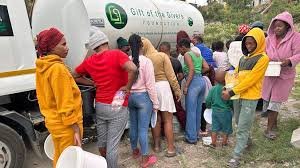
Civil society organisations have stepped in to bridge some of that gap. Gift of the Givers, a well-known humanitarian group, now delivers thousands of litres of water to Knysna almost daily, drawing supplies from privately dug boreholes. Tankers arrive in neighbourhoods where residents cannot afford alternative arrangements, offering temporary relief amid mounting anxiety. The gratitude, according to local coordinator Mario Ferreira, is palpable — but so is his concern.
Ferreira warns that repeated emergencies can normalise crisis conditions. When communities begin to accept water shortages as a permanent feature of life, pressure on authorities to fix underlying problems can weaken. In Knysna, as in many other parts of South Africa, emergency responses risk becoming substitutes for long-term solutions.
Local officials acknowledge the scale of the challenge. The declared state of disaster allows access to emergency funding and fast-tracks certain procurement processes, but it does not automatically resolve structural issues. Fixing leaking pipes, upgrading treatment plants and diversifying water sources all require time, expertise and sustained political will. In a town whose economy depends heavily on tourism, prolonged water insecurity could also carry serious economic consequences.
Hotels, guesthouses and restaurants along the Garden Route are already feeling the strain. Water restrictions limit services, increase operating costs and risk deterring visitors. For a region still recovering from the economic shocks of the pandemic, the threat of a prolonged water crisis adds another layer of uncertainty. Some businesses have invested in rainwater harvesting and recycling systems, but smaller operators often lack the capital to do so.
Climate scientists warn that such crises are likely to become more frequent. Southern Africa is experiencing more intense and unpredictable weather patterns, with longer dry spells punctuated by heavier rainfall that infrastructure struggles to capture or store. Without adaptation, towns like Knysna may find themselves lurching from one emergency to the next.

For residents, the situation is emotionally draining. Knysna’s natural beauty has long been a source of pride and identity. The idea that such a water-rich landscape could run dry feels both ironic and alarming. Community groups have begun organising information sessions and conservation campaigns, urging people to reduce consumption and report leaks. Yet many also express frustration that individual sacrifices are being asked to compensate for systemic failures.
As authorities race to stabilise the situation, Knysna has become a symbol of the choices facing South Africa more broadly. Invest now in resilient infrastructure and sustainable water management, or risk a future where crises become the norm. The declaration of disaster may buy time, but it also underscores the urgency of reform.
Whether Knysna ultimately avoids day zero remains uncertain. What is clear is that the town’s experience serves as a warning. Even places defined by natural beauty and apparent abundance are vulnerable when governance falters and climate pressures intensify. For this Garden Route gem, the coming weeks and months will test not only its water system, but the resilience of the community that depends on it.