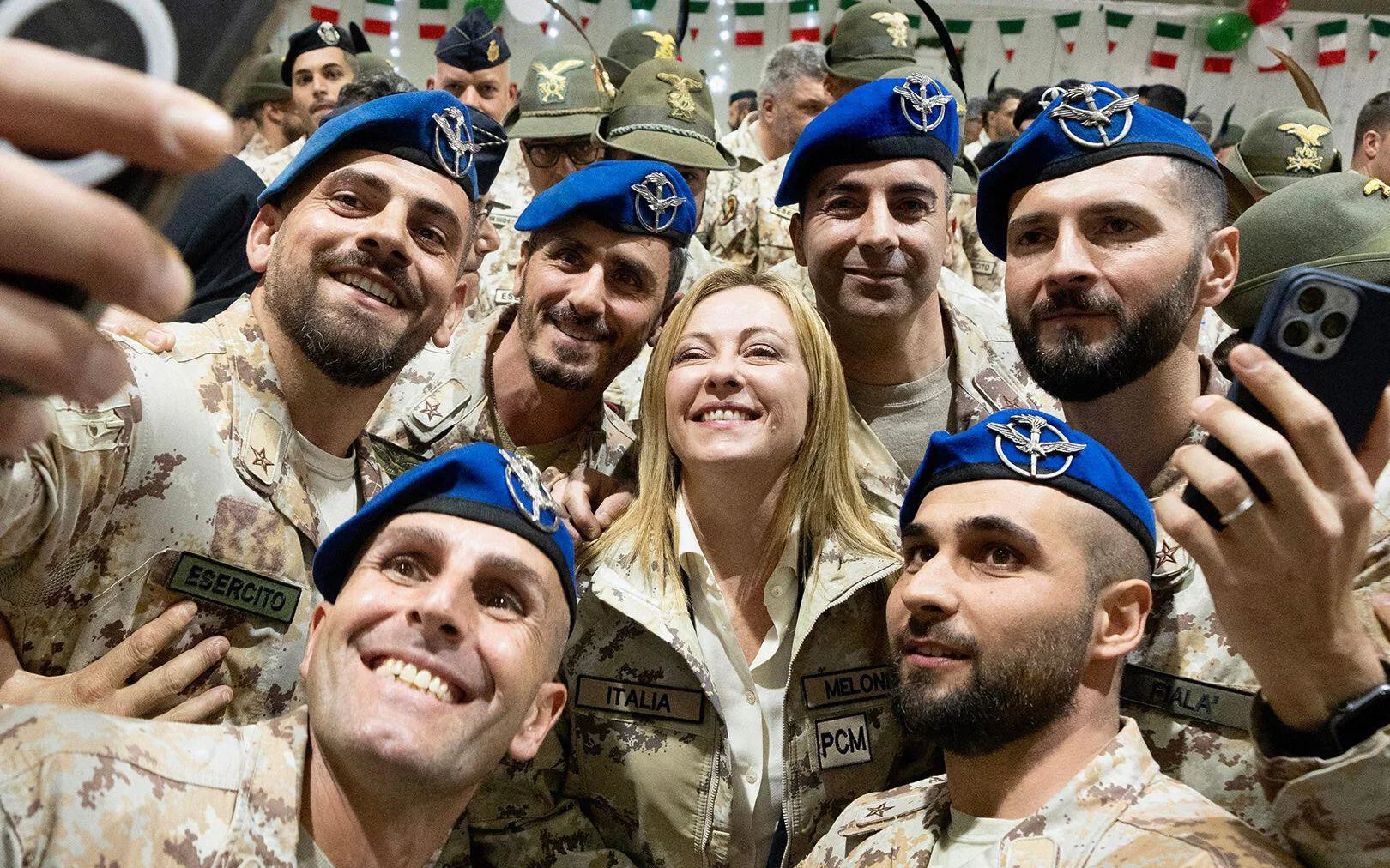
On the surface, Italian Prime Minister Giorgia Meloni appears to command a formidable political army. Her party, Brothers of Italy, dominates opinion polls, her coalition controls parliament, and her international profile has risen sharply since taking office. To supporters, she represents stability, strength and a decisive break from Italy’s revolving-door politics.
Yet beneath the image of unity and control lies a far more fragile reality. Meloni’s political “army” — a blend of party loyalists, coalition partners, bureaucratic allies and ideological supporters — looks powerful from a distance but reveals deep structural weaknesses when examined closely. Internal divisions, policy contradictions, institutional constraints and external pressures all threaten to erode the authority she has worked hard to project.

Meloni’s government has benefited from something rare in Italian politics: continuity. While previous administrations collapsed under the weight of infighting, her coalition has largely held together. This durability has fed the perception of strength.
However, unity within the governing bloc is more tactical than ideological. Brothers of Italy governs alongside the League and Forza Italia — parties with overlapping voter bases but competing priorities. Their cooperation is driven less by shared vision and more by fear of electoral punishment should the coalition collapse.
Behind closed doors, disagreements over economic policy, EU relations, immigration and regional autonomy are persistent. The absence of open conflict masks a delicate balancing act rather than genuine cohesion.
Brothers of Italy has grown rapidly, transforming from a fringe force into Italy’s dominant party in just a few years. That rise, however, has created its own vulnerabilities.
The party’s leadership structure is heavily centralised around Meloni herself. Loyalty often outweighs experience, and many newly elected officials lack governing expertise. While this has allowed Meloni to maintain control, it has also left her exposed to policy missteps and administrative inefficiency.
“It’s a movement built on discipline and identity, not institutional depth,” says Professor Luca Moretti, a political scientist at the University of Bologna. “That works well in opposition, but governing is another matter entirely.”
The League, led by Matteo Salvini, remains a constant source of instability. Salvini’s influence has waned, but his ambitions have not. On issues such as infrastructure spending, relations with Russia, and migration enforcement, tensions regularly surface.
Forza Italia, weakened by the absence of Silvio Berlusconi’s personal authority, is fractured and increasingly marginal. Yet its presence remains essential to the coalition’s parliamentary arithmetic.
Both partners tolerate Meloni’s leadership for now — but neither is fully aligned with her long-term strategy. Their loyalty is conditional, not absolute.
Meloni’s government has projected confidence on economic management, emphasising fiscal responsibility and pragmatism. International investors initially welcomed her cautious tone, particularly her reassurances on debt and EU budget rules.
But Italy’s structural economic problems remain unresolved. High public debt, sluggish growth, low productivity and regional inequality continue to weigh heavily on the country.
The government’s room for manoeuvre is limited. Any serious attempt at tax cuts, pension reform or large-scale spending risks triggering tension with Brussels or unsettling financial markets.
“Meloni looks strong because she hasn’t yet been forced into hard economic choices,” says economist Silvia Romano. “When she is, that strength will be tested.”
Despite her nationalist roots, Meloni has adopted a pragmatic stance towards the European Union. She understands that confrontation would be costly and politically risky.
Yet this pragmatism creates tension with her ideological base, which expects assertiveness against Brussels. Balancing domestic expectations with EU obligations is one of her most delicate challenges.
Italy’s reliance on EU recovery funds further limits her freedom. Any deviation from agreed reforms could jeopardise billions in funding — a risk her government cannot afford to take lightly.
Internationally, Meloni has worked hard to position herself as a reliable Western partner. Her strong support for Ukraine and alignment with NATO have won praise from Washington and European capitals.
However, this stance sits uneasily alongside the views of some coalition allies and parts of her electorate, where scepticism of sanctions and sympathy for Moscow remain present.
Maintaining credibility abroad while managing internal dissent requires constant recalibration — another sign that her apparent strength rests on fragile foundations.
Italy’s institutions — from the presidency to the judiciary and civil service — act as powerful counterweights to executive authority. While Meloni has criticised unelected elites in the past, she has so far avoided direct confrontation.
Attempts to reform the constitution, reshape the justice system or alter the balance of power have met quiet but firm resistance. The Italian state, experienced in outlasting governments, has little incentive to move quickly or accommodate radical change.
This institutional inertia limits Meloni’s ability to turn political dominance into lasting transformation.
Poll numbers suggest strong support, but beneath them lies volatility. Many voters back Meloni less out of enthusiasm than exhaustion with alternatives. Support is broad but shallow.
Living costs, energy prices and public service pressures could quickly erode goodwill. Italy’s electorate has a long history of turning on leaders once expectations go unmet.
“Italian voters are loyal to results, not personalities,” notes veteran political analyst Gianni Ferraro. “If daily life doesn’t improve, support will fade.”
Meloni’s personal authority is both her greatest strength and her biggest weakness. By centralising power, she has minimised internal rebellion — but also made herself the focal point for blame.
Any major failure, scandal or economic downturn will be attributed directly to her. There is no obvious successor, no shared leadership structure to absorb shocks.
This makes her position powerful but brittle — impressive from afar, vulnerable up close.

For now, Meloni’s army marches in step. The opposition remains fragmented, her coalition intact, and her international standing solid. But strength measured in polling numbers and appearances can be deceptive.
Real power lies in resilience — the ability to withstand economic shocks, institutional pushback, coalition tensions and shifting public mood. On those fronts, Meloni’s position is far less secure than it appears.
Whether she can convert short-term dominance into lasting political transformation remains an open question. History suggests Italian politics is unforgiving to leaders who mistake momentum for permanence.
Giorgia Meloni’s political army looks formidable at first glance: disciplined, dominant and confident. Yet closer inspection reveals an alliance held together by caution rather than conviction, constrained by economics, institutions and internal contradictions.
Her leadership has so far avoided serious crisis — but the tests are coming. When they do, the true strength of her government will be measured not by appearances, but by its capacity to endure pressure without fracturing.
In Italian politics, strength is rarely what it seems — and Meloni’s army may yet prove no exception.
Related News:
 High-speed Spain train crash leaves nation in mourning
 EU weighs response amid Greenland tariff crisis with Trump
 EU Says US Ties Have Suffered ‘Big Blow’ After Greenland Crisis
 EU launches Grok AI probe into X over explicit images
 Scotland–France Ferry Revival Tied to Dunkirk’s Green Rebirth
 Thousands Left Without Heating in Ukraine Amid Russia Strikes
 Russia sanctions hit economy hard, says EU envoy
 Canada Dispatches Senior Officials to Open Greenland Consulate
 TikTok Design Faces EU Crackdown Over Addictive Features
 Italy Arrests Protesters Amid Milan Olympic Chaos
 Portugal Election Delivers Socialist Win as Far Right Surges
 On Board an RAF Voyager as Britain and US Prepare for War with China