Published: 19 February 2026. The English Chronicle Desk. The English Chronicle Online.
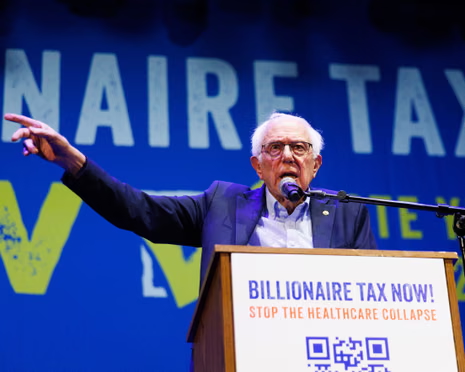
Vermont senator Bernie Sanders unleashed a fierce critique of billionaire greed during a rally in Los Angeles, framing California’s proposed wealth tax as a moral and political imperative. The 84-year-old lawmaker, known for decades of outspoken criticism of economic inequality, addressed a packed Wiltern Theater on Wednesday, warning voters that the richest Americans are “treading on very, very thin ice” if they continue to avoid civic responsibility. His remarks, combining moral outrage with political urgency, underscored the growing tension between California’s billionaire elite and the progressive movement pressing for systemic economic reforms.
Sanders’ speech highlighted the “arrogance” and “moral turpitude” of the nation’s wealthiest citizens, arguing that the top one percent no longer sees itself as accountable to ordinary Americans. “Never before have so few people had so much wealth and so much power,” he declared, drawing raucous applause and chants of “shame” from the assembled crowd. The senator compared contemporary billionaires to historical monarchs and oligarchs, suggesting that the ultra-wealthy believe they possess a divine right to dominate society and ignore democratic norms.

Before Sanders spoke, Suzanne Jimenez, chief of staff at SEIU-UHW, stressed the urgency of equitable taxation. She warned that without intervention, working families would continue to face longer waits and greater hardship for healthcare and basic necessities, while billionaires expanded their already immense fortunes. Her remarks set the tone for Sanders’ address, which linked moral accountability to political action and encouraged voters to treat the ballot as a lever for systemic change. The proposed billionaire tax was framed as a tool to ensure fairness in a state increasingly dominated by extreme wealth.
Outside the theatre, supporters actively collected signatures to place the measure on the November ballot, a step requiring nearly 875,000 valid endorsements. Even with sufficient signatures, success would depend on convincing a majority of California voters to embrace a billionaire tax that directly challenges some of the world’s wealthiest individuals. The politics are complex, even in a state widely considered a Democratic stronghold, and the measure has sparked intense debate within the party itself.
Governor Gavin Newsom and other critics have argued that the billionaire tax could damage California’s long-term fiscal stability and drive wealthy residents and businesses to relocate, jeopardising the state’s competitive position in the national economy. The initiative has already attracted well-funded opposition from prominent tech leaders, including Google co-founder Sergey Brin, who is supporting alternative measures designed to neutralise the union-backed plan. The opposition highlights the high stakes, demonstrating that billionaires remain influential players in shaping public policy and electoral outcomes.
A key feature of the proposal is its retroactive application to 2025 wealth accumulation, intended to prevent preemptive departures by the state’s wealthiest citizens. Analysts and policymakers anticipate legal challenges due to the measure’s complexity, particularly in valuing non-cash assets such as private companies, intellectual property, and high-value collectibles. The California Legislative Analyst’s Office projects that the one-time billionaire tax could generate tens of billions of dollars, but cautions that the final yield depends heavily on whether targeted billionaires choose to remain in the state and continue contributing to income tax revenues.
Public opinion on the measure is closely divided. A recent poll indicated 48% support among likely voters, with 38% opposed and 14% undecided. The numbers reflect both enthusiasm for redistributive policies and concern about potential economic repercussions. Sanders, appearing on stage to loud cheers, emphasised that the billionaire tax represents a broader struggle against entrenched economic power and a political system that often prioritises wealth over democracy.
Among the attendees, individuals like Morgan, a 29-year-old Sanders supporter, voiced hope that progressive mobilization could counteract the financial influence of billionaires. Others, like Chelsea Gods, travelled hours to participate in the rally, arguing that policies prioritising people over profit are essential for sustaining a fair political future. Their presence underscored the intersection of grassroots activism and high-stakes economic policy, showing how public sentiment can shape debates dominated by powerful financial interests.

Throughout his address, Sanders named high-profile billionaires and highlighted extravagant displays of wealth, from private jets to luxurious yachts, drawing boos from some audience members while energising others. He argued that these examples illustrate a broader trend of relentless accumulation of wealth and power at the expense of ordinary citizens. His rhetoric reinforced the moral framing of the tax, portraying it as a necessary corrective to systemic imbalance and a reaffirmation of democratic principles.
The senator also cited historical examples of civic resistance, including Minnesota’s opposition to federal immigration enforcement, suggesting that collective action can successfully confront concentrated authority. By advocating for the California Billionaire Tax Act, Sanders positioned the initiative as an opportunity to assert that economic extremism will not be tolerated, sending a clear message that fairness and accountability remain central to American democracy.
Sanders concluded by asserting that the initiative offers a test of public will and a chance to challenge the influence of billionaires over civic life. “The billionaire class cannot have it all. This nation belongs to all of us,” he said, calling on Californians to recognise the moral and political stakes involved. His remarks left a strong impression on supporters, framing the wealth tax not merely as a fiscal measure but as a defining moment in the struggle for economic justice and democratic accountability. The California vote, he insisted, represents a pivotal opportunity to confront the concentration of wealth and power in a way that reflects the principles of fairness and shared responsibility.
Related News:
 Government Unveils Northern Powerhouse Rail Plans
 Trump Fed bid heads to Supreme Court
 Tories Push to Dilute Labour’s Workers’ Rights Bill
 Wales May Introduce Four-Day Work Week After Elections
 Trump’s UK Ambassador Urges North Sea Drilling to Strengthen US Ties
 Rachel Reeves Set to Break Labour Pledge and Raise Income Tax
 Thinktanks Urge Rachel Reeves to Reform UK Tax System
 Company linked to Michelle Mone owes £39m in tax
MPs Press Rachel Reeves to Hike Gambling Taxes
Company linked to Michelle Mone owes £39m in tax
MPs Press Rachel Reeves to Hike Gambling Taxes
 Cuts to home insulation funding threaten UK climate goals
 Millionaires group urge Reeves to introduce wealth tax to ‘lift kids out of poverty’
 Canada Passes Carney’s First Budget in Tight Parliamentary Vote
 PM Highlights UK Business at G20 in South Africa
 English Mayors Set to Introduce Tourist Taxes
 Putin Intensifies Territorial Demands Before US Talks
 US National Guard Member Killed in DC Shooting
 India’s Labour Law Overhaul Sparks Fierce Debate
 Trump to Recheck Green Cards from 19 Nations After DC Attack
 Carney’s Alberta Pipeline Deal Sparks Immediate Pushback
 Trump to pause migration from ‘third-world countries’
 Starmer Says Labour’s Economic Plan Needs Years to Deliver
 Republicans Hold Tennessee Seat Despite Democratic Surge
 Franklin Turtle, Sabrina Carpenter Slam US Social Media Use
BBC bosses ‘right to stick by their guns’ against Trump, says minister
Franklin Turtle, Sabrina Carpenter Slam US Social Media Use
BBC bosses ‘right to stick by their guns’ against Trump, says minister
 Closer EU Trade Ties ‘Strategic Necessity’ for UK Firms
 Russia losses Ukraine war peace talks intensify amid rising deaths
 Trump Escalates Minnesota Immigration Surge Amid Rising Tensions
 Austrian Airlines Halts Tehran Flights Amid Political Unrest
 Homeland security agents deployed amid Minneapolis protests
 Democrats Push Affordability to Challenge Trump Ahead of Votes
 German Supermarket Aldi to Open 180 US Stores This Year
 Top Senate Republican Says Federal Probe of Powell Could Challenge Fed Nominees
 Trump Administration Probe of Fed’s Powell Draws Pushback
 Starmer links foreign trips to tackling cost of living crisis
 Greenland Faces Pivotal Summit Over Arctic Power Struggle
 Mark Carney Walks Diplomatic Tightrope on China Visit
 Trump Threatens Strong Action If Iran Executes Protesters
 China Dependence Threatens UK Energy Supply Chains and Jobs
 Trump press secretary attacks reporter over ICE question
 Kyrsten Sinema Faces High-Profile Lawsuit Over Marriage Interference
 Trump Receives Machado’s Nobel Medal in White House Meeting
 ‘He Believed Help Was Coming’: Why Iran’s Protesters Feel Betrayed
 MPs warn AI financial risks threaten UK stability
 MPs warn AI financial risks threaten UK stability
 Starmer Plans UK-China Visit Amid Business and Diplomatic Goals
 UK Government Borrowing Drops to £11.6bn in December
 EU Says US Ties Have Suffered ‘Big Blow’ After Greenland Crisis
 ‘Unfathomable’: Australian veterans rebuke Trump claims
 Trump officials continue false claims after Alex Pretti shooting
 Labour Must Revive High Streets to Avoid Election Collapse
 ‘Evil is resilient’: Pressure Mounts on Stephen Miller
 Keir Starmer meets Xi to strengthen UK-China economic relations
 UK food industry urges transition if post-Brexit rules reset
 Fulton election raid hits Georgia election office
 AstraZeneca China Investment Signals Strategic Shift Abroad
 Partial US Government Shutdown Hits Homeland Security Funding
 Thousands Protest ICE Operations in Nationwide US Day of Action
 Epstein Files Reveal Trump Officials’ Emails with Financier
 Thousands Protest ICE in New York Against Trump Deportation Campaign
 Sinema payment row deepens after $9,000 transfer claim
 EU Signals Open Mind on UK Customs Union Talks
 Trump Praises ‘Terrific’ Petro After White House Talks
 Barclays drops Global Counsel after Mandelson link scrutiny
 Unsustainable gaps in franchise policing, MPs warn
 Nurses’ families fear breakup under UK immigration crackdown
 UK shelves £110m border project amid trade strain
 Reeves Faces Setback as Labour May Miss Homes Target
 Shadow Fleet at Sea: Europe’s Battle Against Illicit Oil Shipping
 Khaleda Zia Death in Bangladesh: First Female PM Dies at 80
 Minnesota Sues Trump Administration Over ICE Surge
 US Senate rejects resolution limiting Trump military powers
 No Gas Boiler Ban as UK Warm Homes Plan Backs Heat Pumps
 Sussan Ley leadership milestone shakes Liberal future
 Police response times face strict new national limits
 US Dollar Hits Four-Year Low Amid Market Turmoil
 Australia’s Opposition Coalition Reunites After Rift
 ‘Trump Will Be Gone in Three Years,’ Top Democrats Tell Europe
 Could Manchester Lead the UK’s Economic Revival?
 Australian Families Leave Syrian Camp for Home
 Trans Youth Care Crisis: NY Hospital Ends Gender‑Affirming Treatment