Published: 11 December 2025. The English Chronicle Desk. The English Chronicle Online.
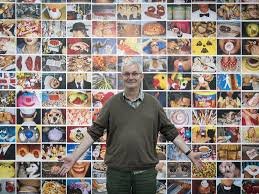
When news broke that Martin Parr had died at the age of seventy-three, the reaction told its own story about the man and his lens. In France, Le Monde carried the announcement on its front page. French public radio devoted a full ten-minute bulletin to his life. Across the Channel, the British press offered respectful obituaries, yet the tone measured, almost cautious. The contrast spoke volumes. Few British photographers have ever been treated like international rock stars, yet Parr, the Epsom-born chronicler of sunburnt backs and soggy seaside holidays, achieved exactly that status abroad.

Quentin Bajac, director of the Jeu de Paume in Paris, put it simply. “In France we loved him like a rock star or a movie star.” The affection began early. Parr’s breakthrough series, The Last Resort, photographs of working-class families enjoying – or enduring – a day out in New Brighton, Merseyside, first found serious acclaim not in London or Manchester but at the Rencontres d’Arles festival in 1986. Almost twenty years later, in 2004, the same festival invited him back as guest artistic director. By then the love affair was sealed. Bajac recalls how Parr himself felt overlooked at home for many years. “Nul n’est prophète en son pays,” the French say. No one is a prophet in their own land.
Parr’s pictures always walked a tightrope. He photographed the rituals that define English life: rainy bank holidays at the coast, village fetes, garden shows, Ascot racegoers in morning suits and outrageous hats. He used garish flash and hyper-saturated colour to turn the everyday into something almost surreal. The results could feel affectionate, forensic, and merciless all at once. For many British viewers the question lingered: was he celebrating these people or gently mocking them? Abroad, few seemed troubled by the ambiguity. They simply saw a great observer of human behaviour.
In Germany the influence ran deep, though it arrived less through galleries than through magazines. Andreas Wellnitz, picture editor at Die Zeit’s award-winning colour supplement, worked with Parr on several projects after 2011. He remembers an artist who made the ordinary feel fresh. “You could identify with his pictures anywhere in the world,” Wellnitz says. “Normal people found themselves in them because he discovered beauty in daily life.” Parr’s harsh flash and bold palette inspired a generation of German photographers in the same way Wolfgang Tillmans and Jürgen Teller did. The look became a visual language for capturing contemporary life without cynicism.
Across the Atlantic the connection felt even more direct. Elizabeth Renstrom, former photo editor at Vice, describes Parr’s impact on American photography as boundless. Young photographers adopted his unapologetic closeness, his saturated colours, his willingness to let absurdity sit beside sincerity. Vice sent teams to cover the 2018 US midterm elections not only on the campaign trail but inside Disney World, home of “the original Donald”. The magazine’s scrappy, flash-heavy style owed a clear debt to Parr. “He showed that humour was not a detour from truth,” Renstrom says. “It was a way into it.”
Back home the relationship remained more complicated. Some critics accused Parr of trading in cliché: the lobster-red tourist, the middle-class couple in socks and sandals, the fancy hat at Royal Ascot. Parr himself grew wary of photographic tropes. In a 2010 speech he criticised fellow photographers for predictable choices – the bent lamp-post, the modern typology, the newly rich caught in awkward poses. “We need to consider our subject matter more carefully,” he warned. Yet curators who knew him well insist his gaze always went deeper. “He was brilliant at engaging with people,” Wellnitz recalls. “He didn’t just collect clichés. He learned about lives.”
As his career progressed, Parr took that curiosity far beyond Britain’s shores. He photographed sleeping commuters on the Tokyo subway, tourists crowding the Acropolis, beachgoers on the Amalfi coast, visitors dwarfed by Machu Picchu. Two major books he edited – The Photobook: A History (2004) and The Chinese Photobook (2015) – celebrated Japan and China’s central roles in photographic culture. In Japan especially, the affection was mutual. Lucille Reyboz and Yusuke Nakanishi, directors of the Kyotographie festival, invited Parr to document overtourism in Kyoto for the 2025 edition. Japan’s national broadcaster NHK followed him for days as he worked. “Martin offered affection and critique without falling into cliché,” they said. “His profoundly human gaze on Kyoto will resonate here forever.”

Even in death, Parr’s work continues to evolve in the eyes of others. A major retrospective titled Global Warning opens at the Jeu de Paume in late January 2026. The exhibition will trace recurring themes: consumer excess, car culture, our addiction to screens and souvenirs. While Britain often remembers him as the ironic chronicler of Englishness, audiences in France, Germany, the United States and Japan came to see something larger: a political artist holding a mirror to modernity itself.
Martin Parr spent half a century training his camera on the small, revealing moments that others overlooked. He turned rain-soaked seaside promenades and overcooked buffet tables into universal symbols of human hope and folly. In the end the prophet found his honour far from home, yet the sharpness of his vision now feels unmistakably part of the British photographic tradition he once seemed to stand apart from. The seaside postcards may fade, but the laughter – affectionate, uncomfortable, and utterly alive – rings on.
Related News:
 Ancient Echoes, 4,000-Year-Old Handprint Unearthed on Egyptian Soul House Sparks Global Fascination
 Jack Holden reinvents Peter Pan and 1980s queer classics for stage and nightclub
 How ‘Hair’ Broke Boundaries and Escaped UK Censorship
 Karen Carney Shines on Strictly Come Dancing Week Two Despite Tango Wobbles
 Jilly Cooper: The Bonkbuster Queen Who Redefined Romantic Fiction
 Alan Davies Criticises England Flag Displays and Patriotism
 D’Angelo: Neo-Soul’s Radical Genius and Lasting Legacy
 Man Charged Over 2020 Death of Tattoo Artist Georgina Ward
 Dave Ball: The Unsung Genius Behind Soft Cell’s Bold Sound
 Netflix’s A House of Dynamite Hits Reality Walls
 Viewing Van Gogh paintings Can Boost Your Health, Study Finds
 Charlie Kaufman: They told me Being John Malkovich would never get made
 UK launches search for first-ever ‘town of culture’ to highlight overlooked areas
 Who is Rama Duwaji? What Zohran Mamdani’s wife has said about Gaza and ICE as he’s elected NYC mayor
 One of world’s last dinosaurs on sale for £3m
 David Szalay’s ‘Flesh’ Wins 2025 Booker Prize
 Nigeria’s $25m Museum Faces Political Storm Amid Benin Bronzes Debate
 Miss Mexico Wins Miss Universe After Walkout Drama
 Chef Skye Gyngell, Slow Food Pioneer, Dies Aged 62
 Bill Murray Terrified Wes Anderson but Became His Closest Collaborator
 Rosalía Inspires Young Listeners to Discover Classical Music
 Rusty Bond-Era Aston Martin Restored to £1m Glory
 Pavarotti statue frozen in Italian ice rink sparks backlash
 Mary, Queen of Scots’ Final Letter to Be Exhibited After Nearly Ten Years