Published: 29 December 2025. The English Chronicle Desk. The English Chronicle Online.
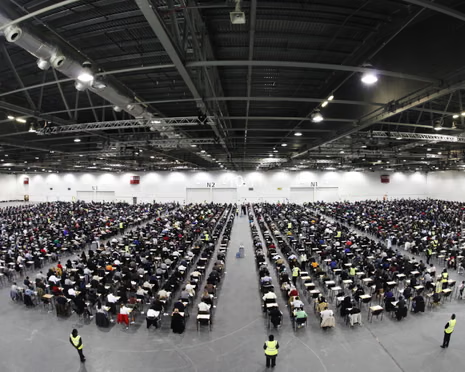
The Association of Chartered Certified Accountants (ACCA) has announced it will largely end remote examinations due to escalating concerns over cheating driven by artificial intelligence tools. This shift, effective from March, signals a major change for the world’s largest accounting body, which represents nearly 260,000 professional members and more than half a million students globally. ACCA chief executive Helen Brand told the Financial Times that the sophistication of cheating systems has outpaced the safeguards institutions can implement, making online assessments increasingly unreliable.
Remote examinations were first introduced during the Covid-19 pandemic to allow students to continue pursuing professional qualifications despite nationwide lockdowns. The approach offered flexibility and continuity, but the ACCA now argues that online testing has become too difficult to monitor effectively. “People who want to do bad things are probably working at a quicker pace than we can counter,” Brand said, highlighting the challenges posed by the rapid adoption of AI technologies.

Concerns over professional exam integrity are not new in the UK. In 2022, the Financial Reporting Council (FRC), which regulates the accounting and auditing sectors, described cheating in professional qualifications as a “live” issue among Britain’s largest companies. High-profile cases have reinforced these warnings, with multinational auditing firms receiving multimillion-dollar fines related to cheating scandals. The FRC investigation revealed that even tier-one auditors, including the so-called “big four”—KPMG, PwC, Deloitte, and EY—along with Mazars, Grant Thornton, and BDO, had experienced cheating incidents during employee examinations.
One of the most notable cases involved EY, which in 2022 agreed to pay a record $100 million (£74 million) to US regulators following allegations that dozens of employees had cheated on an ethics exam. The company was also accused of misleading investigators, underscoring the serious consequences that exam malpractice can carry for both individuals and institutions. These incidents illustrate why the ACCA has taken a stricter stance, especially as AI tools capable of aiding academic dishonesty become more sophisticated and widely accessible.
Brand emphasized that the ACCA had worked “intensively” to counter cheating in online exams, implementing security measures and monitoring systems. Despite these efforts, the body concluded that AI-assisted fraud had reached a tipping point where continuing remote assessments posed an unacceptable risk. “The rapid rise of technology, particularly artificial intelligence, has made online examinations increasingly vulnerable,” she explained, adding that physical exams remain the most secure means of maintaining professional standards.
Other professional bodies have faced similar pressures. Last year, the Institute of Chartered Accountants in England and Wales (ICAEW) reported rising incidents of cheating, although it continues to allow certain examinations to be taken online. The ACCA’s decision may pressure other organisations to reconsider the balance between accessibility and integrity in professional certification. Brand noted that very few high-stakes examinations globally now permit remote invigilation, reflecting a wider trend in professional education to prioritise reliability and credibility over convenience.
The move to restrict remote examinations also reflects broader societal concerns about the role of artificial intelligence in academic and professional assessments. AI tools, capable of producing sophisticated responses and bypassing traditional monitoring systems, have prompted regulators and educators to rethink long-established practices. For students and professionals, this shift will likely necessitate a return to controlled, in-person assessment environments that uphold the credibility of accounting qualifications worldwide.
Although the ACCA has framed this policy change as necessary to maintain standards, it also raises questions about accessibility, particularly for international students or those with health or mobility challenges. Exceptional circumstances will still allow online exams, but these will be tightly regulated and require robust justification. Critics argue that the change could create additional barriers for learners, while supporters contend that it is essential to preserve the integrity of a profession that underpins global financial systems.
As professional bodies continue to grapple with the intersection of technology and ethics, the ACCA’s decision underscores a broader trend of increased scrutiny over assessment methods. Maintaining the credibility of qualifications is vital not only for the reputation of the accounting profession but also for public trust in financial reporting and auditing practices. With the influence of AI tools growing across educational and professional spheres, organisations are increasingly forced to reassess how assessments are conducted to prevent malpractice and protect standards.

The ACCA’s move has also sparked debate among students and educators about the future of professional training and examination. While some lament the loss of flexibility offered by remote testing, many recognise the importance of safeguarding the value of qualifications. Institutions worldwide are watching closely, as the ACCA’s decision may set a precedent for other professions facing similar technological challenges. The coming months will reveal whether stricter in-person testing will significantly reduce incidents of cheating or if additional measures will be necessary to address the evolving capabilities of AI-assisted dishonesty.
Ultimately, the ACCA’s decision highlights the delicate balance between innovation and integrity in professional education. While technology has enabled new learning opportunities and broader access, it has also created vulnerabilities that can undermine the very qualifications it seeks to enhance. By restricting remote examinations, the ACCA aims to ensure that professional accounting credentials remain credible, fair, and trusted globally.
Related News:
 A-level Results in England Expected to Return to Pre-Pandemic Norms with Shifting Subject Preferences
 Parents spending £5,000 on special school assessments in England
 New V-Level qualification to transform post-16 education
 Bloomsbury chief: AI will aid authors in beating writer’s block
 Post Office Scandal Compensation Tops £1 Billion as Victims Finally See Justice
 Tensions Unfold in Market Harborough as Asylum Seeker Hotel Sparks Divisive Protests
 Modi’s London Visit Seals Historic UK-India Trade Pact Amid Global Tensions
 How to Exit Your Broadband Contract Without Paying Exit Fees
 Diageo Faces Profit Slump and Tariff Blow Amid Leadership Crisis
 Princess of Wales Launches Animated Video Series to Support Early Childhood Development
 My Husband Won’t Stop Playing with Lego and It’s Driving Me Nuts
 China’s crackdown on civil servant perks sparks economic concerns
 More than a Quarter of A-Level Students Poised to Achieve Top Grades Across UK
 Chancellor Rachel Reeves Pushes for Sweeping Changes to Environmental Protections to Accelerate Development
 Inflation Latest: Cost of Living Expected to Rise Again in Key Figures Released Today
 Why Where You Live Can Affect Your School Grades – And the Gap Between Areas Is Only Widening
 Compulsory Period Education for Boys and Girls Urged by New Study
 Calls Grow for a Complete Ban on Smacking as Public Opinion Shifts
 Education Leaders Call for End to Compulsory GCSE Resits in English and Maths
 Thousands of New School Nursery Places to Be Rolled Out Across England
 Retail Sales See Uptick Amid Errors and Delays as ONS Faces Scrutiny
 UK House Prices Hit Record £299,331 as Market Shows Steady Growth
Shein UK Faces Allegations of Shifting Majority of Profits to Singapore to Reduce UK Tax
UK House Prices Hit Record £299,331 as Market Shows Steady Growth
Shein UK Faces Allegations of Shifting Majority of Profits to Singapore to Reduce UK Tax
 UK Retail Sales Rise in August, but Tax Concerns Loom Over Festive Period
 UK Graduates in Healthcare Report Highest Satisfaction with Degree Choices
 UK and US Forge Landmark Deals to Build Modular Nuclear Reactors Across Britain
 Big Pharma Investment Freeze Puts UK Life Sciences Sector Under Strain
 Jaguar Land Rover Extends Production Halt Following Cyber-Attack
 UK Labour Market Shows Signs of Cooling as Wage Growth Slows and Redundancies Rise
 Growing Crisis in UK Schools: One in Three Parents Seek Special Needs Assessments
 British AI Startup Outshines Human Forecasters in Global Prediction Contest
 Vodafone Franchisees Sound Alarm: Mental Health Toll of Commission Cuts Revealed Years Before £120m Court Battle
 UK Launches Initiative to Teach Democracy to Toddlers in Memory of Sir David Amess
 Great Britain’s Energy Operator Commits to Strengthening Grid to Prevent Blackouts
 It Changed My View’: Campaign Encourages Pupils in Deprived Areas to Consider University
 White Low-Income Pupils in England Show Lowest Levels of School Engagement, Study Finds
 UK Government Backs Return of International Rail Travel to Kent Stations
 GSK Chief Executive Emma Walmsley to Step Down After Eight Years at the Helm
 Senior Tories Condemn Badenoch’s Vow to Repeal Climate Change Act as Catastrophic
 Wetherspoon vows to keep prices low amid soaring energy and tax costs
 Teacher Permanently Banned After Slapping Pupil Over Classroom Incident
 UK House Price Growth Slows as Buyers Exercise Caution Ahead of Autumn Budget
 Kemi Badenoch Unveils ‘Golden Rule’ to Halve Spending Cuts for Deficit Reduction at Tory Conference
 Capita Fined £14m for 2023 Cybersecurity Failures
 Pizza Hut to shut 68 sites after collapsing into administration
 The debate over England’s compulsory reading test for 13-year-olds
 Real living wage set to rise nearly 7% for UK workers in 2026
 One in 12 Secondary Pupils Sent to Isolation Weekly
 Reeves Faces Setback as Labour May Miss Homes Target
 Virgin Trains Moves Closer to Challenging Eurostar Monopoly
 Trump’s UK Ambassador Urges North Sea Drilling to Strengthen US Ties
 Children to Learn Local History in Major Curriculum Overhaul
 Ryanair Chief UK Economy ‘Doomed’ Under Labour
 Top Christmas Books Reads: Classics to Cozy Romcoms
 M&S Profits More Than Halve After Cyber-Attack
 Greta Thunberg Backs Student Facing UK Visa Revocation
 Tony Blair think tank warns Rachel Reeves must cut taxes if manifesto broken
 Labour immigration crackdown could cost UK £4.4bn
 Earl of Yarmouth Faces £1.3m Legal Bill Over Family Estate
 London’s Childlessness Crisis: Schools Closing as Families Shrink
 Millionaires group urge Reeves to introduce wealth tax to ‘lift kids out of poverty’
 From Lego to Pokémon: How Adults Are Driving UK Toy Market Growth
 New laws to bolster UK’s defences against cyber attacks on NHS, transport and energy
 Skims Eyes Global Expansion After Reaching $5 Billion Value
 Nigeria’s $25m Museum Faces Political Storm Amid Benin Bronzes Debate
 Phillipson Accused of Appeasing Unions by Diluting EBacc
 England’s Special Needs Support Faces Breaking Point
 Global markets drop amid tech sell-off and China slowdown
 Canada Passes Carney’s First Budget in Tight Parliamentary Vote
 Ex-Harvard President Pauses Teaching Over Epstein Emails
 Scottish Families Take Legal Action Over School CO Leak
 Mossmorran Plant Closure Hits Cowdenbeath Hard
 Starmer Says Labour’s Economic Plan Needs Years to Deliver
 Virgin Media Fined £23.8m Over Telecare Safety Failures
 Rising Water Bills Lift Troubled Thames Back to Profit
 Graduate Surge Boosts Maths and Science Teacher Recruitment
 Anglo American Scraps Bosses’ £8.5m Bonus Plan After Investor Fury
 Christmas Code-Crackers: GCHQ Unveils Annual Festive Puzzle Card
 Tory Free Schools Waste £325m on Failed Projects
 Historic £100-Weekly Pension Boost Brings Relief for UK Mineworkers