Published: 10 September 2026. The English Chronicle Desk. The English Chronicle Online.
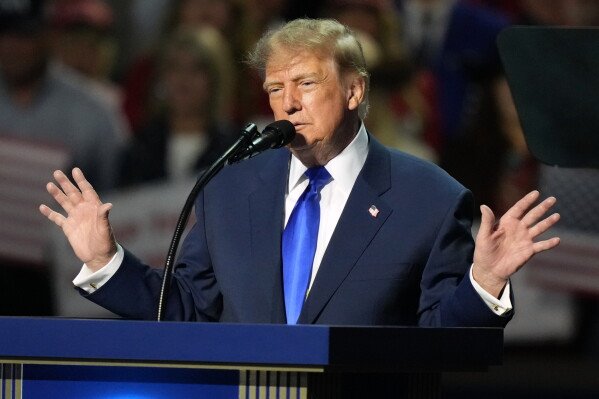
US President Donald Trump has pledged to give every adult American citizen $5,000 if Republicans retain control of both the House of Representatives and the Senate in the upcoming midterm elections, making the extraordinary promise during a lengthy speech at the Republican midterm convention in Dallas, Texas.
The proposal, which could cost the federal government more than $1 trillion if implemented nationwide, quickly drew attention because of its enormous potential financial implications and the uncertainty surrounding how such a payment would be funded. Trump presented the offer as part of a broader appeal to voters ahead of the November elections, urging them to support Republican candidates and effectively treat his own political future as part of the contest.
“If the Republicans win, you win with us, and you get $5,000,” Trump told an enthusiastic audience during a speech that lasted nearly two hours. He later made a direct appeal to voters, asking them to “pretend that I’m on the ballot”, even though he is not personally seeking election in the midterms.
Trump’s comments came as Republicans attempt to overcome the historical disadvantages faced by the party controlling the White House during midterm elections. The president argued that a Republican victory was essential to preserving his administration’s policies on immigration, taxation, public safety and the economy.

“If we lose, you’re going to lose your border, you’re going to lose your tax cuts, you’re going to lose your safety and security, you’re going to lose your wealth,” Trump told supporters. He portrayed a Democratic victory as a serious threat to the direction of the country and warned that America could once again experience severe political and economic difficulties.
The president also used the convention speech to defend his record during his second term, claiming without providing supporting evidence that his administration had delivered the most successful two years in the history of the US presidency in financial and other respects.
Trump’s unusually strong focus on the midterm elections reflected the importance Republicans have placed on maintaining congressional control. His party is facing a difficult electoral environment, with forecasts suggesting Republicans could lose control of the House. Trump’s personal popularity is also a significant concern for Republican candidates in competitive districts and states.
His approval rating has remained around the high 30s, according to polling cited during the convention, creating a complicated political calculation for Republican candidates. While Trump remains highly influential among the party’s core supporters, some candidates in competitive races reportedly stayed away from the two-day convention, highlighting concerns about the potential electoral consequences of appearing too closely aligned with the president.
Despite those concerns, Trump appeared determined to make himself central to the Republican campaign. His repeated instruction for voters to imagine that he was personally on the ballot reflected his belief that his political movement remains the party’s strongest electoral asset.
The Republican gathering in Dallas is the first midterm convention of its kind for the party. Organizers presented the event as an opportunity to energize Republican voters and highlight issues including economic costs, border security, public safety and the interests of American workers and families.
However, much of the programming focused on attacks against Democrats and cultural issues. Speakers repeatedly criticized Democratic positions on transgender rights and other social issues, suggesting that cultural divisions could play a significant role in Republican campaigning as the November elections approach.
Trump also devoted substantial attention to the conflict involving Iran. He warned Tehran against what he described as provocative behavior, saying the United States could respond with overwhelming force if necessary. The president also appeared to acknowledge the economic consequences of the conflict, particularly the rise in oil prices.
During his speech, Trump described how he had discussed the possibility of military action with economic advisers before the conflict began. He said he had been concerned that Iran was only weeks away from obtaining a nuclear weapon and suggested that the potential threat had to be addressed despite the risks to the economy.
The remarks came at a politically sensitive moment, as higher energy prices can create pressure on household budgets and complicate the economic message of an administration preparing for midterm elections. Trump has frequently made economic performance a central part of his political appeal, making the cost of energy and consumer prices particularly important issues for Republicans.
The atmosphere at the convention itself appeared less enthusiastic than the president’s rhetoric suggested. Compared with the large and highly attended Republican gathering held in Milwaukee two years earlier, the Dallas event appeared quieter during its opening day. Empty seats were visible during Trump’s speech, while there were fewer signs of the long queues and large crowds associated with major party conventions.
Trump nevertheless insisted that the arena was packed, claiming that a similar number of people were also standing outside. Those outside crowds were not observed by reporters attending the event.
Questions also emerged over attendance arrangements. Republican organizers had previously indicated that tickets would be distributed through a lottery system because of expected demand. However, during the convention, tickets were reportedly being made available through the party’s registration system, raising further questions about the level of public enthusiasm.
Trump’s appearance was nevertheless energetic. He joked about several Republican politicians, including Ken Paxton, his preferred candidate for the US Senate in Texas. Paxton defeated incumbent Senator John Cornyn in a primary earlier in the year and is now preparing for the general election.
Trump acknowledged Paxton’s unconventional public image while strongly praising his political credentials. He also attacked Paxton’s Democratic opponent, James Talarico, along with Democratic candidates and prominent figures in other states.
Among those targeted were former North Carolina Governor Roy Cooper, who is running for the Senate, and Abdul El-Sayed, the Democratic Senate nominee in Michigan. Trump’s attacks reflected the increasingly combative tone expected to dominate the campaign as Republicans seek to maintain control of Congress.
Democratic National Committee Chair Ken Martin criticized the Republican gathering, describing it as an unusual event designed largely to satisfy Trump and protect his political standing. Martin argued that the convention demonstrated the president’s political vulnerability and accused him of leading Republicans toward electoral defeat.
The convention featured a tightly scheduled programme spread across two nights. Many speakers were given only a few minutes, with the event emphasizing fast-paced presentations and political entertainment rather than the extended speeches traditionally associated with national party conventions.
Among the prominent Republican speakers were Florida gubernatorial candidate Byron Donalds and senior administration officials Mehmet Oz and Scott Bessent. The convention also highlighted Trump’s interest in mixed martial arts, with UFC fighters Bo Nickal and Justin “The Highlight” Gaethje introducing the president.
Gaethje used his appearance to draw a comparison between combat sports and electoral politics. He warned Republicans against becoming complacent after previous electoral victories and urged supporters to remain focused on turning out voters in November.

Trump is scheduled to speak again as the convention concludes, although he indicated that his next address would be considerably shorter than his opening speech.
The $5,000 promise, however, is likely to remain one of the most striking elements of the convention. Beyond the headline figure, the proposal raises major questions about eligibility, funding, implementation and its potential impact on federal finances. Trump did not provide detailed information about how the payments would be financed or how the programme would operate.
The pledge also demonstrates how intensely Republicans are focused on mobilizing voters before the midterms. With control of Congress at stake and Trump’s own political standing remaining deeply divisive, the president is attempting to turn the election into a referendum on his administration.
For Republicans, the November elections will determine whether Trump can continue pursuing his agenda with congressional support or whether Democrats can regain enough power to constrain his administration during the final years of his presidency. Trump’s unusual $5,000 promise has added another dramatic dimension to an already closely watched political contest.