Published: 05 December 2025. The English Chronicle Desk. The English Chronicle Online
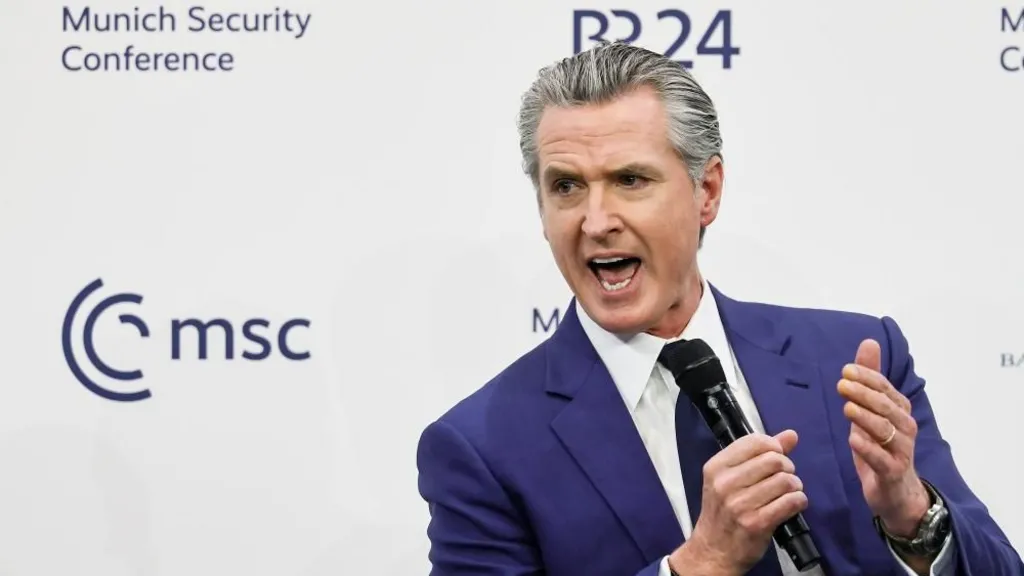
In the grand halls of the Munich Security Conference, a gathering that traditionally serves as a crucible for international cooperation and strategic dialogue, a palpable undercurrent of unease lingered over the future of the U.S.–Europe alliance. As European leaders and diplomats convened to discuss shared security challenges, Democratic figures from the United States made a conspicuous effort to reassure their European counterparts, insisting that current tensions under the Trump administration are temporary and that a return to steady partnership will come once President Donald Trump’s tenure concludes.
California Governor Gavin Newsom, speaking to an audience of diplomats, policymakers and journalists, did not mince words when he remarked, “Donald Trump is temporary. He’ll be gone in three years.” The comment, delivered with a mixture of defiance and certainty, echoed through the conference, capturing both the anxiety and the political positioning that Democrats are increasingly adopting on the global stage.

Newsom’s remark was emblematic of a broader theme among high-profile Democrats at the event. Their mission was not merely to critique the policies of the Trump administration — policies that have unsettled many European governments — but to offer a narrative of continuity and reassurance: that U.S. commitment to transatlantic ties and collective defense will endure beyond the next few years. “The reason we’re here,” Democratic Senator Jeanne Shaheen of New Hampshire emphasised, “is to provide reassurance that we understand how important our European allies are.”
This message of future reassurance stands in contrast to recent episodes that have strained relations. From controversial tariff impositions tied to Greenland to unwavering skepticism about long-standing multilateral institutions, the Trump White House’s unilateral posture has unsettled traditional partners in Europe. These tensions have only magnified calls for transatlantic cohesion — something Democrats argue will be more tenable once a new U.S. administration takes office.
European responses to these visible efforts at reassurance were mixed. Some officials welcomed the overtures, acknowledging that constructive dialogue with American leaders from both major parties remains essential for geopolitical stability. Yet others pointed out that reassurance alone may not be sufficient without tangible policy shifts. The question for many European capitals is not just whether Trump will be succeeded in office, but whether the structural uncertainties exposed during his term can be repaired in time to address urgent global challenges, from Russia’s aggression to economic volatility and climate change.
Analysts note that Democrats’ positioning at Munich also serves a domestic political purpose. With the 2028 U.S. presidential election already on many observers’ minds, figures like Newsom and Senator Shaheen are staking out foreign policy credibility, articulating a bipartisan message of alliance and strategic cooperation. Their international pronouncements are not only designed to comfort Europe but also to appeal to U.S. voters who prioritise global leadership and diplomatic engagement.
Underlying the confidence expressed by Democrats is the assumption that even though President Trump retains significant support domestically, his approach to foreign policy — broadly perceived as transactional and unpredictable — will eventually give way to a more traditional alliance-centered strategy once he leaves office. By highlighting the temporary nature of current tensions, Democratic leaders aim to reassure partners that the foundational bonds between North America and Europe remain intact despite current political headwinds.
Critics of this optimistic framing point out that even if Trump departs in three years, the legacy of his policies may linger. Structural shifts taking place within American political discourse — including growing skepticism of international institutions, rising nationalism, and increasing domestic polarisation — could shape the contours of U.S. foreign policy long after a new administration arrives. Some European observers argue that reassurance must be matched by clear commitments to NATO, climate accords, economic cooperation and coordinated responses to emerging global threats.

Nevertheless, the Munich Security Conference provided a rare stage where Democratic leaders could articulate a long-term vision for U.S.–Europe relations beyond the Trump era. By explicitly recognising the anxieties felt in Europe and by framing Trump’s presidency as a disruptive, yet temporary, chapter in transatlantic history, they sought to reaffirm shared commitments to democratic values, collective defense, and joint leadership.
As the conference concluded, the message from top Democrats was unmistakable: the present moment of uncertainty is not permanent, and the longstanding partnership between the United States and Europe can not only survive but flourish once leadership in Washington transitions. Whether that message resonates with European leaders — and whether it translates into renewed strategic cooperation — remains to be seen.
Related News:
 Putin Intensifies Territorial Demands Before US Talks
 US National Guard Member Killed in DC Shooting
 Trump to Recheck Green Cards from 19 Nations After DC Attack
 Trump to pause migration from ‘third-world countries’
 Republicans Hold Tennessee Seat Despite Democratic Surge
 Franklin Turtle, Sabrina Carpenter Slam US Social Media Use
 Russia losses Ukraine war peace talks intensify amid rising deaths
 Trump Escalates Minnesota Immigration Surge Amid Rising Tensions
 Trump: US Stands Ready to Help Iran Find Freedom Amid Widespread Unrest
 US Conducts Large-Scale Strikes Against ISIS Targets Across Syria
 Trump Says US Will Act on Greenland ‘Whether They Like It or Not’
 Homeland security agents deployed amid Minneapolis protests
 Democrats Push Affordability to Challenge Trump Ahead of Votes
 Top Senate Republican Says Federal Probe of Powell Could Challenge Fed Nominees
 Trump Administration Probe of Fed’s Powell Draws Pushback
 US Senator Mark Kelly Sues Pentagon Chief Hegseth Over Demotion Threats
 Greenland Faces Pivotal Summit Over Arctic Power Struggle
 Trump Threatens Strong Action If Iran Executes Protesters
 Government Unveils Northern Powerhouse Rail Plans
 Trump press secretary attacks reporter over ICE question
 Kyrsten Sinema Faces High-Profile Lawsuit Over Marriage Interference
 Trump Receives Machado’s Nobel Medal in White House Meeting
 Greenland Crisis Forces Europe to Draw a Line With Trump
 European Leaders Condemn Trump Tariff Threat Over Greenland
 Iran Cannot Be Bombed Into Democracy, Only Helped There
 ‘He Believed Help Was Coming’: Why Iran’s Protesters Feel Betrayed
 Trump Fed bid heads to Supreme Court
 Historic Abu Dhabi Talks Bring US, Ukraine and Russia Together
 Trump Pulls Canada from His Controversial ‘Board of Peace’ Plan
 EU Says US Ties Have Suffered ‘Big Blow’ After Greenland Crisis
 ‘Unfathomable’: Australian veterans rebuke Trump claims
 Trump officials continue false claims after Alex Pretti shooting
 ‘Evil is resilient’: Pressure Mounts on Stephen Miller
 Fulton election raid hits Georgia election office
 Partial US Government Shutdown Hits Homeland Security Funding
 Thousands Protest ICE Operations in Nationwide US Day of Action
 Epstein Files Reveal Trump Officials’ Emails with Financier
 Thousands Protest ICE in New York Against Trump Deportation Campaign
 Sinema payment row deepens after $9,000 transfer claim
 Trump Praises ‘Terrific’ Petro After White House Talks
 Starmer to Release Mandelson Files
 California Wins Supreme Court Approval for New Map
 US Must Be Prudent When Supplying Arms to Taiwan, Xi Tells Trump
 Fears of New Arms Race as US-Russia Nuclear Weapons Treaty Expires
 Nurses’ families fear breakup under UK immigration crackdown
 Trump Calls Democrats ‘Demented and Evil’ in Unhinged Tirade About Voter IDs
 UK Must Act with Courage and Clarity on Israel-Palestine Conflict, Says Foreign Affairs Committee Report
 The Fight for Trans Safety Is a Fight for Everyone’s Safety — MPs Must Debate This Crucial Issue
 Radioactive Leak at UK’s Nuclear Warhead Base Sparks Outcry Over Safety and Secrecy
 Hong Kong Summons UK and Australian Envoys Following Asylum Grants to Democracy Activists
 Is the UK Ready to Put Boots on the Ground in Ukraine? Assessing Military Capacity and Challenges
 Police Scotland Spends £500,000 Compensating Officers Over Trump Visit
 Rylan Clark Criticizes UK Immigration Policies on This Morning, Sparking Public Debate
 Tanni Grey-Thompson Faces Abuse Over Opposition to Assisted Dying Bill
 Nigel Farage Unveils Controversial Immigration and Welfare Plans at Reform UK Press Conference
 Yvette Cooper Signals Global Momentum Towards Gaza Peace Deal Amid Humanitarian Crisis
 UK border officers deployed to Balkans to tackle migrant smuggling
 UK MPs warn of repeat riots over online misinformation
 Russia’s Latest Push to Win US Favors Shows Deep Desperation
 Trump’s UK Ambassador Urges North Sea Drilling to Strengthen US Ties
BBC to Apologise Over Edited Trump Speech Amid Backlash
Trump’s UK Ambassador Urges North Sea Drilling to Strengthen US Ties
BBC to Apologise Over Edited Trump Speech Amid Backlash
 Millionaires group urge Reeves to introduce wealth tax to ‘lift kids out of poverty’
 Reeves rejects £1bn plea for NHS redundancy payouts
 PM Condemns Leaks, Vows Loyalty to Ministers and Stability
 Greene Pushes Epstein Files Amid Trump Fallout
 Shadow Fleet at Sea: Europe’s Battle Against Illicit Oil Shipping
 Starmer Says Labour’s Economic Plan Needs Years to Deliver
 England delays four mayoral elections amid criticism
 Tory Free Schools Waste £325m on Failed Projects
 Khaleda Zia Death in Bangladesh: First Female PM Dies at 80
 Trump Weighs Response to Iran Crackdown as Tehran Says Communication Open With US
 Minnesota Sues Trump Administration Over ICE Surge
 US Clears Nvidia AI Chip Sales to China in Policy Shift
 US Senate rejects resolution limiting Trump military powers
 UK Ministers Drop Foreign Student Targets for Global Education Push
 No Gas Boiler Ban as UK Warm Homes Plan Backs Heat Pumps
 Shinzo Abe’s killer receives life sentence in Japan
 Sussan Ley leadership milestone shakes Liberal future
 Police response times face strict new national limits
 Australia’s Opposition Coalition Reunites After Rift