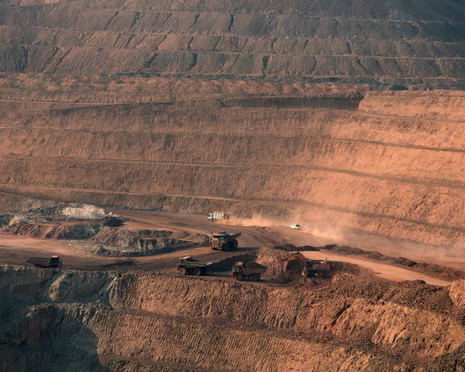
Published: 18 February 2026. The English Chronicle Desk. The English Chronicle Online.
Glencore’s announcement of a $2bn shareholder payout has intensified rate cut speculation as investors weigh company resilience. The FTSE 100 commodities giant revealed the distribution despite reporting a 6% decline in annual profits, which fell to $13.5bn amid falling coal and energy prices. Market analysts suggest this bold move signals confidence in Glencore’s long-term growth strategy, particularly in copper, even as global economic uncertainties continue to fuel rate cut speculation.
The payout comes after months of high-profile but ultimately unsuccessful merger discussions with Rio Tinto. Had the merger succeeded, it would have created the largest mining entity globally, valued at roughly $260bn. Talks collapsed following extensive negotiations, leaving Glencore to focus on organic expansion. The failed merger highlights the increasingly competitive nature of the mining sector and the strategic importance of copper to global infrastructure plans, amid persistent rate cut speculation.
Glencore, founded in 1974 as a trading house, now operates in over 30 countries and employs approximately 140,000 staff. Its business spans metals, minerals, and energy commodities, making it a pivotal player in global supply chains. While coal and energy prices struggled in 2025, copper output increased significantly in the latter half of the year, positioning the company to meet growing global demand for electric vehicles, renewable energy, and modernised power grids. Analysts note that these dynamics contribute directly to ongoing rate cut speculation as markets assess economic stability.

The company has committed to a copper-led growth strategy, aiming to produce over one million tonnes of copper annually by 2028 and 1.6 million tonnes by 2035. This expansion would cement Glencore as one of the world’s largest copper producers. CEO Gary Nagle emphasized that last year marked “significant progress” toward this strategy, underlining the company’s focus on sustainable, long-term growth. Experts argue that these ambitions play a key role in shaping market expectations and continued rate cut speculation, given copper’s critical role in global decarbonisation efforts.
Despite profit pressures, Glencore’s balance sheet includes a $4bn stake in Bunge, a US agricultural trader acquired after Bunge’s merger with Glencore’s Viterra business. Nagle described this as surplus capital that could be returned to shareholders, reinforcing confidence in the company’s financial flexibility. Investors welcomed the announcement, interpreting the payout as a clear signal of Glencore’s resilience amid macroeconomic uncertainty, which continues to drive rate cut speculation in financial markets.
Environmental groups have long criticised Glencore’s coal operations, calling them incompatible with climate goals. However, the company argues that coal remains essential for energy access in developing economies. In 2024, Glencore abandoned plans to spin off its coal division after shareholder input confirmed the unit’s high profitability, despite its environmental impact. The decision illustrates the tension between profitability and sustainability, contributing indirectly to investor conversations surrounding rate cut speculation and global commodity markets.
Recent mining mergers, including Anglo American’s acquisition of Teck last September, have reshaped the competitive landscape, creating pressures and opportunities for companies like Glencore. Although its own merger with Rio Tinto failed, Glencore continues to pursue strategic growth projects. Copper, increasingly vital for low-carbon technologies, underpins the company’s future prospects and the broader market outlook. Analysts suggest that strong copper positioning may mitigate some economic risks, while maintaining investor attention on rate cut speculation driven by wider macroeconomic indicators.
Glencore’s strategic decisions highlight a dual focus on immediate shareholder returns and long-term market positioning. The $2bn payout demonstrates the company’s commitment to shareholder value, even as external pressures and commodity price volatility persist. Its investment in copper production, along with surplus assets like Bunge, provides a buffer against economic fluctuations, which in turn informs ongoing rate cut speculation by global investors. Observers note that these measures underscore the importance of strategic planning in maintaining corporate resilience amid economic uncertainty.

Industry experts view Glencore’s approach as an example of balancing growth and shareholder interests, navigating a complex environment where commodity prices, climate policy, and global economic trends intersect. The payout, coupled with ambitious copper expansion plans, may serve as a blueprint for other resource companies seeking to maintain investor confidence while addressing sustainability challenges. Market participants continue to monitor these developments closely, as they feed directly into broader discussions of monetary policy and rate cut speculation.
Glencore’s position in the mining sector remains formidable. The company is now the sixth-largest copper producer globally and the largest listed coal trader. Its strategic copper expansion and diversified portfolio allow it to weather fluctuations in commodity markets and maintain liquidity for shareholder distributions. Investors are increasingly assessing the company’s moves against economic indicators and central bank policies, fueling rate cut speculation about how such payouts influence market stability and investment flows.
Ultimately, Glencore’s $2bn payout amid a profit slump illustrates a calculated risk, balancing operational performance with investor expectations. The decision underscores confidence in its copper-driven growth and the value of strategic asset management, even in a volatile economic landscape. Financial commentators argue that these factors contribute to rate cut speculation, reflecting market sensitivity to corporate resilience and global economic trends. The company’s continued expansion and proactive capital allocation signal that Glencore remains a formidable force in global mining, positioning itself for both profitability and influence in key commodity markets.
Related News:
 Reeves Faces Setback as Labour May Miss Homes Target
 Virgin Trains Moves Closer to Challenging Eurostar Monopoly
 Trump’s UK Ambassador Urges North Sea Drilling to Strengthen US Ties
 Ryanair Chief UK Economy ‘Doomed’ Under Labour
 Court Hears Challenge Over Water Bills Funding Sewage Fixes
 ABF May Split Primark from Food Division Amid Tough Market
 Rachel Reeves Set to Break Labour Pledge and Raise Income Tax
 UPS Cargo Plane Crash in Kentucky Kills Seven
 M&S Profits More Than Halve After Cyber-Attack
 Tony Blair think tank warns Rachel Reeves must cut taxes if manifesto broken
 Oprah enjoys Meghan’s jam on English muffins
 MPs Press Rachel Reeves to Hike Gambling Taxes
 Earl of Yarmouth Faces £1.3m Legal Bill Over Family Estate
 North Sea oil workers must lose weight or face job loss
 Warning as Britons prepare to spend £4 billion this Black Friday
 Millionaires group urge Reeves to introduce wealth tax to ‘lift kids out of poverty’
 From Lego to Pokémon: How Adults Are Driving UK Toy Market Growth
 UK toy market enjoys bumper year as ‘kidults’ fuel demand
 New laws to bolster UK’s defences against cyber attacks on NHS, transport and energy
 Skims Eyes Global Expansion After Reaching $5 Billion Value
 Trump Moves to Cut Coffee and Banana Tariffs in Latin America Deals
 Global markets drop amid tech sell-off and China slowdown
 Canada Passes Carney’s First Budget in Tight Parliamentary Vote
 UK Rejects Funding to Save Mossmorran Plant
 PM Highlights UK Business at G20 in South Africa
 Mossmorran Plant Closure Hits Cowdenbeath Hard
 UK Taskforce Unveils Plan to Streamline Nuclear Reactor Rules
 Steel billionaire Lakshmi Mittal reportedly leaves UK
 India’s Labour Law Overhaul Sparks Fierce Debate
 Starmer Says Labour’s Economic Plan Needs Years to Deliver
 Virgin Media Fined £23.8m Over Telecare Safety Failures
 Rising Water Bills Lift Troubled Thames Back to Profit
 Tesla Warns UK That Weak EV Rules Could Threaten Sales
 BP agrees £7.4bn Castrol sale to US investment firm
 Sainsbury’s CEO leads business honours in New Year list
 FTSE 100 Hits 10,000: UK Market Celebrates Record Year
 UK House Prices Fall Sharply at Year-End, Nationwide Reports
 UK Car Sales Pass 2 Million as Chinese Brands Surge
 Wessex Water chiefs receive £50,000 extra despite government bonus ban
 3,000 Jobs at Risk Without UK Helicopter Order
 German Supermarket Aldi to Open 180 US Stores This Year
 Starmer links foreign trips to tackling cost of living crisis
 China Dependence Threatens UK Energy Supply Chains and Jobs
 Canada-China trade gains momentum in new strategic partnership
 ScottishPower Tops List of Worst UK Energy Suppliers
MPs warn AI financial risks threaten UK stability
ScottishPower Tops List of Worst UK Energy Suppliers
MPs warn AI financial risks threaten UK stability
 MPs warn AI financial risks threaten UK stability
 City & Guilds pay surge sparks backlash amid £22m cuts
 Trump Fed bid heads to Supreme Court
 B&M and The Works Struggle During Christmas Trading
 UK Disposable Income Growth Transforms Eleven Towns and Cities
 US Dollar Hits Four-Year Low Amid Market Turmoil
 Amazon mistakenly signals new global layoffs to employees
 Labour Must Revive High Streets to Avoid Election Collapse
 Households in England Face Rising Water Bills in April
 UK needs new factory to reach 1.3m car target, says industry chief
 UK food industry urges transition if post-Brexit rules reset
 AstraZeneca China Investment Signals Strategic Shift Abroad
 UK New Car Discounts Near £6,000 as Prices Are Slashed
 Study Finds One in Seven England Takeaways Are Dark Kitchens
 Riverford sales surge as UK organic market booms
 Barclays drops Global Counsel after Mandelson link scrutiny
 Norway’s Petrol Car Sales Hit Record Low Amid EV Surge
 Telstra AI jobs cuts as automation drive expands
 Europeans Shift Travel Habits as US Trips Lose Appeal
 BT Names New Openreach Chief Amid Major Fibre Expansion
 AI fears hit UK wealth and comparison sites
 Elliott Takes LSEG Stake, Pressures Strategy Shift
 UK Housing Market Shows Early Recovery Signs
 UK economy struggles as growth stalls at 0.1% in late 2025
 Schroders sold to US investor in £9.9bn deal ending family control
 Aberdeen Chosen for GB Energy HQ at Marischal Square
 Bank of England Urged to Cut Rates to Spur Growth
 Rural Drivers Face Hefty Costs From UK EV Mileage Tax
 Lloyds Faces Scrutiny Over Staff Data Use in Pay Talks
 Santos Wins Landmark Greenwashing Case in Court
 Royal Mail Blames Poor Weather and Sickness for Delayed Deliveries
 UK Unemployment Rate Climbs to 5.2% Peak
 British Steel wins Turkey rail boost
 UK Inflation Surprise Sparks Early Rate Cut Hopes