Published: 20 February 2026. The English Chronicle Desk. The English Chronicle Online.
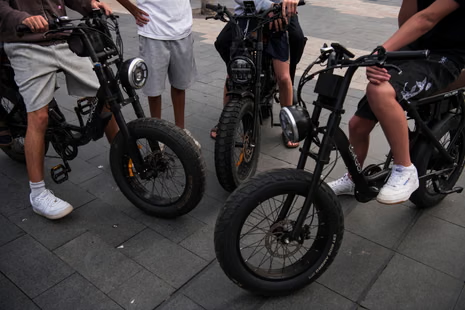
New South Wales is preparing to introduce a minimum age requirement for riding ebikes, aiming to tackle growing safety concerns and limit “dangerous behaviour” among young riders. The Minns government announced the reforms on Friday, highlighting a detailed expert review led by Transport NSW that will recommend a legal minimum age somewhere between twelve and sixteen years. Officials are also considering whether children and teenagers should be allowed to carry passengers, ensuring that safety is the top priority.
The review process will involve consultations with child development specialists, road safety experts, parents, and young people themselves. Findings from this investigation will be presented to the minister for transport and the minister for roads by June, after which the NSW government will make a final determination on age limits and passenger rules. Currently, children of any age can ride an ebike in New South Wales and carry passengers if the bike’s design permits it, a policy that differs significantly from Western Australia’s approach.
Western Australia already enforces a minimum age of sixteen for ebike riders, with penalties for underage riding including fines of fifty Australian dollars. John Graham, the minister for transport in NSW, emphasised the importance of outdoor activity for children but insisted that safety must remain “paramount.” He warned that allowing children as young as ten or eleven to operate high-powered bikes presents serious dangers. These new age restrictions will complement other measures being introduced in New South Wales, such as empowering police to seize and destroy illegal high-powered bikes.

The NSW government noted that ebike ownership has increased rapidly, with approximately 760,000 bikes now registered across the state. While ebikes have encouraged more people to stay active and facilitated easier commuting, authorities stressed the necessity for clearer rules to prevent accidents and misuse. Large gatherings of young riders, often referred to as mass “rideouts,” have raised safety concerns, with federal health minister Mark Butler recently labelling illegal ebikes a “total menace on the roads.”
Statistics illustrate the urgency of reform. In 2024, New South Wales recorded 226 injuries associated with ebikes. By the first seven months of 2025, the state had already experienced 233 injuries and four fatalities linked to these vehicles. Police minister Yasmin Catley explained that implementing an age limit and cracking down on illegal high-powered bikes would allow officers to intervene before more serious harm occurs. She highlighted that police witness firsthand the dangers posed by misused ebikes and stressed the need to maintain them as a safe transport option.
Alongside the age restrictions, the Minns government confirmed it will adopt European safety standards for ebikes, ensuring these vehicles operate more like traditional bicycles rather than motorbikes. Under this framework, modifications that increase power or speed will be prohibited, with maximum power output limited to 250 watts. The power assistance system must disengage when a rider exceeds 25km/h, and it should also cut out when the rider is not pedalling at speeds above 6km/h.
A three-year transition period will allow manufacturers and owners to adjust, with only European-standard compliant bikes considered road-legal in New South Wales from March 2029. Minister Graham acknowledged the challenge of this transition, particularly after previous policies allowed 500-watt bikes. He reassured the public that options would be provided for those wishing to modify existing bikes in line with safety requirements. The government plans to collaborate with manufacturers to guarantee that future ebike stock fully adheres to these updated regulations.
Peter McLean, CEO of Bicycle NSW, welcomed the move to European standards, describing them as “the gold standard” for safety. He praised the convenience and efficiency of ebikes, noting that they are often faster than public transport or private cars, particularly in congested Sydney. McLean emphasised that while ebikes offer significant benefits, their growing popularity underscores the importance of public safety education and responsible usage.
The decision to introduce an age limit comes amid increasing public debate on child safety and traffic regulation. Experts argue that younger riders may lack the coordination and judgment needed to safely navigate urban roads on high-powered electric bikes. By setting a minimum age, authorities aim to reduce injuries and fatalities while still encouraging young people to engage in outdoor physical activity. The consultation with parents and child specialists ensures that policies are informed by both scientific insight and community perspectives.
These reforms also address a broader trend of increasing urban mobility and electric vehicle adoption. As ebikes become more common across cities, striking a balance between accessibility and safety becomes critical. Authorities are particularly concerned about powerful bikes being used inappropriately during mass gatherings, stunts, or group rides that pose risks to both riders and pedestrians. Implementing both age limits and European safety standards is intended to prevent accidents without discouraging the benefits that ebikes provide to daily commuters.
In addition to safety measures, the government is focusing on enforcement. Police will have new powers to identify and remove illegal or unsafe bikes, helping reduce incidents before they occur. Public awareness campaigns are expected to accompany these changes, aiming to educate riders and families about responsible usage. Experts predict that such initiatives, combined with stricter rules and European compliance, will significantly lower injury rates over the coming years.
Families have expressed mixed reactions to the news. Many parents welcome clearer regulations and believe the age limit will reduce risks for their children. Others, particularly those with teenagers who rely on ebikes for commuting, are concerned about potential inconvenience. Government officials have reiterated that public safety takes precedence and that the transition period allows time for adjustments, including ensuring access to compliant bikes.
The popularity of ebikes continues to grow as Sydney and other urban centres face traffic congestion and rising environmental concerns. These vehicles provide a practical, eco-friendly alternative to cars while promoting an active lifestyle. However, the increase in ownership has also correlated with a rise in accidents, prompting urgent calls for regulation. Authorities hope the combined approach of age restrictions, safety standards, and enforcement will allow the public to enjoy ebikes responsibly and reduce preventable injuries.

As New South Wales moves toward implementing these policies, the government emphasises collaboration with manufacturers, retailers, and communities to ensure smooth compliance. The phased introduction of European standards also reflects a recognition of technological advancements and the need for regulatory frameworks to keep pace with innovation. Minister Graham noted that while safety remains the primary concern, the reforms also seek to preserve the benefits of ebikes for commuting and recreation, maintaining a balance between protection and accessibility.
Public health advocates support the measures, highlighting that safer ebike usage can prevent long-term injuries and fatalities among young riders. Road safety campaigns will complement the legislative changes, emphasising responsible riding behaviour, helmet use, and adherence to speed limits. This comprehensive approach reflects a commitment to evidence-based policymaking, aiming to safeguard children while encouraging sustainable transportation options.
In conclusion, New South Wales is poised to introduce minimum age requirements for ebike riders, alongside European safety standards and stricter enforcement of illegal or modified bikes. These measures aim to protect children and young people, reduce accidents, and ensure that ebikes remain a safe, accessible transport option. By balancing innovation, practicality, and safety, the government intends to create a regulatory framework that benefits the public while addressing increasing concerns about road safety.
Related News:
 Brisbane School Stabbing Leaves Teenager Critical
 Is a two-week half-term a good deal? Some parents in England aren’t so sure
 Children to Learn Local History in Major Curriculum Overhaul
 UK University Suspends Human Rights Research Following Pressure from China
 UK University Faces Counter-Terror Probe Over China Pressure
 Top Christmas Books Reads: Classics to Cozy Romcoms
 Greta Thunberg Backs Student Facing UK Visa Revocation
 Audio Books deals and promo codes to explore in November 2025
China-critical UK academics face ‘extremely heavy’ pressure from Beijing
Audio Books deals and promo codes to explore in November 2025
China-critical UK academics face ‘extremely heavy’ pressure from Beijing
 Labour immigration crackdown could cost UK £4.4bn
 London’s Childlessness Crisis: Schools Closing as Families Shrink
 Government urges schools to ban phones to curb classroom disruption
 Nigeria’s $25m Museum Faces Political Storm Amid Benin Bronzes Debate
 Algeria Pardons French-Algerian Novelist Sansal After Year in Jail
 Phillipson Accused of Appeasing Unions by Diluting EBacc
 England’s Special Needs Support Faces Breaking Point
 Nigerian Education Reversal: Mother-Tongue Teaching Scrapped
 Ex-Harvard President Pauses Teaching Over Epstein Emails
 Scottish Families Take Legal Action Over School CO Leak
 Men Aren’t Vanishing From Fiction, But Misconceptions Persist
 Oxford Names ‘Rage Bait’ Word of the Year
 Cambridge College Faces Backlash Over Private School Recruitment
 Liberal Turmoil Threatens Victorian Election Hopes
 PM pushes urgent hate speech and gun laws after Bondi terror attack
 Jewish MP school visit cancelled after Bristol campaign pressure
 UK Launches First Town of Culture Competition
 Guildford resignation sparks public trust debate in West Midlands
 Bondi memorial flowers preserved in lasting tribute artwork
 City & Guilds pay surge sparks backlash amid £22m cuts
 Nationals Crisis Meeting Threatens Coalition Stability
 Silence and Unity Mark Bondi Terror Attack Memorial
 Victorians Evacuate Otways Amid Massive Fire Threat
 How Sandhill Ashes Rebuilt a Bushfire-Hit Rural Community
 School Suspensions Now Reserved for Only Severe Misbehaviour
 Townsville Hospital Probes Privacy Breach After Activist Posts Foetus Image
 Lenore Taylor steps down as Guardian Australia editor
 Send spending gap leaves deprived areas behind
 Angus Taylor Faces Immense Test with New Frontbench
 Councils Urge Means Testing for Send School Transport
 NSW Braces for Return of IS-Linked Women and Children
 Student Loan Crisis Sparks Outrage Among Graduates in England
 Anthony Albanese Must Uphold Rights for All Australians
 Larry Summers Resigns From Harvard Amid Epstein Files
 Liberal Review Shelved After Historic Election Loss
 SA Liberals Back Candidate With Controversial Views on Homosexuality
 New Survey Reveals Troubling Rise in Campus Antisemitism
 Greater Manchester Expands Night Bus Network Across Boroughs
 Sydney Teacher Arrested in Teenage Grooming Investigation
 Victorian Liberals Face New Crisis Over Candidate Ethics
 Exhibition Revisits Life of 18th-Century Black Court Figure
 Student Loan Interest May Rise Despite 6% Cap
 School Plate Revolution: England Bans Fried Menu Classics
 City & Guilds Sale Sparks Fees and Pay Uproar
 Governments Fail Murray-Darling River Projects
 NHS Safety Fears as Nurses Cover Doctor Gaps
 Elite School Teacher Claims Misogynistic Culture Fuels Abuse
 Older Than Dinosaurs: Secrets of Mayfly Dance Revealed
 Germany to Return Rare Irritator Dinosaur Skull to Brazil
 Queensland Government Faces Heat Over Ministerial Scandal
 Tractor Breakdown Tests Lincolnshire Farmers
 Cambridge University in Talks With Saudi Ministry
 Cambridge South Signals New Era for British Rail Travel
 Tony Abbott Returns as New Liberal Party President
 Victoria Labor Launches Apprenticeship Expansion Plan
 Man killed in shark attack on Great Barrier Reef
 Gen Z Graduates Face Economic Uncertainty
 Is a University Degree Still Worth the Cost?
 Shockwaves Across Australian Cricket as Melbourne Rivals Dissolve
 Global Tech Giants Face Off Against Australia Over Media Levies
 Breakthrough in Hunt for Sovereign Citizen Accomplices
 The Hybrid School Revolution Defying the Social Media Ban
 A State in Turmoil: Aussie MP Denies Assault Allegation
 School Bosses Face Strict Pay Cap
 Moira Deeming Gains Respite in Liberal Party Standoff
 Court Lifts Suppression on Senator Thorpe MCG Assault Case
 China’s Pacific Missile Test Sparks Regional Alarm
 The Melbourne Bird: Art or Vandalism?
 Taylor Defends Henderson Over Triple-Zero Calls
 UK Schools Struggle as Classrooms Top 40C
 Cambridge Professor Jason Arday Found Dead at Home