Published: 12 January 2026. The English Chronicle Desk. The English Chronicle Online.
Pressure is steadily intensifying on Downing Street as political voices converge around the under-16s social media ban debate. What began as a Conservative proposal has gathered unexpected momentum after support emerged from Labour’s Greater Manchester mayor, Andy Burnham. The renewed focus reflects rising public unease about children’s online lives, digital wellbeing, and the responsibilities of government and technology companies. Ministers now face a complex political moment, shaped by parental anxiety, professional warnings, and international precedents that challenge the UK’s current approach.
The government maintains that it does not intend to introduce a blanket prohibition on social media use by younger teenagers. Officials argue that existing safeguards, strengthened by recent legislation, already provide meaningful protection. Yet sources confirm that ministers are closely watching how platforms respond to tighter age verification measures. Major services including Facebook, Instagram, TikTok, X, and YouTube have announced or expanded systems designed to limit underage access. These steps, while welcomed, have not silenced critics who believe stronger statutory limits are unavoidable.
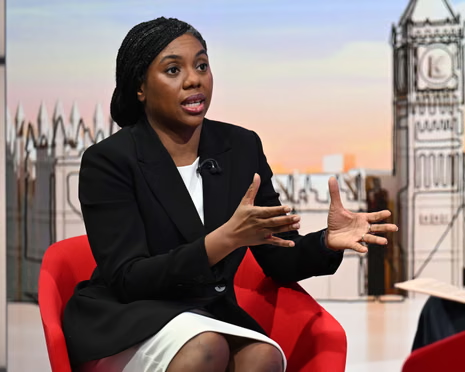
Kemi Badenoch, the Conservative leader, has placed the issue firmly on the national agenda. She has argued that social media platforms are deliberately engineered to capture attention and monetise anxiety. While cautious about the language of prohibition, she has made clear her support for setting a firm minimum age of sixteen. Badenoch frequently references Australia’s recent restrictions, presenting them as evidence that democratic governments can act decisively without undermining adult freedoms or digital innovation.

Her intervention has sharpened debate within Westminster, particularly as peers prepare amendments to the children’s wellbeing and schools bill. The proposed changes would effectively enforce an under-16s social media ban through clearer legal duties and penalties. Supporters believe this route could compel the government to reconsider its position, especially if the House of Lords delivers a significant defeat. The cross-party nature of the amendment is seen as its greatest strength, signalling a shared concern that transcends traditional ideological lines.
Andy Burnham’s endorsement has added notable weight to the campaign. As a senior Labour figure and a potential future leadership contender, his words carry influence beyond regional politics. Burnham has spoken candidly about parental exhaustion and the sense of helplessness many families feel. He argues that a clear national rule would remove daily conflict from households and establish consistent expectations for children. His call for cross-party consensus has resonated with parents who feel caught between social pressure and safeguarding instincts.
The debate is also being driven by voices outside Parliament. Teaching unions have increasingly warned that excessive social media use affects concentration, behaviour, and mental health. The NASUWT recently urged ministers to legislate, citing evidence from classrooms across the country. Teachers describe pupils arriving tired, distracted, and emotionally overwhelmed, often following nights spent online. Union leaders argue that voluntary measures by technology firms have failed to keep pace with the scale of the problem.
Health professionals have echoed these concerns. The health secretary, Wes Streeting, has suggested that more robust protections may be necessary to address rising anxiety and self-harm among teenagers. While careful not to pre-empt policy decisions, he has acknowledged that digital environments play a growing role in young people’s wellbeing. Public health experts increasingly frame social media exposure as a population-level issue rather than an individual parenting challenge.
Despite mounting pressure, the prime minister remains unconvinced. Keir Starmer has previously expressed personal reservations about age-based bans, warning against unintended consequences. Technology secretary Liz Kendall shares similar concerns, emphasising the importance of digital literacy and proportional regulation. Both argue that outright restrictions could push young users towards unregulated spaces, creating new risks rather than eliminating existing ones.
Central to the government’s defence is the Online Safety Act, which imposes duties on platforms to protect under-18s from harmful content. Ministers describe the legislation as world-leading, highlighting requirements around self-harm material, suicide promotion, and algorithmic accountability. They insist that the law strikes a careful balance between safety and freedom. However, critics argue that enforcement remains untested and that age limits would provide clearer protection.
Supporters of tougher measures counter that the evidence is already overwhelming. Conservative peer John Nash, a former schools minister, has been outspoken in his support for raising the age threshold. He points to growing political alignment, noting backing from Labour, Liberal Democrats, and major education unions. Nash argues that incremental adjustments cannot reverse what he describes as generational harm caused by unregulated digital exposure.
The international context continues to influence the discussion. Australia’s decision to restrict social media access for younger teenagers is being closely studied by UK officials. Early indications suggest strong parental support, although long-term impacts remain unclear. Proponents believe the Australian example undermines claims that age limits are unworkable. Opponents caution that cultural and regulatory differences limit direct comparison.

Public opinion appears increasingly sympathetic to decisive action. Polling suggests that many parents would welcome clearer rules, even if enforcement proves challenging. For families, the debate is less about ideology and more about daily reality. Many describe constant negotiations over screen time, online behaviour, and emotional fallout. A nationally mandated standard, they argue, would shift responsibility away from individual households.
Technology companies find themselves under intensifying scrutiny. While firms emphasise investments in safety tools and moderation, critics question their commercial incentives. The business models of major platforms rely heavily on engagement, often driven by emotionally charged content. This tension fuels arguments that self-regulation cannot adequately protect children, regardless of technological advances.
As Parliament prepares for further debate, the political stakes are rising. A defeat in the Lords would not automatically force a policy change, but it would send a powerful signal. For a government keen to project stability and competence, sustained opposition from across the spectrum presents a challenge. The issue touches deeply held values about childhood, responsibility, and the role of the state.
The coming weeks are likely to prove decisive. Ministers must weigh evidence, public sentiment, and political risk while navigating internal disagreement. Whether or not an under-16s social media ban becomes law, the debate has already reshaped the conversation around children and technology. It has exposed shared anxieties and rare areas of consensus, suggesting that the status quo may no longer satisfy a concerned nation.
Related News:
 Six-Figure Tutors Teach Toddlers to ‘Be British’
 How Bringing Forests Into Preschools Boosts Children’s Health
 Is a two-week half-term a good deal? Some parents in England aren’t so sure
 Posthumous books are messy and fraught – but Virginia Giuffre’s gives her a voice
 The upcoming book-to-screen adaptations I’m most excited about
 Bridget Phillipson Vows to Confront Unions Over Reading Tests
 Children to Learn Local History in Major Curriculum Overhaul
 UK University Suspends Human Rights Research Following Pressure from China
 My standout favourite book of 2025: The Names
 UK University Faces Counter-Terror Probe Over China Pressure
 Top Christmas Books Reads: Classics to Cozy Romcoms
 England Curriculum Review Recommends Major Changes
 Mortgages and AI Set to Feature in English Schools
 Greta Thunberg Backs Student Facing UK Visa Revocation
 Audio Books deals and promo codes to explore in November 2025
China-critical UK academics face ‘extremely heavy’ pressure from Beijing
Audio Books deals and promo codes to explore in November 2025
China-critical UK academics face ‘extremely heavy’ pressure from Beijing
 Labour immigration crackdown could cost UK £4.4bn
 London’s Childlessness Crisis: Schools Closing as Families Shrink
 No link found between paracetamol in pregnancy and autism
 Government urges schools to ban phones to curb classroom disruption
 Stephen Fry backs SafeCall to protect missing children
 England schools to receive AI-generated attendance targets
 Nigeria’s $25m Museum Faces Political Storm Amid Benin Bronzes Debate
 Algeria Pardons French-Algerian Novelist Sansal After Year in Jail
 South Korea’s College Exam Tests Perseverance of Blind Students
 Phillipson Accused of Appeasing Unions by Diluting EBacc
‘I’ve Read 38 Books, but This Is My Standout Favourite’
Phillipson Accused of Appeasing Unions by Diluting EBacc
‘I’ve Read 38 Books, but This Is My Standout Favourite’
 England’s Special Needs Support Faces Breaking Point
 Nigerian Education Reversal: Mother-Tongue Teaching Scrapped
 Higgs Donates Nobel Medal to His Beloved University
 UK Schools Face Staff Exodus Amid Wellbeing Crash
 Ex-Harvard President Pauses Teaching Over Epstein Emails
 Scottish Families Take Legal Action Over School CO Leak
 Men Aren’t Vanishing From Fiction, But Misconceptions Persist
 Schools urged to trial four-day week to ease pressure on teachers in England and Wales
 Oxford Names ‘Rage Bait’ Word of the Year
 Youth Strategy Aims to End Decades of Political ‘Indifference’
 Starmer’s communications chief to outline media strategy overhaul
 Farm Inheritance Tax U‑Turn Eases Burden After Months of Protests
 U‑Turn on Farmers’ Inheritance Tax Sparks Political Firestorm
 UK to Launch Military ‘Gap Year’ Scheme to Boost Recruitment
 Starmer Allies Honoured in New Year Awards List
 Blair Pressured Officials Over Iraqi Detainee Case, Files Reveal
 Royal Documents Withheld Sparks Accusations of Cabinet Cover-Up
 European Court Questions UK Over Shamima Begum Case
 Polanski Burnham Reform Strategy Signals Green–Labour Divide
 Starmer Unveils Cost of Living Plan for 2026 Renewal
 UK Small Boat Crossings Surge Past 41,000 in 2025
 UK rails face crisis as calls to end “rail outsourcing racket” grow louder
 UK Govt Faces Backlash Over Focus on Freeing Activist Alaa Abd el-Fattah
 GMB Union Faces Turmoil Amid Female Leaders’ Claims
 UK MPs Challenge Ministers Over Venezuela Attack Response
 Labour Urged to Rebuild Voter Trust Amid Poll Warning
 MoJ Prison Leasing Scandal Triggers £100m Public Cost
 Smaller farms funding prioritised in England nature plans
 Election Deepfakes Pilot Launched for Scottish and Welsh Votes
 Reeves Pub Business Rates U-Turn Calms Labour Revolt
 Cambridge College Faces Backlash Over Private School Recruitment
 Reform UK council tax pledges face backlash over rising local bills
 Glasgow rector cleared by watchdog in antisemitism case
 Zarah Sultana Faces Scrutiny Over Your Party Membership Launch
 Wessex Water chiefs receive £50,000 extra despite government bonus ban
 UK Immigration Perception Divides Voters Despite Falling Numbers
 Elon Musk warns of UK clampdown on X free speech
 Lammy and Vance unite against AI abuse images on X
 Ban Social Media for Under-16s, Teachers Demand Action
 UK urges peaceful Iran transition amid escalating protests
 Labour MPs push ban on crypto political donations
 Reeves Faces Setback as Labour May Miss Homes Target
 Kate Winslet to Narrate Film Highlighting King’s Environmental Mission
 Trump’s UK Ambassador Urges North Sea Drilling to Strengthen US Ties
 UK Bans Fake Numbers: Scammers Lose Their Trick
 Vibe coding’ named Collins dictionary’s word of the year
BBC to Apologise Over Edited Trump Speech Amid Backlash
Vibe coding’ named Collins dictionary’s word of the year
BBC to Apologise Over Edited Trump Speech Amid Backlash
 Millionaires group urge Reeves to introduce wealth tax to ‘lift kids out of poverty’
 Reeves rejects £1bn plea for NHS redundancy payouts
 PM Condemns Leaks, Vows Loyalty to Ministers and Stability
 Saka Solidifies Role as Tuchel’s Key England Lieutenant
 Greene Pushes Epstein Files Amid Trump Fallout
 Zelenskyy Signs Fighter Jet Deal Amid Russian Drone Attacks