Published: 26 February 2026. The English Chronicle Desk. The English Chronicle Online.
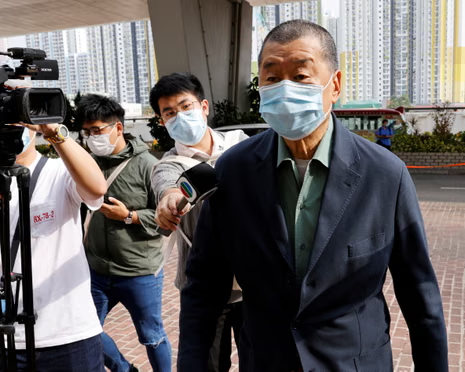
Hong Kong’s judiciary delivered a surprising legal outcome Thursday when an appellate court overturned fraud convictions against Jimmy Lai, the veteran pro-democracy activist and media figure. Lai, 78, has long been a symbol of resistance against Beijing’s influence in Hong Kong and the founder of the now-shuttered Apple Daily, a publication renowned for its outspoken political reporting. The focus keyword, “Jimmy Lai,” emerges immediately as the court ruling has drawn global attention, highlighting the ongoing tension between Hong Kong’s legal institutions and the mainland Chinese government. While this decision marks a rare victory for Lai, he remains imprisoned due to a separate national security conviction that carries a 20-year sentence.
The overturned conviction dates back to a 2022 case alleging that a consultancy firm Lai controlled misused office space leased by his media organisation. Prosecutors claimed Lai and co-defendant Wong Wai-keung concealed the firm’s occupation of the premises, effectively using Apple Daily’s resources as a protective shield. At the time, the lower court found the defendants guilty of two counts of fraud, sentencing Lai to five years and nine months and imposing a HK$2 million fine, roughly $257,000. However, the higher appellate court determined that the prosecution had failed to demonstrate beyond reasonable doubt that Lai had made false representations, resulting in both convictions being dismissed. Neither Lai nor Wong attended the hearing.

Although the overturned fraud conviction may slightly reduce Lai’s cumulative prison time, the effect is limited because his 20-year national security sentence continues. Judges in that separate case allowed only a two-year overlap with the fraud sentence, leaving the remaining 18 years to be served consecutively. This has drawn widespread concern that Lai could spend the remainder of his life in detention. His case has become a focal point for international criticism over Hong Kong’s diminishing press freedoms, with advocacy groups and foreign governments urging the city’s authorities to consider humanitarian measures.
Lai’s children have expressed optimism that former US President Donald Trump, who previously stated intentions to secure their father’s release, might assist during his upcoming visit to Beijing. The White House confirmed that Trump is scheduled to meet Chinese President Xi Jinping from 31 March to 2 April, raising hopes of potential diplomatic interventions. Meanwhile, UK Foreign Secretary Yvette Cooper, emphasising Lai’s British citizenship, condemned the national security sentence as punishment for exercising freedom of expression and urged Hong Kong authorities to release him on humanitarian grounds.
The Hong Kong and Chinese governments, however, defended the sentences, asserting that they reflected the principles of the rule of law and were essential to maintaining the city’s stability. Officials argued that the national security law, under which Lai was sentenced, is necessary to prevent threats to Hong Kong’s governance and social order, despite international criticism. Lai’s case remains the harshest penalty handed down under the law since its implementation, amplifying concerns about its long-term impact on civil liberties.
The implications of Thursday’s appellate decision extend beyond Lai himself, highlighting the complex intersection of Hong Kong’s judiciary, international law, and political freedoms. Legal experts have described the overturning of the fraud conviction as unusually rare in a city where court decisions under politically sensitive cases often align with state interests. Some observers have suggested that this outcome may reflect internal judicial deliberations attempting to maintain procedural integrity while balancing pressure from Beijing.
In a separate yet related case, Hong Kong courts on the same day sentenced Kwok Yin-sang, the father of an overseas pro-democracy activist, to eight months in prison under the national security law. Kwok was found guilty of attempting to access or control his daughter Anna Kwok’s financial assets while she was classified as an absconder under the law. Anna Kwok, based in Washington and a key member of the Hong Kong Democracy Council, is among 34 overseas activists wanted by Hong Kong authorities for national security violations. Her father allegedly tried to withdraw HK$88,609 from an education savings policy he purchased for her when she was two. Acting principal magistrate Cheng Lim-chi ruled that any attempt to manage a fugitive’s assets constitutes an illegal act under the national security law.
Anna Kwok described her father’s prosecution as “utterly despicable,” emphasising the personal toll of Hong Kong’s legal crackdown on families of activists. Her case underscores how the national security legislation has been applied broadly, affecting relatives and supporters of individuals living abroad. Legal analysts argue that such applications of the law have a chilling effect, reinforcing a climate of fear and self-censorship in both local and overseas communities connected to pro-democracy movements.
Jimmy Lai’s broader struggle began more than five years ago, following his arrest under the national security law, part of a sweeping crackdown on Hong Kong’s prominent activists and dissidents. His imprisonment and the closure of Apple Daily have been interpreted globally as evidence of eroding press freedom, sparking protests and condemnation from international human rights organisations. The overturned fraud conviction, while legally significant, does little to mitigate the continuing restrictions on Lai’s liberty or the broader implications for Hong Kong’s independent media sector.
Observers note that the appellate court ruling could provide a minor precedent, demonstrating that Hong Kong’s courts can, in specific circumstances, exercise independent judgment and overturn lower court verdicts. However, the enduring weight of national security penalties means that such victories are limited in practical effect, as political charges often dominate outcomes. The case also exemplifies the tension between procedural justice and politically motivated prosecutions, reflecting the complex landscape activists face in Hong Kong today.

Despite these challenges, Jimmy Lai’s resilience continues to inspire supporters worldwide who advocate for press freedom and democratic rights. His family remains engaged in diplomatic outreach, hoping international attention might yield practical outcomes in reducing his prison term or securing humanitarian relief. Meanwhile, local authorities maintain a firm stance that the legal processes were appropriate and necessary, reinforcing the city’s narrative that national security laws protect public order rather than target freedom of expression.
Thursday’s ruling highlights both the limits and possibilities of legal recourse for those imprisoned under politically sensitive charges in Hong Kong. While the fraud conviction was overturned due to insufficient evidence, the overarching national security sentence remains unchanged, illustrating the stark realities faced by dissenting voices in the city. International observers continue to monitor developments, with particular attention to any diplomatic engagement between foreign governments and China that might influence outcomes for Lai or other high-profile activists.
The duality of these legal outcomes—the rare appellate court victory and the persistent national security sentencing—provides a sobering illustration of Hong Kong’s current judicial and political climate. While the overturning of the fraud conviction is symbolically significant, it does little to alter Lai’s immediate situation, underscoring the challenges faced by pro-democracy figures and their families. His case continues to serve as a litmus test for international scrutiny, offering insight into the complex balance between law, politics, and civil liberties in one of the world’s most closely watched cities.
Ultimately, Jimmy Lai remains a central figure in the global conversation surrounding Hong Kong’s autonomy and freedom of the press. The recent appellate decision marks a rare legal victory, yet it also reinforces the enduring difficulties for activists confronting harsh sentences under sweeping national security legislation. As diplomatic discussions and public advocacy continue, the world watches whether such interventions can mitigate the consequences faced by individuals like Lai and their families.
Related News:
 Trump Plans Venezuela Meeting, Warns of Cartel Land Strikes
 Mandelson apologises over Epstein ties after public scrutiny
 US Senate rejects resolution limiting Trump military powers
 Trump Calls Greenland Critical for US Security After Denmark Talks
 Trump: Iran Killing Has Stopped, Strike Threats Pulled Back
 Machado Trump medal gesture reshapes Venezuela power struggle
 Trump Receives Machado’s Nobel Medal in White House Meeting
 Iran unrest slows under brutal crackdown and global tensions
 Trump Allies Pursue $200m European Gas Pipeline Deal
 US Considers Asylum for British Jews Amid Rising Antisemitism
 Starmer Challenges US Over Controversial Greenland Deal
 Spoof “Make America Go Away” Caps Rally Denmark Over Greenland
 Trump slams UK ‘stupidity’ over Chagos Islands, eyes Greenland takeover
 UK Presses On With Chagos Handover Despite Trump Criticism
 Kim Jong-un Fires Vice-Premier Over Factory Failures
 Shinzo Abe’s killer receives life sentence in Japan
 Starmer Resists Matching Trump Amid Greenland Tensions
 Netanyahu Accepts Trump’s ‘Board of Peace’ Invitation
 South Korean Ex-PM Jailed 23 Years Over Martial Law Role
 Canada Rules Out Free Trade Deal With China Amid US Tensions
 Snow Threatens Japan Election Turnout Amid Extreme Cold
 Keir Starmer meets Xi to strengthen UK-China economic relations
 Crisis Looms as Liberals Debate Sussan Ley Future
 Cambridge Faces Scrutiny Over Arms Investment Transparency
 Files Link Andrew to Epstein Dinner After Prison Release
 Thousands Protest ICE Operations in Nationwide US Day of Action
 Epstein Files Reveal Trump Officials’ Emails with Financier
 Thousands Protest ICE in New York Against Trump Deportation Campaign
 Trump-Petro Meeting Sparks Hopes of Diplomatic Detente
 Epstein UAE Emails Shake British Royal Andrew’s Legacy
 Liberal Fallout: Taylor Challenge Casts Shadow Over Sussan Ley’s Leadership
 Ukraine, Russia Meet in Geneva Ahead of War Anniversary
 Brazilian Politician Brothers Sentenced for Marielle Murder
 Tommy Robinson Meets Trump Officials at US State Department
 HMS Dragon to Head to Cyprus Amid Rising Tensions
 Starmer Praised for Stance on Trump and Iran Conflict
 Yvette Cooper: UK Must Follow Principles, Not US Pressure
 UK Ministers Signal Strategic Independence From Trump Demands
 Florida Governor renames Palm Beach Airport for Donald Trump
 Farage Shuns Truss as US Right-Wing Roadshow Hits London
 European Leaders Slam Hungary Over Alleged Russian Ties
 Starmer Urges Ambitious EU Ties Amid Middle East Conflict
 A Global Voice For Justice: Stephen Lewis Dies At Age 88
 Trump Mocks Starmer and UK Carriers in White House Speech
 Final Countdown as Trump Deadline Looms Over Tehran
 Starmer visits Gulf as US and Iran agree ceasefire
 GOP Senator Criticizes Trump’s Feud With Pope Leo XIV
 Global Oil Prices Surge Amid Renewed Gulf Tensions
 Faith and Power: Catholics React to Trump-Pope Feud
 Timor-Leste Faces Tough Questions Over Resort Proposal
 Security Scrutiny After Washington Shooting Incident
 Aukus Submarine Plan Faces Critical Failures
 UK Envoy Sparks Controversy Over Special Relationship Claims
 US Calls Australia Media Law “Foreign Extortion”
 USS Gerald R Ford Ends Record Naval Deployment
 Activists allege abuse after Gaza flotilla seizure
 Australia pushes Pacific security pact amid China tension
 Indiana Republicans Defy Trump in Key Vote Test
 Middle East Crisis Escalates as Oil Routes Shake Markets
 One Nation Candidate’s Surprising Ties to Independents
 Anika Wells Repays Over £5,000 in Travel Claims
 Tensions Emerge in Netanyahu-Trump Alliance
 California Mayor Resigns Over Foreign Agent Charges
 Liberal Senator Criticises Immigration Rhetoric
 Hanson Stunner: Norway Model Sparking Energy Row
 Tony Abbott Returns as New Liberal Party President
 Tulsi Gabbard exits after turbulent intelligence tenure
 UK Urged to Build EU Rejoin Consensus, Says Miliband
 Zelenskyy warns over Oreshnik threat as Kyiv hit
 Discontent grows around Putin amid war strain
 Former ICC prosecutor condemns US sanctions
 Trump Weighs Retreat from Controversial $1.8bn Slush Fund
 Iran Prepares for Massive Six-Day Funeral for Khamenei
 Trump’s Mount Rushmore Speech: A Divisive Anniversary
 Iran Mourns: Millions at Khamenei’s Final Procession
 Starmer Braces for Nato Spending Clash in Ankara
 Trump Swaps Planes Amid Iran Tensions
 House Democrats Divided Over Israel Military Funding Bid
 Houthis Strike Saudi Arabia as Middle East Tensions Rise
 Taliban global ties grow as rights fears mount