Published: 09 October 2025. The English Chronicle Desk. The English Chronicle Online.
British scientist Professor Richard Robson has been awarded the Nobel Prize in Chemistry for inventing a material that behaves much like Hermione Granger’s seemingly bottomless handbag in the Harry Potter series.
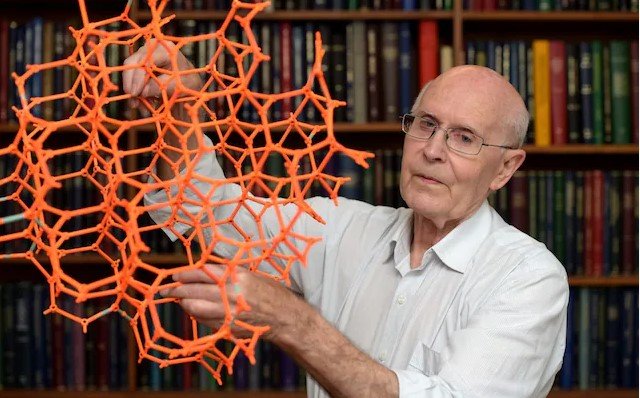
Robson, 88, from Glusburn, West Yorkshire, discovered that combining metal atoms with carbon-based molecules could produce structures known as metal-organic frameworks, or MOFs, which possess enormous internal surface areas. A sugar cube-sized MOF, for instance, can have a surface area equivalent to a football pitch.

In the Harry Potter stories by J.K. Rowling, Hermione’s handbag, played by Emma Watson in the films, can hold an endless number of objects, from clothes and books to camping gear, despite its ordinary size. Robson’s MOFs, while scientific, mirror that principle: storing large amounts in a compact volume.
Dr Anette Doherty, president of the Royal Society of Chemistry, praised the discovery, noting that MOFs have “fantastic potential in a range of applications – from gas storage and separation to targeted drug delivery and even removing pollution from the environment.”
Heiner Linke, chairman of the Nobel Committee for Chemistry, explained how MOFs work: “A small amount of such material can be almost like Hermione’s handbag in Harry Potter. It can store huge amounts of gas in a tiny volume. The possibilities for these materials are nearly limitless, offering enormous benefits for humanity.”
Already, MOFs are being applied in everyday life. They are used to extend the shelf life of fruit by absorbing ethylene gas, which accelerates ripening. Other applications include locking away carbon dioxide, harvesting clean water from arid environments, and filtering toxic chemicals.
Professor Robson, elected a Fellow of the Royal Society in 2022, graduated from Oxford University before moving to the University of Melbourne in Australia. While he shares the Nobel with Susumu Kitagawa of Japan and Omar M Yaghi of the United States, Robson is credited with pioneering the foundational work in the 1980s. He demonstrated that copper ions could be linked with organic molecules to form solid crystals containing micro-cavities, the first demonstration of atoms assembled beyond a closed solid state.

Dr David Pugh, lecturer in inorganic chemistry at King’s College London, highlighted the environmental and practical applications: “MOFs were quickly identified as materials capable of storing large amounts of gases like carbon dioxide, which has obvious benefits for carbon capture. They also help control the ripening process of fresh produce, reducing food wastage during transit. This versatility is only the beginning; MOFs will continue to find new uses in the years ahead.”
Professor Sheila Rowan, physical secretary and vice-president of the Royal Society, added: “I warmly welcome the news that two Fellows of the Royal Society, Professor Susumu Kitagawa and Professor Richard Robson, have been awarded today’s Nobel Prize in Chemistry alongside Omar M Yaghi. Their research into metal-organic frameworks is enabling scientists to address some of the world’s toughest challenges, from harvesting clean water to capturing carbon dioxide and catalysing low-energy chemical reactions. They have laid the foundations for one of the fastest-growing areas of modern chemistry research.”
The recognition of Robson and his colleagues underscores the far-reaching potential of MOFs, bridging fundamental scientific discovery with practical applications that could shape environmental and technological advances for decades to come.
Related News:
 Market Jitters Send Stocks Lower as Trade Tensions and Earnings Anxiety Weigh on Investors
 Oxford Shatters Records with State School Admissions in Historic Move Towards Educational Equity
 Birmingham City’s Premier League Ambition Ignites: A 150th Anniversary Marked by Vision, Investment, and a Relentless Promotion Push
 Private Parking Under Pressure: Transparency Demands Mount Amid Soaring Ticket Appeals and Rising Fines
 Global Trade Earthquake: Trump Slaps 35% Tariff on Canada and Expands Tariff Blitz to Over 90 Nations
 100 children from Gaza seek evacuation to the UK for critical medical treatment
 Putin Considers Temporary Suspension of Air Strikes on Ukraine Amid Pressure from Trump Administration
 Going Loco: Major UK Rail Line Faces Two-Week Shutdown Amid Critical Upgrade Works
 Tariff Tempest: India Rebukes Trump’s ‘Unfair’ Oil Sanctions as Diplomatic Tensions Mount
 Tough Call, Softer Blow: Bank of England Cuts Interest Rates to 4% Amid Economic Crosswinds
 Minute’s Silence for Diogo Jota Abruptly Ended After Wembley Tribute Disrupted
 Women’s Rights Groups Warn Far-Right Is Exploiting Women’s Safety for Political Gain
 Britain Invests £118 Million in New Air Defence Missiles Amid Rising Threats
 Anglo American to Merge with Teck in $53bn Mining Deal
 Cardi B Announces Pregnancy with NFL Star Stefon Diggs Amid Personal Triumphs
 Putin, Gaza, Tariffs and Mandelson: Key Insights from Trump-Starmer Press Conference
 Kimmel Stands Firm Against Trump Amid Free Speech Storm
 Sir Sadiq Khan Accuses Trump of Racism and Islamophobia Following UN Remarks
 Brentford Punish United’s Inconsistencies as Amorim’s Struggles Deepen
 Scottish Government Mandates Single-Sex Toilets and Changing Facilities in Schools
 Conservatives Plan Controversial Immigration Taskforce Inspired by US ICE
 De Bruyne Brace Crushes Wales’ World Cup Qualification Hopes
 NHS Health Checks to Include Menopause Questions
 Rachel Reeves Faces Pressure to Break Tax Pledge in Budget
 Woman Denied £3,800 Disability Benefit Over Bra Trick
 Sturgeon’s Government Accused of Misleading Firms on Green Scheme
 Britain’s Waterways at Risk Amid Climate Funding Crisis
 UK Could See Snow Next Week as Temperatures Set to Plummet