Published: 17 December 2025. The English Chronicle Desk. The English Chronicle Online.
The UK government has announced it will bring forward its review of electric vehicle sales targets from 2027 to next year, responding to ongoing concerns from the automotive industry. Ministers stressed that this adjustment would not weaken the existing commitment to ban the sale of new petrol and diesel vehicles from 2035, despite recent EU decisions to delay the full phaseout of combustion engine cars. The accelerated review aims to assess the feasibility of zero-emission vehicle mandates while ensuring industry compliance and economic sustainability.

The zero-emission vehicle (ZEV) mandate requires carmakers to sell an increasing proportion of electric vehicles annually, with penalties for non-compliance. Earlier this year, the government introduced “flexibilities” to support manufacturers, allowing additional credits for hybrid vehicle sales to address concerns that the original targets were economically challenging. Industry Minister Chris McDonald confirmed that the review will start next year, emphasising the government’s commitment to balancing market realities with environmental objectives.
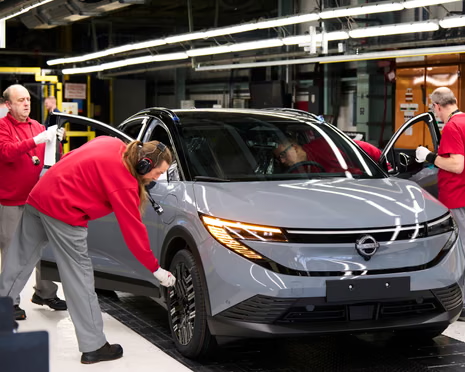
McDonald visited Nissan’s Sunderland factory, highlighting the launch of the third-generation Leaf, a milestone in the UK’s transition to electric vehicles. The Leaf was the first mass-market battery electric car produced domestically, and over 280,000 units have already been manufactured at the north-east England plant, the country’s largest car factory. The new model underscores the increasing investment and technological development in UK electric car production, which has become central to meeting future sustainability targets.
Sales of electric cars have accelerated rapidly in recent years, accounting for more than a fifth of the UK market by July. However, demand predictions initially overestimated consumer uptake, forcing manufacturers to reduce prices to attract buyers. The upcoming review is intended to consider such market fluctuations, ensuring that the ZEV mandate remains practical while driving continued adoption of electric vehicles across the country.
The EU recently announced it will no longer require 100% of cars and vans produced to be zero-emission from 2035. Following pressure from industry leaders in Germany, Italy, and other member states, the European Commission revised the rule to 90%, permitting a 10% allowance for plug-in hybrids or combustion engine vehicles. EU regulations also include a requirement for manufacturers to offset emissions through alternative green measures, such as using European green steel or biofuels for non-electric vehicles.
UK officials emphasised that while the EU adjustment provides flexibility abroad, the domestic commitment to the 2035 petrol and diesel ban remains unchanged. Policymakers hope that the early review will provide clarity to manufacturers and consumers alike, supporting the country’s transition to a low-emission automotive sector. The government also noted that the ZEV mandate plays a vital role in incentivising innovation, increasing investment in green technology, and ensuring the UK remains competitive in the rapidly evolving global electric vehicle market.
The accelerated review highlights the government’s approach to balancing environmental priorities with practical industry needs. Analysts suggest that reviewing targets sooner will provide a clearer roadmap for production planning, consumer incentives, and infrastructure development, including charging networks and supply chain adaptation. Industry representatives welcomed the move, noting that it demonstrates a collaborative approach to achieving zero-emission objectives while maintaining economic stability.

Carmakers have increasingly embraced electrification, driven by both policy pressures and consumer demand. The Sunderland factory’s continued expansion of electric vehicle production reflects wider trends across the UK, where manufacturers are investing heavily in battery technology, assembly facilities, and workforce training to meet anticipated growth in electric car adoption. Experts predict that with the early review, the government can better align regulatory targets with market realities, ensuring a smoother transition toward sustainable transportation.
By moving the review forward, the UK aims to provide clarity for the next generation of electric vehicles and reassure both domestic and international manufacturers. Officials expect that this proactive approach will strengthen confidence in the sector, increase investment in green technology, and help the country maintain its competitive edge in the global automotive industry while achieving ambitious climate commitments.