Published: 19 December 2025. The English Chronicle Desk. The English Chronicle Online.
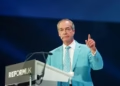
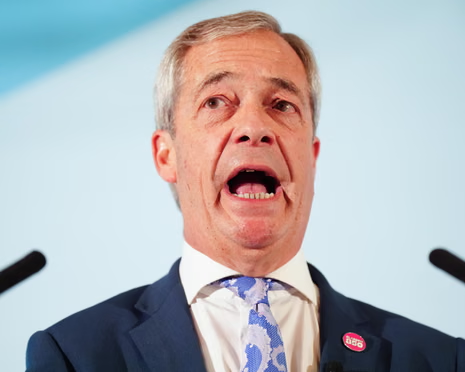
In a development that has captured the attention of political commentators and party supporters alike, Nigel Farage will not face a police investigation over claims that his campaign breached electoral law during the 2024 general election in Clacton. Essex Police confirmed this week that any potential investigation is now barred by the statutory one-year time limit for commencing prosecutions under the Representation of the People Act 1983, effectively closing the door on criminal scrutiny of the alleged overspend.

The allegations, which first emerged in reports from both national media and former members of the Reform UK campaign team, centred on claims that Mr Farage and his campaign may have exceeded the £20,660 legal spending limit imposed on candidates. These claims were brought forward by Richard Everett, a former Reform councillor and one-time member of the campaign, who submitted documents to the Metropolitan Police suggesting that certain items of expenditure may have been misreported.
According to the complaint, spending on campaign leaflets, banners, utility bills and even the refurbishment of a campaign office bar in Clacton were either not declared properly or were reported in a manner that misclassified them as national party expenditure. If such spending had been correctly accounted for as local campaign costs, it could have pushed the total above the legal limit. However, as Essex Police noted, the report was made too late for any legal action to be taken under current electoral law.
The Enforcement Act sets a firm one-year deadline for initiating prosecutions of this nature, and with the alleged offences occurring in July 2024 and the complaint being lodged in December 2025, the statutory period had already expired. The police statement made clear that this limitation on prosecutions prevented any further investigation into the claims.
Reform UK has consistently denied that it broke any electoral law throughout the campaign. Party spokespeople described the accusations as inaccurate and politically motivated, suggesting that the complaints came from a disgruntled former member who was no longer aligned with the party. They maintained that all spending was reported appropriately, and that the campaign operated within the legal framework set out by electoral regulations.
While the police decision not to pursue a probe may bring relief to Farage and his supporters, the matter has not entirely dissipated. The Electoral Commission, a separate regulatory body responsible for overseeing party and campaign finances, has indicated that it is reviewing correspondence and information relating to the wider context of Reform UK’s spending declarations. Labour Party chair Anna Turley had written to the Commission, urging them to consider whether there were any failures to comply with relevant rules, particularly around how national and local spending were categorised.
Turley’s intervention underscores a broader concern within the opposition that there may be discrepancies in how expenditure was reported. She publicly called on Mr Farage to address these questions directly, emphasising the importance of transparency and accountability in electoral practices. The Labour Party’s call for clarity reflects a growing political debate about campaign finance and the integrity of spending limits.
Experts in political finance have also weighed in, noting the distinction between local campaign spending, which falls under police jurisdiction, and national party expenditure, which the Commission regulates. This division has added complexity to determining whether any regulatory breaches occurred and who should be responsible for enforcing the rules. In this particular instance, it was the police who declined to investigate due to the timing of the report, not because of any determination on the merits of the allegations.
The controversy first gained traction last week, when a series of reports suggested that police forces were considering whether to assess the allegations that Reform UK had misreported expenses in Clacton. Early accounts described how the Metropolitan Police initially received the complaint, later transferring it to Essex Police due to jurisdictional considerations. At that time, media outlets indicated that both local and national authorities were assessing the situation, although nothing had yet been concluded.
This sequence of scrutiny came against the backdrop of other challenges facing Mr Farage. Beyond questions about spending, he has recently been the subject of criticism over comments and allegations related to his past conduct, which other public figures and former school peers have raised. Reform UK dismissed these attacks as part of a broader attempt to undermine their party’s positions and policies rather than engage with substantive political debate.

Despite these wider controversies, the electoral spending issue ultimately hitting a procedural wall has sparked debate among political observers about the effectiveness of current legal frameworks. Some argue that the one-year limitation may hinder accountability for genuine breaches, calling for reforms that allow for more flexible investigation periods in complex cases. Others counter that fixed limitations are necessary to provide certainty and prevent indefinite exposure to legal risk for political actors.
The Electoral Commission’s ongoing review means that, while police action is off the table, questions about financial reporting and compliance could still surface in another forum. Should the Commission find evidence of regulatory non-compliance, it could impose sanctions or require further corrective measures, though such outcomes are distinct from criminal prosecution. Observers note that how the Commission proceeds will be closely watched as a test of regulatory oversight in political finance.
For now, Nigel Farage remains clear of police investigation over the disputed spending, but the political and regulatory conversation continues. Supporters of the Reform UK leader see the matter as settled and an affirmation that the legal system functions as intended, while critics suggest that unanswered questions remain about transparency, reporting practices and the broader integrity of electoral processes.
Related News:
 King Charles Pledges to Defend Europe Against Russia
 Treasury Opens Inquiry into Autumn Budget Leak Claims
 Families to Receive Support to Exit Temporary Accommodation
 Labour MP’s Biscuit Debt Video Surges Past 3.3m Views
 UK Ends Haven Status for Dirty Money in Bold New Crackdown
 UK Asylum Crackdown Fuels Deaths and Violence
 Prince Harry’s Security Faces UK Review
 Farage Urged to Come Clean on Clacton Spending
 Reform campaign in Clacton faced ‘juggernaut’ scrutiny, say rivals
 Starmer Calls for Modern ECHR Curb to Counter Europe’s Populist Surge
 Youth Strategy Aims to End Decades of Political ‘Indifference’
 UK Borrowing Costs May Ease as Markets Gain Confidence
 Asylum Overhaul Could Worsen Homelessness, Whitehall Warns
 Javid Claims Johnson Was Cummings’ Puppet Before Resignation
 Conservatives Pledge to Scrap 2030 Petrol and Diesel Car Ban
 Ministers to back regulation of England’s funeral industry
 Starmer’s communications chief to outline media strategy overhaul
 Minister Rejects Claims of Abuse Against Hunger Strikers