Published: 26 February 2026. The English Chronicle Desk. The English Chronicle Online.
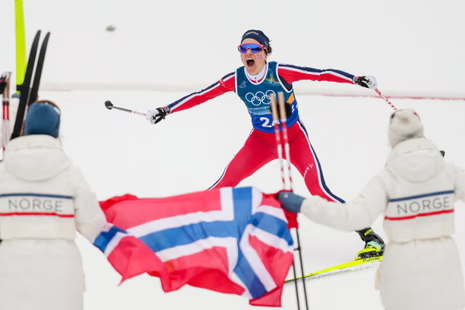
Norway has once again proven that its unique sports system is the most successful in the modern world. The small nation recently stormed the majestic mountains of Milano Cortina to claim an incredible eighteen gold medals. This tiny population of five million people consistently outperforms global superpowers on the ice and the snow. Their victory at the Winter Olympics was not just a lucky streak but a result of planning. Many people wonder how they achieve such dominance while maintaining a focus on the joy of sport. Their athletes left the competition wondering how such a small country regularly tops the prestigious medal table. This success is not limited to the winter months as they also performed well in Paris 2024. However, focusing only on the medals misses the most important part of their sustainable and healthy system.
The core of their success lies in a national youth strategy called the Joy of Sport. This philosophy ensures that no child participates in competitive league sports before they reach age twelve. This approach is the complete opposite of the intense talent identification schemes used in the United Kingdom. In Britain, young children are often pushed into mini-leagues and rigid pathways from a very early age. These systems often lead to anxious discussions about rankings and devastating losses for very young children. Instead of pressure, the Norwegian model focuses on building a foundation of fun and social connection. They believe that children should stay active with their friends without the fear of being judged. This lack of pressure actually helps them develop more resilient and capable athletes in the long run.

The Norwegian sports system is designed to keep as many children playing for as long as possible. They do not believe in telling a five-year-old that they must suffer to succeed in life. Instead, they give trophies to every child who participates to celebrate their effort and their personal growth. This idea is often ridiculed in other countries as being too soft or not like real life. Yet, the results speak for themselves when you look at the final Olympic medal standings this year. The mighty Norwegians prove that giving everyone a trophy does not stop them from becoming elite champions. They play the long game by ensuring that children actually enjoy their time on the field or slopes. This creates a culture where sports are a natural part of daily life for every single citizen.
Johannes Høsflot Klæbo is a perfect example of how this relaxed approach creates world-class legendary performers. He won six gold medals at the recent games and now holds eleven Olympic titles in his career. Interestingly, he did not enter a formal performance system until he was fifteen years old as a teen. Before that, he simply enjoyed a wide range of different sports and activities with his many friends. In the UK, we often grant godlike status to athletes who achieve far less than this man. The Norwegian system avoids the damaging practice of separating children into winners and losers at a young age. This prevents the trauma that often causes young people to drop out of sports entirely before adulthood. By keeping it inclusive, they ensure that late bloomers have the same opportunities as early developers.
The statistics regarding physical activity in Norway are truly impressive compared to those in the United Kingdom. Reports show that ninety percent of Norwegian children are active, which is a remarkably high national figure. Even as they reach their teenage years, over seventy percent of them continue to stay very active. In contrast, fewer than half of British children get the recommended amount of daily exercise each week. Research indicates that the biggest reason children quit sports is because the experience stops being fun. The Norwegian director of elite sport often asks why other countries focus on getting rid of kids. He believes the biggest motivation for any child is simply to have fun with their friends nearby. This simple realization is the foundation of their entire national approach to health and elite performance.
Schools in Norway have dedicated winter ski days where everyone participates regardless of their current skill level. Families also spend their weekends skiing together, making physical activity a shared and joyful social experience. This culture avoids the intense pressure found in British academies where selection decisions can feel like life. The Norwegian approach allows for more play and creativity during the most critical years of child development. Children have more time to develop a wide range of movements and better overall physical coordination. By being less competitive early on, they actually learn the technical skills of sport much more effectively. It is a paradox that being less serious at the start leads to more serious global success. This common-sense method prioritizes human flourishing over the traditional idea of suffering for a distant goal.

A Norwegian friend living in London recently shared how the press back home celebrated the latest medals. While they love the gold, they also realize that youth sport should never be a grim business. Our obsession with elite pyramids and pathways often misleads us and creates a deep divide in society. We have separated the idea of sport for fun from the idea of serious competitive sport. This is a false choice that many Norwegian coaches and leaders work hard to undo every day. Every coach should see it as their duty to ensure that children want to return next week. If we help every child to love sport, we will naturally produce better and healthier athletes. The Joy of Sport is not just a slogan but a proven roadmap for national success.
The simplicity of their system liberates coaches from the old tropes that still haunt many British clubs. We need to design a new strategy that focuses on the long-term health of every single child. Coaching courses should teach how to create environments where every participant feels valued and very happy. This is the ultimate win-win situation for any nation that wants to improve its overall public health. We can look to the mountains of Norway for inspiration on how to fix our own system. Their athletes have shown us that the path to the top is paved with genuine happiness. By embracing the Joy of Sport, we can transform the lives of millions of young people today. Let us dream of a future where every child finds a lifelong love for being active.
Related News:
 Sarr Double Sinks Young Liverpool in Carabao Cup
 Nwaneri and Saka Secure Arsenal Win Over Brighton
 Salah & Gravenberch Lead Liverpool to Win Against Villa
 Dyche Criticises Corner Decision as Forest Draw with United
 Caicedo Shines as Chelsea Edge Spurs in Chaotic Derby
 Granit Xhaka Rescue Earns Everton Draw at Sunderland
 Burn and Joelinton Head Newcastle to Victory Over Bilbao
 Foden shines as Man City dismantle Dortmund in dominant display
 Tension and Turmoil at Aston Villa v Maccabi Match
 Bellingham has ‘the edge’ among England No 10s
 Man City Masterclass on Guardiola’s Milestone Day Exposes Liverpool Woes
 Lando Norris Dominates Brazil GP to Strengthen F1 Title Bid
 England cannot afford to be in awe of the All Blacks, warns Jamie George
 VAR Must Rein Its Neck In to Save Football’s Spirit
 Trescothick Hints Pope Will Keep Number Three Spot
 Ronaldo Confirms Final World Cup and Plans Retirement
 Mary Earps’s Manchester United Return Faces Mixed Reception
 Sam Kerr Stars in Chelsea Return with Champions League Double
 This kid is something else: Alex Scott’s rise to England call-up
 UK and Ireland Announce Venues for Euro 2028 Tournament
 Saka Solidifies Role as Tuchel’s Key England Lieutenant
 Former Lion Heskey Warns of Shortage of England Strikers
 Australia Mourns Paralympic Champion Paige Greco
 Irish Hero Parrott Says Goal Brought First Tears in Years
 Nigeria Misses World Cup Again After Play-Off Loss
 From heartbreak to glory: Scotland’s dramatic return to the World Cup
 Tiny Curacao Makes History as Smallest Nation to Reach World Cup
 Haiti Qualifies for World Cup Despite Coach Never Visiting Country
 Major League Baseball Scores New Broadcast Deals Through 2028
 Barcelona Returns to Camp Nou vs Athletic Bilbao
 Moyes Defends Gueye After Dramatic Everton Bust-Up
 Kids Football Coach Removed Over Suspected ‘Drugs Menu’
 Mbappe Scores 4 as Real Madrid Edge Olympiakos
 Man City Lose, Champions League Risk
 Jac Morgan to Miss Six Nations Start After Surgery
 Alexander Isak ends drought as Liverpool stop rot with win at West Ham
 Mbappe rescues Real Madrid with a penalty at Girona
 Barcelona, Atletico set for decisive La Liga showdown
 Maxwell withdraws from IPL 2026 after 13 seasons
 Mbappe stars as Real Madrid thrash Athletic, close on Barca
 Australia Face Big Changes as Cummins and Lyon Ruled Out of Ashes
 Van de Ven Tackle Leaves Isak with Fractured Leg
 City Set to Land Semenyo After Chelsea Exit from Transfer Race
 Arrizabalaga Sends Arsenal Through in Dramatic Shootout
 Ashes Shock: Boland Admits Struggle Bowling With Keeper Up
 ECB powerless to halt England’s recurring Ashes failures
 Stokes urges empathy for England players amid Ashes struggles
 Damien Martyn in Induced Coma After Meningitis Diagnosis
 Spin Bowling Struggles as Pace Dominates 2025 Ashes Series
 Anthony Joshua Released After Nigeria Car Crash
 Chelsea Sack Looms: Enzo Maresca Relationship Collapses
 Africa’s Superpowers Shine in Cup of Nations Quarter-Finals
 Amorim’s United Future Uncertain Amid Wilcox Tension
 Raducanu Battles Injury as Britain Exit United Cup
 Australia Dominates England: Smith, Head Crush Bowlers in Sydney
 Australian Open Prize Money Hits Record $111.5m
 Nick Kyrgios Faces Singles Struggles at Brisbane Tennis Return
 Nottingham Forest Deny West Ham in Dramatic Late Win
 Manchester United Fan Group Targets Jim Ratcliffe Over Club Chaos
 Morocco sail into Afcon semis after Díaz inspires win
 Wrexham stun Nottingham Forest with Okonkwo FA Cup heroics
 Salah Shines as Egypt Knock Out Ivory Coast at Afcon
 Israeli fans ban questioned after Dutch police dispute evidence
 Semenyo Shines for City – Winners and Losers of Transfer
 Geopolitical football: Iran, Trump and the World Cup clash
 Regragui condemns Afcon final chaos after dramatic defeat
 Brahim Díaz’s Panenka Fail Highlights Penalty Risks
 Madison Keys’ Australian Open defence tested as Ukrainian debutant dazzles
 ‘A long time coming’: US table tennis finds its moment
 Mbappé’s Late Penalty Lifts Real Past Nine-Man Rayo
 Women’s FA Cup Could Introduce Seeded Teams from Last 32
 Yamal and Rashford Shine as Barcelona Reach Copa Semis
 Newcastle fans face bleak reality under Saudi ambitions
 ‘Scrutiny and Pressure on Irish Has Reached New Level’ — Rugby Faces Brutal Spotlight After France Defeat
 Hugo Ekitike Becomes Liverpool’s New Cult Hero
 ‘We’re like a family here’: Habib Diarra thrives at Sunderland
 Infantino Faces Russia Threat and Trump Concerns at Uefa Congress
 Hilary Knight speaks out on Trump’s recent hockey remarks
 Champions League Thrills as Atalanta and Galatasaray Advance
 English Cricket Faces Moral Crisis Over Indian Investment