Published: 30 March 2026. The English Chronicle Desk. The English Chronicle Online.
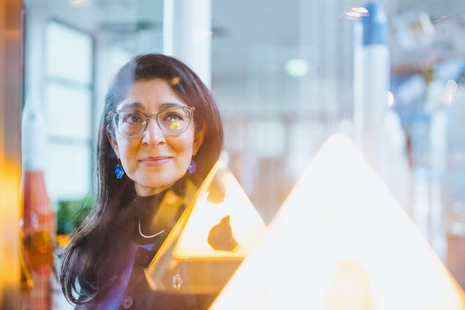
The vast silence of outer space holds many secrets and some dangers for our planet. One woman in Vienna stands ready to alert the world if a disaster ever approaches us. Aarti Holla-Maini is a British lawyer who now leads a very specialized United Nations department. Her office sits inside a grey concrete tower located right next to the beautiful Danube River. She serves as the director for the UN Office for Outer Space Affairs, known as Unoosa. This small team handles the massive responsibility of tracking objects that might collide with the Earth. Holla-Maini has spent years training for a moment that most people only see in movies. She has run many complex simulations to prepare for a potential strike from a large asteroid. The process involves precise steps to ensure that every global government receives a timely warning. If a threat is confirmed, she must immediately notify the UN Secretary General about the risk. The message then travels to nearly two hundred member states across every corner of the globe. This role is often quiet, but recently it became a source of intense real-world pressure.
Just over one year ago, the theoretical drills suddenly transformed into a very serious reality. A colleague approached Holla-Maini between her busy travel schedule to deliver some startling news today. They had detected a real object in space that required the team’s full, immediate attention. This was not a practice run or a table-top exercise for the dedicated Vienna staff. On 27 December 2024, a robotic telescope in Chile spotted a rock moving through space. Scientists first estimated the size of this object to be around that of a building. It is common for telescopes to find small rocks, but this one was behaving differently. Experts began tracking its path to calculate the exact probability of an impact with Earth. The news of the discovery started to spread through the scientific community and the public. At first, the chance of a collision was rated at less than one percent total. However, the data changed as more observatories began to follow the journey of the rock. The asteroid received the name 2024 YR4 as it continued its silent flight toward us.

The threat grew more serious as the impact probability climbed over the next three weeks. Calculations suggested a growing chance that the rock could strike the Earth in late 2032. This triggered the first global notification from Unoosa since the planetary defense program began in 2013. Even a small percentage chance is taken seriously when the potential damage is so high. The energy released by such an impact could equal hundreds of Hiroshima-sized atomic bomb blasts. Such an event could easily destroy an entire city or a very large geographical region. Romana Kofler, a dedicated programme officer at the agency, stayed up late to monitor data. She is the primary contact for planetary defense and even has an asteroid named after her. Kofler worked closely with the International Asteroid Warning Network to verify all the incoming figures. This body includes experts from NASA and the European Space Agency who track distant rocks. The team felt the adrenaline kick in as they realized the situation was truly happening. They drafted a formal letter to send to António Guterres at the United Nations headquarters. This was the first real-time test of how the international community would respond to danger.
The history of space impacts shows us that these threats are not just science fiction. In 2013, a meteor exploded over the city of Chelyabinsk in the nation of Russia. That rock was only twenty metres wide but it caused a massive amount of damage. The resulting shock wave shattered windows and injured over one thousand people in the area. It glowed brighter than the sun and caused skin burns to those standing nearby today. This event proved that even smaller rocks can cause significant harm without any advanced warning. The asteroid 2024 YR4 became the most significant threat seen in over twenty years of searching. It was briefly rated at a level three on the famous Torino Impact Hazard Scale. This scale measures the risk of a collision from zero up to a level ten. A level ten rating would mean a certain collision that threatens our entire modern civilization. The detection of this rock activated a group tasked with finding ways to save Earth. One method involves hitting an asteroid with a spacecraft to knock it off its course. NASA successfully tested this technique during the Dart mission which took place back in 2022.
Despite these high-stakes moments, the daily life at Unoosa is often focused on bureaucracy. The office is relatively small with only thirty-five employees working in the quiet Vienna complex. It was founded in the late 1950s at the very start of the space age. The UN wanted to ensure that political rivalries on Earth did not move into space. Today, the agency manages a huge workload as more countries and private companies launch rockets. Holla-Maini moved from the private commercial sector to this sprawling international government organization recently. She spends much of her time traveling to global conferences to discuss new space regulations. The agency runs a program called Space for All to help smaller nations join orbit. They also provide satellite imagery to countries that are dealing with sudden, natural disasters today. One of their most critical jobs is keeping a register of every satellite in orbit. There are now over ten thousand satellites circling the planet with many more planned soon. This makes the area nearest to Earth a very crowded and dangerous zone for traffic.
The agency now acts as a vital hotline to prevent collisions between different national satellites. This task becomes very difficult when the nations involved do not have any diplomatic relations. Holla-Maini remembers a tense weekend last June involving a satellite from the nation of Malaysia. It was on a collision path with a satellite belonging to the state of North Korea. The two objects were only seventy-five metres apart which is considered a very close call. The team had no direct way to call officials in the city of Pyongyang. They sent information to every known email address even though they expected no direct reply. Suddenly, the North Korean satellite moved out of the way without any formal verbal exchange. This successful outcome showed how important the informal communication channels of the UN remain today. Whether stopping a satellite crash or an asteroid strike, the team works very hard now. Holla-Maini says the small budget forces her office to be extremely efficient and focused. The recent scare with asteroid 2024 YR4 was a perfect test for their notification systems. The probability of an impact has since dropped to a level that is now negligible.
Related News:
 Indonesia blocks Grok chatbot over sexual content risk
 Virgin Trains Moves Closer to Challenging Eurostar Monopoly
 UK Bans Fake Numbers: Scammers Lose Their Trick
 Vibe coding’ named Collins dictionary’s word of the year
 Patients to Test Health at Home to Ease NHS Winter Pressure
 Britain deploys RAF specialists to assist Belgium with drone threats
 Stop using ChatGPT to write speeches, AI minister tells MPs
 Northern Lights may illuminate UK skies this week
 New laws to bolster UK’s defences against cyber attacks on NHS, transport and energy
 Hitler’s DNA Confirms He Truly Had Only One Testicle
 Working-Class Men with Prostate Cancer Left Behind by NHS
 New AI tool could cut wasted efforts in organ transplants
 How Cultures Interpreted the Aurora Through History
 Sundar Pichai Cautions on AI Hype and Market Risks
 Google Chief Urges Caution: Don’t Trust AI Blindly
 US Judge Says Meta Did Not Hold Illegal Social Media Monopoly
 Healthy Habits in Your 30s That Boost Life in Your 70s
 Coffins Now Too Large to Cremate Amid Rising Obesity Crisis
 AI Actress Creator Says Tilly Norwood Won’t Replace Actors
 Capitol Attack Anniversary Sparks Deep Political Divide
 Saudi Officials Report Zubaidi Flee Before Yemen Peace Talks
 AI Grok Sparks Child Safety Alarm in the UK
 UK Targets in New York Bomb Threat Hoax: Man Jailed
 Gambia Supreme Court Hears Case to Overturn FGM Ban
 Google Removes Some AI Health Summaries Over Safety Concerns
 Trump targets Iran trade with 25% tariff warning
 US Clears Nvidia AI Chip Sales to China in Policy Shift
 Amazon Milton Keynes closure sparks concern for UK warehouse workforce
 US Senate rejects resolution limiting Trump military powers
 Gulf states warn Trump Iran strikes risk wider Middle East war
 Machado Trump medal gesture reshapes Venezuela power struggle
 Greenland defence seen as shared Nato duty amid troop arrivals
 Geopolitical football: Iran, Trump and the World Cup clash
 Canada-China trade gains momentum in new strategic partnership
 Trump Receives Machado’s Nobel Medal in White House Meeting
 Astronomers Prepare for First-Ever Movie of a Black Hole
 Syria President Declares Victory as Ceasefire Reached with SDF
 US Considers Asylum for British Jews Amid Rising Antisemitism
 MPs warn AI financial risks threaten UK stability
 MPs warn AI financial risks threaten UK stability
 Trump slams UK ‘stupidity’ over Chagos Islands, eyes Greenland takeover
 Shinzo Abe’s killer receives life sentence in Japan
 China General Under Investigation Amid Leadership Purge
 Philippines ferry disaster leaves 15 dead, dozens missing
 Pornhub blocks new UK users over age checks dispute
 Amazon mistakenly signals new global layoffs to employees
 AI breast screening cuts later cancer diagnoses by 12%, study finds
 UK Launches First Rapid-Charging Battery Train This Weekend
 UK New Car Discounts Near £6,000 as Prices Are Slashed
 Cambridge Faces Scrutiny Over Arms Investment Transparency
 Most Statin Side-Effects Are Not Caused by Drugs, Study Confirms
 Epstein UAE Emails Shake British Royal Andrew’s Legacy
 Christchurch gunman seeks to vacate guilty plea
 BT Names New Openreach Chief Amid Major Fibre Expansion
 Infantino Faces Russia Threat and Trump Concerns at Uefa Congress
 AI fears hit UK wealth and comparison sites
 Tech Trends Set to Transform Life in 2026
 Concerns rise for Canberra boy amid Iran detention fears
 Indian University Kicked Out of AI Summit for Claiming Chinese Robot Dog as Its Own Invention
 Caribbean Leaders Urge Dialogue Amid US Oil Embargo on Cuba
 How Ancient Scottish Rocks Challenge ‘Snowball Earth’ Theory
 Ayahuasca Psychedelic DMT Shows Potential as Depression Therapy
 Stewart Brand on Musk, Bezos and a Life of Long Thinking
 Facial Recognition Error Leads to Wrongful Arrest in Milton Keynes
 Social Media Trial: Woman Says Addiction Began at Six
 Ukraine Sends Drone Experts to Defend US Bases in Jordan
 Revealed: UK AI Push Faces Phantom Investment Claims
 Ministers Urged to Act Faster on Deepfakes Threat
 Abramovich Chelsea Sale Cash Faces Jersey Probe
 Tesla Enters British Energy Market Following Ofgem Approval
 Social Media Giant Trial Reaches Final Jury Decision
 Yvette Cooper: UK Must Follow Principles, Not US Pressure
 Cern Prepares First-Ever Antimatter Transport Test
 The Molten Mystery of L98-59d: A New Class of Liquid Planet
 Slovenia Election: A Nation at a Crossroads
 Jury Rules Meta and YouTube Liable for Addictive Design
 House of Lords Backs Landmark Social Media Ban for Youth
 Charity Watchdog Warns Alan Turing Institute Over Conduct
 Saudi Arabia Urging US to Keep Up Iran Attacks
 Trump Softens Cuba Oil Stance as Russian Tanker Nears