Published: 24 January 2026. The English Chronicle Desk. The English Chronicle Online
For decades in the United States, table tennis has existed in a strange cultural limbo. It is one of the most widely played recreational sports in the country, found in schools, community centres, offices and basements, yet it has long struggled to be taken seriously as a professional or cultural force. Often dismissed as little more than a casual pastime, the sport has rarely enjoyed sustained mainstream attention. That perception is now shifting, driven by an unlikely combination of cinema, social media and a new generation of players.
The release of Marty Supreme, a critically acclaimed biopic inspired by the life and myth of postwar American table tennis champion Marty Reisman, has coincided with a surge of interest across the sport. The film, steeped in obsession and intensity, has pushed ping-pong into the pop-culture conversation at a moment when professional competition and grassroots participation in the US were already quietly gaining momentum.
Across the country, table tennis clubs report a noticeable rise in new members, while professional matches are drawing larger crowds than ever before. Major League Table Tennis (MLTT), founded in 2023 as the first professional table tennis league in the US, recently recorded its highest regular-season ticket sales to date. League founder Flint Lane has acknowledged that the timing of the film’s release has played a role in this renewed enthusiasm.

At the grassroots level, businesses built around the sport are seeing tangible growth. David Silberman, cofounder of PingPod, which operates table tennis venues across the north-eastern US, describes the film as a clear catalyst. He says customer data shows a sharp rise in interest since the movie’s Christmas Day release, with new reservations increasing by as much as 40% year on year and existing players spending more time at the tables.
Silberman’s connection to the film goes beyond its impact on his business. In 2022, he began playing regularly with Marty Supreme director Josh Safdie at PingPod’s Midtown Manhattan location. Safdie, whom Silberman describes as a keen but still-developing player, was drawn to the sport’s history and its reputation as an underappreciated discipline. That fascination is reflected in the film’s portrayal of table tennis as a world of intensity, marginal characters and raw ambition.
Professional organisers believe the film has helped reposition the sport in the eyes of a younger, culture-driven audience. Matt Parker, senior vice-president for marketing at MLTT, says the league had already been building momentum, but Marty Supreme has introduced table tennis to people who may never have considered attending a match. The league’s first event following the film’s release, held in Portland, Oregon, sold out and attracted more than 2,000 spectators, marking the highest attendance weekend in its history.
Elite players have welcomed the renewed attention, while also expressing cautious optimism about its long-term impact. Lily Zhang, a six-time US national champion and four-time Olympian, describes the current moment as overdue. In November, Zhang became the first woman to top MLTT’s power rankings, a milestone she hopes will help shift perceptions of the women’s game as well as the sport as a whole.
Despite her achievements, Zhang notes that professional table tennis remains poorly understood in the US. Many Americans are surprised to learn that it is an Olympic sport, let alone a viable career path. She says casual players often underestimate the technical and physical demands of the professional game, assuming that basement experience translates easily to elite competition. This gap in understanding, she argues, has long limited financial opportunities for top-level players.
A recent high-profile interview highlighted this disconnect. Actor Timothée Chalamet, who portrays Marty Reisman in Marty Supreme and won a Golden Globe for the role, was asked whether his training might qualify him for the US Olympic team at the 2028 Los Angeles Games. Chalamet quickly dismissed the idea, noting that even years of preparation left him nowhere near the level required. The exchange, widely shared online, underscored how little the broader public grasps the intensity of the professional sport.
Social media is playing its own role in reshaping perceptions. Viral clips of professional matches, featuring lightning-fast rallies and extreme spin, have drawn millions of views and left many viewers stunned by the sport’s speed and precision. MLTT officials believe this exposure, combined with the planned introduction of regulated wagering in the coming months, could further deepen fan engagement.
Beyond the US, the film’s influence is also being felt within established table tennis communities. In Vancouver, Luba Sadovska, co-owner of the North Shore Table Tennis Club and a former Czechoslovakian national team player, says Marty Supreme has prompted both nostalgia and reflection. Her club has seen former players returning to the sport, reconnecting with skills and passions they left behind years earlier.
Sadovska recently organised a hardbat doubles tournament inspired by a key moment in the Marty Reisman story, when traditional players struggled against opponents using newer sponge paddles. The event, she says, fostered laughter, camaraderie and a strong sense of belonging, qualities that often define real-life table tennis more accurately than the film’s darker, angrier themes.

At the same time, Sadovska believes the film has sparked important conversations about what is mythologised in sport and what is overlooked. While cinematic portrayals often emphasise rage and lone genius, she argues that elite table tennis rewards emotional control, patience and mental resilience. Displays of anger, she notes, are considered a weakness at the highest level.
That emphasis on focus and mental strength underpins the sport’s growing recognition as a tool for wellbeing. At the Vitality Pong Neuro Active Clinic, which Sadovska co-founded, table tennis is used to support people living with Parkinson’s disease, Alzheimer’s, attention deficit hyperactivity disorder and those recovering from strokes. The rapid decision-making, coordination and reflexes required by the game can help improve cognitive function and emotional balance.
Silberman echoes these benefits, pointing to research suggesting that regular play may help slow neurodegenerative decline. He argues that table tennis offers something rare: a sport that is accessible, social and deeply beneficial to both physical and mental health. With PingPod reaching a valuation of $50m in 2024, he believes the business case and the social case for the sport are now aligned.
As Marty Supreme continues to attract audiences and conversation, those within the table tennis world hope the spotlight will endure beyond the film’s awards season. For players, organisers and fans alike, the current surge feels less like a passing trend and more like long-awaited recognition. Whether this cultural moment translates into lasting support for professional athletes and grassroots development remains to be seen, but for now, American table tennis is finally enjoying its time at the table.
Related News:
 VAR Must Rein Its Neck In to Save Football’s Spirit
 Anthony Joshua Faces Backlash Over Proposed Jake Paul Fight
 Franklin Turtle, Sabrina Carpenter Slam US Social Media Use
 Can Congress Stop US Sports Teams From Moving Cities?
 Miami Upgrades Shake Up F1 Title Fight
 Taylor Swift and Travis Kelce Marry at Madison Square Garden
 Trump Intervenes in Fifa World Cup Balogun Ban
 NCAA Rules Unchanged After Supreme Court Transgender Ruling
 Kate Winslet to Narrate Film Highlighting King’s Environmental Mission
 From Lego to Pokémon: How Adults Are Driving UK Toy Market Growth
 UK and Ireland Announce Venues for Euro 2028 Tournament
 Saka Solidifies Role as Tuchel’s Key England Lieutenant
 Tiny Curacao Makes History as Smallest Nation to Reach World Cup
 Director Michael Caton-Jones Reflects on Career and Beginnings
 US National Guard Member Killed in DC Shooting
 Rusty Bond-Era Aston Martin Restored to £1m Glory
 Australia Face Big Changes as Cummins and Lyon Ruled Out of Ashes
 American Mother Extradited From UK to U.S. on Murder Charges
 ECB powerless to halt England’s recurring Ashes failures
 Aston Villa Remain Arsenal’s Key Obstacle in Title Pursuit
 Federal Immigration Shift: Officers Leave Louisiana for Minneapolis
 Xabi Alonso leaves Real Madrid, Arbeloa Takes Over
 Trump press secretary attacks reporter over ICE question
 Trump Fed bid heads to Supreme Court
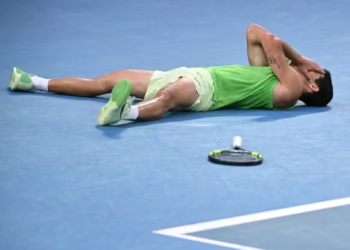 Carlos Alcaraz Triumphs Over Zverev in Five-Set Australian Open Epic
 Thousands Protest ICE Operations in Nationwide US Day of Action
 US-Cuba Negotiations Shift as Oil Blockade Looms
 John Lithgow criticises Rowling stance in trans debate
 Top 10 Must-See Films Arriving This February
 Arsenal blow lead as Arteta rues Wolves draw
 England v Ireland: Scrum Battle Takes Centre Stage
 California Democrats Vow Trump Reckoning
 Trump’s Surgeon General Pick Evades Vaccine Questions
 Buffalo Refugee Tragedy: Border Patrol Neglect Leads to Death
 Buttler Eyes Vital Run Surge as England Face New Zealand
 Saka criticism response: Arsenal star dismisses outside noise
 Abramovich Chelsea Sale Cash Faces Jersey Probe
 Champions League Failure Sparking Premier League Crisis
 Utah Woman Found Guilty of Poisoning Husband for Inheritance
 African World Cup Fans Face $15,000 Entry Bond Fee
 Army Probes Apache Flyover at Kid Rock’s Nashville Estate
 ECB Faces Backlash Over Disability Premier League Inclusion
 Maguire Commits Future to Manchester United with New Deal
 Can De Zerbi Restore Belief to Save Spurs From the Drop?
 Trump’s Presidency: A House of Cards Collapsing?
 Robots Outpace Humans in Beijing Half-Marathon
 Trump Starts $166bn Tariff Refund Process
 Trump Defiant After Washington Hotel Shooting
 Ashley Cole: Finding His Voice and Vision in Italy
 Stephen Fry Sues Tech Organisers For £100k Following Stage Fall
 Trump approval plunges amid Iran war fears
 Ohio’s Battle for Trust: Democrats Vying to Flip the Buckeye State
 US ‘Narco Boat’ Strikes Draw Global Outcry
 FIFA Confirms Global Ban for Benfica Star Prestianni
 US Awaits Iran Reply on New Ceasefire Proposal
 Bracing for the Cherries: Guardiola Likens Vital Bournemouth Trip to the Dentist
 The Battle for Wembley Sparking Unprecedented Legal Warfare
 US green card applicants must apply from abroad, DHS says
 DeSantis’s ‘Alligator Alcatraz’ Faces Final Shutdown
 Chasing Paris Glory Amid Familiar Echoes
 Is Ollie Robinson the Chaos English Cricket Needs Today?
 Saving the Scalloped Hammerhead: The Pacific Battle
 Saka Playing Through Pain As England World Cup Campaign Looms
 Trump Urged to Condemn UFC Fighter Over Obama Slurs
 BBC Faces Backlash Over Ashley Cain Vetting Failures
 US Military Pacific Boat Strike Kills Three People
 Women’s T20 World Cup Breaks Records But Gaps Remain
 Martinelli Strikes Late as Brazil Edge Past Brave Japan
 France Dominate Sweden as Deschamps’ New Era Takes Shape
 US Advance Past Bosnia in World Cup Thriller
 Kane Saves Tuchel as England Survive Dramatic Exit
 US Courts Back Trump on Park Signage Removals
 Trump’s Mount Rushmore Speech: A Divisive Anniversary
 Trump’s Red-Card Intervention Hurts the US World Cup
 USA World Cup Heartbreak: Belgium Ends Their Dream
 US Airman Avoids British Court in Indecent Exposure Case
 Mbappé Brilliance Leads France Into Semi-Finals
 Spain’s Superstar Fan: Keyne Yamal Steals the Spotlight
 Florida Executes One of Its Oldest Death Row Prisoners
 Houthis Strike Saudi Arabia as Middle East Tensions Rise