Published: 26 February 2026. The English Chronicle Desk. The English Chronicle Online.
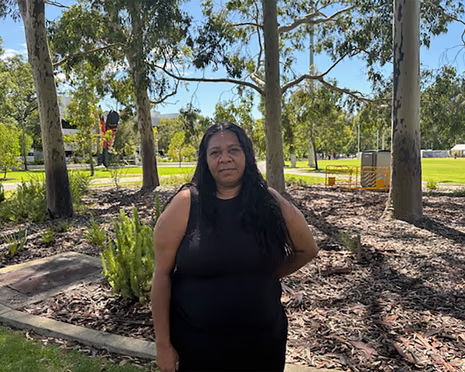
For over two years, Loma Bropho has faced the harsh reality of housing insecurity with her six children. The single mother, originally from the Noongar and Yamatji communities, has been unable to secure a stable rental property in Perth despite exhausting all available avenues. During this period, she and her family have relied on sleeping in their car or temporary stays with relatives, a situation that has left them feeling vulnerable and constantly anxious about the future.
“It’s a horrible feeling,” Bropho explains. “We lay with all the windows up in the car and we can’t breathe properly. If I open them slightly, I can’t sleep because I worry someone might break in and harm us.” Her words highlight the daily tension and fear that comes with homelessness, emphasizing the emotional toll it takes not only on parents but on children as well. The struggle to secure housing has become a cycle of uncertainty, leaving Bropho feeling as though she has “been dropped in a big bowl of karma” despite her persistent efforts to connect with social services and housing providers.
Currently, Bropho and her children are staying in short-term hotel accommodation in the city’s north-east, provided by crisis care. While grateful for the temporary solution, her main concern is how prolonged instability might affect her children. “We just go day by day,” she says. “I tell them, ‘We don’t have a home,’ and they understand. Tomorrow, we get up, get ready for school, and I go see more people about getting us a house. That’s how it is every day.” Her account underscores the resilience and adaptability required by families facing persistent homelessness, particularly within Indigenous communities.

Research from the Australian Housing and Urban Research Institute reveals that families like Bropho’s are slipping through the cracks of an Indigenous housing system described as “fragmented, complex and uncoordinated.” The three-year study, released on Wednesday, examined government initiatives designed to increase self-determination and expand the Indigenous Community-Controlled Housing (ICCHO) sector. Findings indicate that these initiatives are largely failing, leaving many Indigenous families without access to safe and affordable housing.
Despite the Australian government’s commitment to partnering more closely with ICCHOs under the 2020 refreshed Closing the Gap agreement, only 13% of Indigenous people living in public housing are currently connected to an ICCHO. The report, compiled in partnership with Adelaide University, Sydney University, the University of New South Wales, Curtin University, and the Menzies School of Health Research, warns that insufficient engagement and coordination are preventing meaningful progress.
Target 9A of Closing the Gap aims to increase the proportion of people living in appropriately sized housing to 88% by 2031. Indigenous communities, however, continue to experience the highest rate of unmet housing needs in the country. In 2021, approximately 45,700 low-income Indigenous households – nearly one in eight – lacked adequate housing, double the rate of non-Indigenous Australians. The report projects that the number of low-income Indigenous households with unmet housing needs will increase by 26,400 over the next two decades, driven by unaffordable rents, overcrowding, and substandard housing conditions.
A federal government spokesperson insisted that authorities are working in “genuine partnership” with Indigenous communities to ensure better outcomes. “When communities have a real say in the design and delivery of the services that affect them, better results are achieved,” the spokesperson said. Yet, Associate Professor Megan Moskos from Adelaide University, lead researcher of the study, highlights a disconnect between policy and practice. “The study shows Indigenous housing is falling behind because of an uncoordinated policy response,” she says. “There is no evidence of shared decision-making despite government recognition of the sector’s potential.”
Moskos emphasizes the urgent need for concrete actions to strengthen the Indigenous Community-Controlled Housing sector. “There is a lack of growth plans for the sector, and funding for Indigenous housing peak bodies is insufficient to lead its development,” she explains. Her observations suggest that, without strategic support, ICCHOs cannot fulfil their role in delivering culturally appropriate housing solutions.
On the ground, community-controlled organisations echo similar concerns. Tina Ugle, managing director of Perth-based ICCHO Noongar Mia Mia, stresses that these organisations are best positioned to address Indigenous housing needs. “Community-controlled bodies understand the challenges our people face, but there simply aren’t enough available homes,” Ugle says. She also highlights systemic barriers, noting that Indigenous families often face direct and indirect discrimination in the private rental market. “There is no stock transfer or investment from the government, and the private rental market is extremely competitive,” she explains. “Aboriginal people struggle to secure housing, and that’s a fact.”
Government responses include significant investments aimed at alleviating overcrowding and improving housing outcomes for First Nations Australians. Programs such as the $600 million Housing Australia Future Fund and a $2 billion allocation for Northern Territory housing projects represent part of this effort. While these measures provide some relief, researchers and advocates insist that without long-term strategic planning and increased Indigenous sector involvement, such initiatives may fall short of meeting demand.
Bropho’s personal story illustrates the human impact of these systemic issues. Her children’s wellbeing is closely tied to housing security, yet their daily life remains defined by temporary arrangements and uncertainty. For many families in her position, the experience of homelessness is compounded by emotional stress, social marginalisation, and limited access to culturally appropriate support. The struggle is not simply a matter of shelter but encompasses health, education, and social stability, highlighting the urgent need for comprehensive reform.

Indigenous housing experts argue that integrating ICCHOs more fully into policy design could deliver more effective outcomes. “These organisations can address both cultural and practical aspects of housing,” Ugle explains, “but only if governments commit to sustained funding and collaborative planning.” Without such measures, families like Bropho’s will continue to face the precarious cycle of temporary accommodation and housing insecurity, perpetuating disadvantage across generations.
The broader picture reflects a persistent gap between government commitments and on-the-ground realities. While Closing the Gap targets set clear objectives for housing adequacy, the report underscores the limitations of current approaches. Incremental funding and temporary interventions may provide short-term relief but fail to address structural barriers affecting Indigenous communities. Experts consistently point to the need for integrated strategies that prioritise community-led solutions and long-term sustainability.
In the absence of permanent housing solutions, families like Bropho’s navigate daily life with resilience and determination, demonstrating remarkable strength in the face of adversity. Their experiences offer critical insights into the systemic challenges affecting Indigenous housing, reminding policymakers and society alike that cultural understanding, coordination, and investment are essential to meaningful change. As Bropho continues her search for a secure home, her story exemplifies the urgent need for policies that deliver both stability and dignity to those most affected by housing insecurity in Australia.
Related News:
 Victoria Police Ends Warrantless Search Powers, Consolidating Peace
 Liberal Turmoil Threatens Victorian Election Hopes
 Adelaide Festival Sparks Widespread Controversy Among Writers
 Racist Attack on Imam Sparks Melbourne Police Action
 PM pushes urgent hate speech and gun laws after Bondi terror attack
 Hanson and Joyce Use Rinehart Jet to Tour Flooded Queensland
 Craig Silvey faces charges over child exploitation material in Australia
 Labor’s Hate Speech and Gun Laws Face Federal Roadblocks
 Bondi memorial flowers preserved in lasting tribute artwork
 Sydney shark attack leaves boy critically injured in harbour waters
 Sydney Shark Attack Surge Shocks Australia Beaches
 Melbourne Antisemitic Attack Targets Young Boys
 NSW Shark Attacks Surge, Authorities Urge Swimmers to Stay Out
 Nationals Crisis Meeting Threatens Coalition Stability
 Sussan Ley leadership milestone shakes Liberal future
 Deadly NSW Shooting Leaves Three Dead, Gunman Escapes
 Silence and Unity Mark Bondi Terror Attack Memorial
 Andrew Hastie Emerges as Leadership Rival to Ley
 Record-Breaking Heat Looms Over South-East Australia as Catastrophic Fire Risk Escalates
 Victorians Evacuate Otways Amid Massive Fire Threat
 David Speers to host ABC panel on Jewish Australian experiences
 Morrison Faces Backlash Over Call to Regulate Islam in Australia
 How Sandhill Ashes Rebuilt a Bushfire-Hit Rural Community
 David Littleproud and Sussan Ley to Discuss Coalition Future
 Jess Wilson Event Exit After Joyce Controversy
 Townsville Hospital Probes Privacy Breach After Activist Posts Foetus Image
 Psychiatric failings linked to Bondi Junction stabbings, coroner finds
 Gus Lamont Case: Grandmothers ‘Devastated’ by Major Crime Status
 Australia’s Opposition Coalition Reunites After Rift
 Lenore Taylor steps down as Guardian Australia editor
 Liberal Party Faces Leadership Spill as Taylor Challenges Ley
 Angus Taylor Faces Immense Test with New Frontbench
 Sydney Businessman Falsely Claimed Security Advice Came From Kevin Rudd
 NSW to Introduce Minimum Age for Ebike Riders
 NSW Braces for Return of IS-Linked Women and Children
 Reserve Bank May Hike Rates Twice Amid Persistent Inflation
 Anthony Albanese Must Uphold Rights for All Australians
 Liberal Review Shelved After Historic Election Loss
 SA Liberals Back Candidate With Controversial Views on Homosexuality
 Family of Alleged Bondi Gunman Seeks Name Suppression
 Victorian Liberals Face New Crisis Over Candidate Ethics
 Sam Konstas Dropped as Australia Unveils New Contract List
 Labor Reforms NDIS Amidst Mounting Budget Concerns
 Governments Fail Murray-Darling River Projects
 Senator’s Anzac Day Post Sparks Online Music Controversy
 Record May Heat to Cold Front in Eastern Australia
 Queensland Government Faces Heat Over Ministerial Scandal
 Search Intensifies for Missing Hiker on WA Bibbulmun Track
 One Nation Stuns Australia With Historic Farrer Win
 Tony Abbott Returns as New Liberal Party President
 Tony Abbott Returns as New Liberal Party President
 Man killed in shark attack on Great Barrier Reef
 Shockwaves Across Australian Cricket as Melbourne Rivals Dissolve
 Global Tech Giants Face Off Against Australia Over Media Levies
 NSW Prosecutors Charge Labor Officials Over Campaign Funds
 The impact on families six months after Australia’s social media ban
 Breakthrough in Hunt for Sovereign Citizen Accomplices
 A State in Turmoil: Aussie MP Denies Assault Allegation
 The Crisis of Essential Medication Withdrawals
 Moira Deeming Gains Respite in Liberal Party Standoff
 Court Lifts Suppression on Senator Thorpe MCG Assault Case
 China’s Pacific Missile Test Sparks Regional Alarm
 The Melbourne Bird: Art or Vandalism?
 Taylor Defends Henderson Over Triple-Zero Calls
 Brisbane School Stabbing Leaves Teenager Critical
 Sydney’s Metro Future: Fast Trains but Delayed Start
 Reeves Faces Setback as Labour May Miss Homes Target
 Kate Winslet to Narrate Film Highlighting King’s Environmental Mission
 Trump and Tehran Find Common Ground in Landmark Ceasefire
 National Energy Grant Proposed to Slash UK Household Bills
 Stefano Gabbana Resigns as Chair of Italian Luxury Giant
 Rolls-Royce SMR Secures £600m Boost for Nuclear Future
 Kyiv and Odesa Mourn After Deadly Wave of Russian Strikes
 Medellín’s Green Revolution: A Global Climate Blueprint
 Robots Outpace Humans in Beijing Half-Marathon
 US Forces Seize Iranian Ship Near Hormuz Blockade
 Japan’s Youth Defend Pacifist Constitution
 Investigation: Offshore Loans and Sanctions
 Trump Defiant After Washington Hotel Shooting
 Cross-Border Crisis Shatters Fragile Afghan Peace