Published: 01 April 2026. The English Chronicle Desk. The English Chronicle Online.
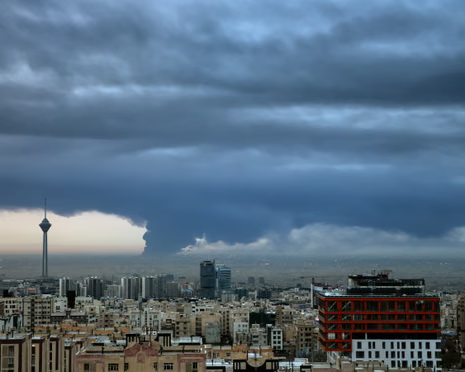
Good morning. So far, there is only one clear winner from the war in Iran: Russia. Before the US and Israel attacked Tehran in late February, Moscow was preparing deep budget cuts to education and healthcare funding to pay for its invasion of Ukraine, which has now entered its fifth year. In just over a month of the fighting in Iran, Vladimir Putin’s Russia has experienced a dramatic reversal in fortunes. The global oil price has shot up from a prewar average of $72 to well over $100 per barrel, providing a financial boost of multi-billions for Moscow that shows little sign of ending. Meanwhile, important restrictions on Russian oil have been lifted, and Kyiv is increasingly nervous about how the Iran war will impact their ability to obtain defensive weapons from the US to fend off Russian drones and missiles. How did the tables turn so quickly? And what will be the impact of the ongoing conflict in the Middle East be on Ukraine? For today’s newsletter, I spoke with Pjotr Sauer, a Russian affairs reporter for the Guardian, about how the two conflicts are connected. But first, the headlines.
Five Big Stories
Middle East | Donald Trump has launched a tirade against European countries that refused to join his war against Iran, calling out the UK and France.
Military | The UK is sending more military support to the Gulf, taking the total deployment to 1,000 troops.
NHS England | Some medicines could run out in weeks or even days, NHS England head warns, after supply line shocks.
UK Politics | Nigel Farage to ‘steer well clear’ of UK CPAC event in July being led by the short-lived former prime minister Liz Truss.
UK News | King Charles’s state visit to US to go ahead in late April despite Iran war concerns.
In depth: Russia is the big winner from this war
On first sight, the US-Israeli attack on Iran may have seemed bad news for Vladimir Putin. The killing of Iranian supreme leader Ayatollah Khamenei marks the loss of another key regional ally for the global superpower, following two others: the fall of Syria’s president Bashar Al-Assad, and the US seizure of Venezuela’s leader Nicolás Maduro. Furthermore, many assumed that by providing direct intelligence on US military positions to the Iranians, Russia risked angering the Trump administration, who have long been sympathetic to the Kremlin’s worldview. But this view has not been proved right so far, says Pjotr. “Russia is the big winner from this war,” he says. He points first to the fact that some restrictions on Russian oil put in place when the war with Ukraine first began have now been lifted.
“The US was putting pressure on Russia’s traditional allies who were buying oil, including India and China. Now, that’s been reversed,” he says. At an opportune time, that reversal means the many Asian countries affected by the global supply squeeze coming out of the conflict in the Middle East are now looking to Russia to fill the gap providing a lifeline to Putin for his stretched war machine. “India is buying lots of Russian oil. We are seeing that other countries are interested, especially in Asia … They’re all turning to Russia now. In that sense, Russia is benefiting immensely. If this continues, we’ll hear more murmurs in Europe about getting Russian oil and gas, which is obviously a devastating outcome for Ukraine.”
The sudden escalation in the Gulf has fundamentally rewritten the global energy map in Russia’s favor. For years, Western sanctions sought to choke the lifeblood of the Russian economy by capping export prices. However, the desperation for energy security in the wake of the Iran war has sidelined these concerns. Major economies that previously hesitated to engage with Moscow are now prioritizing fuel stability over geopolitical alignment. This shift has not only stabilized the ruble but has also replenished the Kremlin’s nearly depleted national wealth funds. The financial breathing room allows Putin to ignore the mounting internal pressure for domestic economic reforms. Instead, he can focus entirely on reinforcing the front lines in the Donbas with renewed vigor. The irony is sharp: a war intended to curb Iranian influence has funded Russian aggression.
A mini domestic crisis in Russia
That does not mean all is well in Moscow, says Pjotr. A crackdown on the popular social media app Telegram, internet blackouts, and frustration over slow progress in Ukraine have irritated many Russians. In mid-March, a popular pro-kremlin blogger abruptly turned on the Russian president, calling him “illegitimate” and demanding he stand trial for war crimes. He was later sent to a psychiatric ward. Approval ratings for Putin’s leadership fell to 70%, according to state-backed polling, the lowest level since the invasion of Ukraine. While the figures remain remarkably high by western standards, Pjotr says it shows a clear trend.
“Russia is facing a mini domestic crisis. We’re seeing that discontent is brewing, primarily over the fact that Russia is starting to block popular messaging apps. WhatsApp has been blocked already. YouTube is blocked. But now Russia is moving to block Telegram, which is this hugely popular messaging app,” says Pjotr. But forecasting the fortunes of the 73-year-old Russian leader is a fool’s errand. In February, Putin did not appear in public for more than a week, sparking rumours about his health, not for the first time. Pjotr says this is a distraction. A month later, Putin reappeared as strong as ever, as he has done after previous ‘disappearances’.
The internal tension highlights a paradox within the Russian state during this global upheaval. While the external economic indicators are booming, the social contract at home is becoming increasingly frayed. Digital censorship has reached unprecedented levels, alienating a younger generation that previously felt insulated from political strife. The state’s heavy-handed response to dissent suggests a deep-seated anxiety within the halls of the Kremlin. Even with record oil profits, the government remains wary of any spark that could ignite public anger. This internal friction complicates Putin’s ability to fully project the strength his new wealth might suggest. Yet, as history shows, the Russian leader often uses international crises to justify domestic repression. The war in Iran provides the perfect cover for his latest campaign of internal control.
A revived war machine
As the fighting continues in the Middle East, Putin appears confident he will be able to sustain his war machine in Ukraine. Russian business contacts tell Pjotr the Kremlin is increasingly convinced that they will get all of the Donbas region of eastern Ukraine as part of any settlement. Putin hopes to make a “grand deal” with the US, says Pjotr, in which the west agrees to halt Nato expansion and stop arming Ukraine in exchange for peace. Such an agreement would make Ukraine permanently weaker – and risk a future invasion for even more of the country. And so far, Russian support for Iran has not yet angered President Trump or affected Moscow’s optimism about the outcome of the Ukraine war.
“It is quite hard to wrap your head around. Russia is directly involved in the war on Iran’s side. Trump still appears to favour Putin. Russia is providing Iran intelligence, and potentially drones in the future, to target American soldiers. Despite all this, Trump is not hardening his position towards Moscow and continues to pressure Volodymyr Zelenskyy,” he says. “Zelenskyy wants to offer his help to the US to protect American soldiers, he wants to offer his help to the Gulf states. It is really hard to understand why [Trump continues to favour Putin].”
This strange geopolitical alignment has left many seasoned diplomats in London and Paris completely baffled. It seems the usual rules of international alliances have been discarded in favor of transactional politics. Russia’s ability to play both sides—supporting Iran while maintaining a rapport with Washington—is a masterstroke of diplomacy. By positioning itself as a necessary broker for any future Middle Eastern peace, Moscow gains leverage. This leverage is then used to squeeze concessions out of a distracted and divided Western coalition. The result is a Ukraine that feels more isolated than at any point since 2022. The “grand deal” Putin envisions is no longer a fever dream but a growing possibility. If Washington pivots fully to the Middle East, Ukraine may find itself sacrificed for regional stability.
A role reversal for Ukraine
For Kyiv, the war in Iran has heaped on more misery after a cold and brutal winter. No negotiations on ending the fighting with Russia have taken place since fighting started in Iran, says Pjotr. In recent days, Zelenskyy has sought to establish partnerships with Gulf states to offer expertise on defending themselves from drones, part of a strategy to remain relevant internationally. “Zelenskyy was in the Middle East over the weekend where he met leaders from Saudi Arabia, Kuwait, and Qatar. He’s now offering his experts to guide countries in the Middle East against Iranian drones, as well as actually offering to sell Ukrainian drones. It is a fascinating situation where Ukraine tries to transform itself from a weapons receiver to actually a weapons deliverer,” he says.
But with the world’s attention elsewhere, Russian attacks have intensified, bringing further misery for Ukraine, says Pjotr. “Last week, it sent more than a thousand drones to Ukrainian cities. It was a record,” he says. “The US is completely distracted by the war in Iran. There haven’t been any talks since the start of the fighting. Zelenskyy seems worried that Ukraine is being forgotten.” In previous years, spring has heralded a fresh Russian assault on the battlefields of eastern Ukraine as the biting winter cold fades. The stakes could not be higher for Kyiv, which is still holding back the Russians in the east. But the spectre of a potential betrayal by the Trump administration looms large.
The transformation of Ukraine into a regional security provider is a desperate but brilliant move. By exporting its hard-won knowledge of drone warfare, Kyiv hopes to create new, wealthy allies. These partnerships could provide the financial and military resources that are currently stalled in the US. However, this strategy takes time to bear fruit, and time is a luxury Ukraine lacks. The sheer volume of Russian aerial attacks is stretching air defenses to their absolute breaking point. Every drone intercepted in the Gulf is one less interceptor available for a city like Kharkiv. The world’s focus has shifted, and the shadows over Ukraine are growing longer each day. As the spring sun rises, it illuminates a battlefield where the odds have shifted. Russia stands tall, fueled by the very conflict that was meant to reshape the world.
Related News:
 UPS Cargo Plane Crash in Kentucky Kills Seven
 US private equity set to acquire UK online retailer Very Group
 Switzerland Rolls Out Charm Offensive to Cut Trump’s 39% Tariffs
 Canada Passes Carney’s First Budget in Tight Parliamentary Vote
 India’s Labour Law Overhaul Sparks Fierce Debate
 Carney’s Alberta Pipeline Deal Sparks Immediate Pushback
 Mark Carney Walks Diplomatic Tightrope on China Visit
 Wall Street shaken by Trump tariff shock as markets tumble
 ‘Black Tax’: Burden, Pride and Survival for African Workers
 UK New Car Discounts Near £6,000 as Prices Are Slashed
 Coles Discounts Under Fire in Federal Court
 Trump Tower Gold Coast to Redefine Skyline
 Rory Amon Trial: Alleged Victim Speaks in Court
 Oil Prices Surge as Iran War Jolts Markets
 Gulf shipping crisis as war risk cover pulled
 Global markets face turmoil as Hormuz crisis deepens
 Gulf shipping crisis sparks food price fears
 Oil Prices Surge Above $100 Amid Iran War
 G7 Weighs Emergency Oil Reserves as Prices Surge
 Brazil Floods Warning as Scientists Urge Fossil Fuel Exit
 Asia Scrambles to Confront Energy Crisis Amid Iran War
 The Truth Behind Rising Energy Costs and Fossil Fuel Myths
 UniCredit’s Bold Move to Reshape European Banking
 RBA rate hike sparks fears amid global crisis
 UK Wage Growth Slows as Jobs Market Holds Firm
 Oil Slides, Stocks Jump on Trump Peace Signals
 ABC Staff Strike Over Pay and AI Concerns
 Middle East Conflict to Hit UK Economy Hardest
 Australian Growth Slows as Global Inflation Spike Looms
 The Strategic Failure of Trump’s Conflict With Iran
 Trump to Deploy “God Squad” Over Gulf Wildlife Protections
 Trump Threatens Iran With Total Infrastructure Destruction
 Iran Drone Strike Hits Kuwaiti Oil Tanker in Dubai Port
 Albanese to Address Nation as War Sparks Economic Crisis
 US Senators Slam Ticketmaster Over Sneaky New Fee Hikes
 Apple at 50: Three Products That Changed How We Live
 California fireworks blast: murder charges filed in case
 IMF Warns Iran War Could Spark Deep Global Recession
 Trump Slams UK Ties and Threatens To Rewrite Trade Deal
 Athens Mayor Moves to Tackle Overtourism Crisis
 Southeast Asia Turns to Russia Amid Energy Crisis
 Ukraine Urges UK to Seize Russian Oil Tankers
 US Calls Australia Media Law “Foreign Extortion”
 Capitalism ‘Suicidal’, Warns Petro at Climate Summit
 Oil Prices Surge Above $120 Amid Iran Blockade Fears
 $13bn World Cup Set to Break All Revenue Records
 US to Escort Trapped Ships Through the Strait of Hormuz
 Trump approval plunges amid Iran war fears
 Infantino’s Grip Tightens as FIFA Eyes a $14bn Future in Vancouver
 Trump Threatens UN Budget Cuts as US Pushes ‘Trade Over Aid’ Agenda
 Global Conflict Hits Home As Bullock Warns Of Economic Pain
 Norway Doubles Down on Oil and Gas for Europe Energy Security
 US Awaits Iran Reply on New Ceasefire Proposal
 Trump’s Gold Coast Tower Dreams Crumble Amid Toxic Fallout
 Trump: Preventing Nuclear Iran Is ‘The Only Thing That Matters’
 High Street Crisis: Fears Grow Over Post Office Closures
 Beijing Becomes Centerstage for Global Diplomatic Ballet
 Oil Markets Face ‘Red Zone’ Threat Amid Iran Crisis
 Hormuz Talks Near Critical Stage
 UK Pushes for New EU Goods Trade Deal
 Reeves Fights to Keep Treasury Role Amid Labour Turmoil
 China mine blast death toll rises to 90
 Japan Suffers Plastic Shortage Due to Middle East Crisis
 UK Economy Suffers a Sharp Downturn as Iran Conflict Bites
 Europe Weighs Hormuz Navigation Fee Plan
 Ukraine Creates Long-Range Strike Command
 Reeves Faces Setback as Labour May Miss Homes Target
 Trump’s UK Ambassador Urges North Sea Drilling to Strengthen US Ties
BBC to Apologise Over Edited Trump Speech Amid Backlash
Trump’s UK Ambassador Urges North Sea Drilling to Strengthen US Ties
BBC to Apologise Over Edited Trump Speech Amid Backlash
 Millionaires group urge Reeves to introduce wealth tax to ‘lift kids out of poverty’
 Greene Pushes Epstein Files Amid Trump Fallout
 Zelenskyy Signs Fighter Jet Deal Amid Russian Drone Attacks
 Shadow Fleet at Sea: Europe’s Battle Against Illicit Oil Shipping
 Trump and Tehran Find Common Ground in Landmark Ceasefire
 Stefano Gabbana Resigns as Chair of Italian Luxury Giant
 Rolls-Royce SMR Secures £600m Boost for Nuclear Future
 Tough Fiscal Realities Await Next Scottish Government
 Aramco Surges as East-West Pipeline Counters Gulf Tensions
 Scepticism and tight security as Beijing braces for Trump
 Tensions Flare as Israeli Nationalists March in Jerusalem