Published: 11 January 2026. The English Chronicle Desk. The English Chronicle Online.
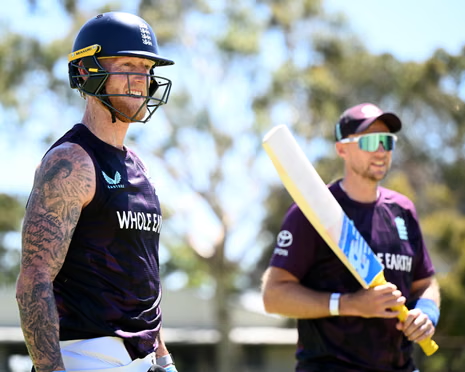
England’s Ashes calamity has cast serious doubts over Brendon McCullum’s credibility as head coach. The team’s collapse in Sydney exposed weaknesses not in talent, but in preparation and leadership that have left supporters and experts alike questioning the management approach. From the outset, England possessed a group of skilled players, many in their peak twenties, yet the execution on-field has repeatedly fallen short of expectations. McCullum’s coaching philosophy, centred on a rigid “brand” of cricket, has failed to adapt to match situations, highlighting a concerning gap between strategy and practical performance.
Before the series, England’s squad looked promising after a strong campaign against India, showing potential for tactical maturity and adaptability. Players like Joe Root and Jacob Bethell demonstrated individual brilliance, yet their successes often came in spite of, rather than because of, McCullum’s methods. The core problem remains the coach’s insistence on a single style of play, leaving little room for individual strengths or situational awareness. While England has high-calibre talent, the disconnect between management directives and player execution has undermined overall performance.

Rob Key, as director of cricket, and McCullum have faced scrutiny for their appointments and planning, intensifying concerns after the Ashes calamity. Ben Stokes, the obvious on-field leader, remains committed, but his effectiveness is inherently tied to McCullum’s guidance, and the Ashes calamity has exposed the limits of this reliance. Vice-captain Harry Brook has yet to demonstrate readiness to shoulder responsibility, leaving Stokes as the principal figure for leadership. Yet even Stokes’ capabilities are constrained by a lack of thorough preparation and the absence of a coherent team culture instilled by the management. Effective coaching requires meticulous planning, the fostering of technical skills, and instilling discipline, all of which were glaringly absent during this Ashes calamity.
England’s approach to coaching and selection has been heavily criticised. McCullum and Key have favoured players based on potential or intuition rather than consistent first-class performance, contributing further to the Ashes calamity. The erosion of specialist support, including technical coaching staff, has compounded the problem. Players show glimpses of excellence, but without a coherent development structure, these performances remain inconsistent. The series highlighted that England’s best performers, including Root’s defensive centuries and Bethell’s disciplined batting, often ignored management instructions, achieving success through fundamentals rather than brand philosophy.
Bowling, too, suffered from misapplied strategies. McCullum’s emphasis on pace over skill proved counterproductive, while Josh Tongue’s disciplined line and length yielded positive results. England’s inability to execute the basics—batting, bowling, and fielding—reflects a larger failure in coaching, preparation, and planning. Analysts note that a team can recover from tactical errors, but repeated underperformance in fundamentals signals serious flaws in management. McCullum’s insistence on brand over adaptability has now overshadowed his credibility, leaving questions about accountability and suitability for the upcoming T20 World Cup in Mumbai.
Even with minor adjustments promised by McCullum, critics argue this may be insufficient. The responsibilities of a head coach extend beyond tactics; culture, player behaviour, and preparation are equally critical. With a mix of experienced Test players and emerging talent, England’s future success depends on clear leadership, technical expertise, and strategic flexibility. McCullum’s tenure has failed to demonstrate these qualities consistently, raising the urgent need for reflection and possibly restructuring at the top levels of management.

Looking forward, the England team faces the challenge of rebuilding confidence, refining fundamentals, and integrating strategic adaptability into their play. The upcoming T20 World Cup is both an opportunity and a test of whether the current coaching model can support elite performance. Experts suggest a return to proven leadership with a focus on culture, technical proficiency, and structured development. Alec Stewart’s long-standing success at Surrey is cited as a model for cultivating disciplined, competitive cricketers capable of thriving in high-pressure scenarios. Stewart’s experience contrasts sharply with the experimental approach that has defined McCullum’s tenure, offering a potential blueprint for sustainable team improvement.
Ultimately, the Ashes calamity is not a reflection of England’s talent but of leadership choices that failed to optimise it. McCullum’s credibility has been eroded, and the team now stands at a crossroads requiring urgent assessment. England’s selectors and coaching staff must balance innovation with fundamentals, ensuring players’ strengths are leveraged effectively. Clear, accountable leadership will be vital to prepare for both imminent tournaments and long-term Test ambitions. Without decisive action, the lessons from Sydney risk being lost, leaving another talented England squad underprepared and overpromised.
Related News:
 Tottenham shine at Everton but Frank wary of title push
 Matty Cash seals Villa win as City falter again at Villa Park
 Sarr Double Sinks Young Liverpool in Carabao Cup
 Nwaneri and Saka Secure Arsenal Win Over Brighton
 Woltemade Hot Streak Fires Newcastle Past Spurs
 Kieffer Moore Hat-Trick Ends Coventry’s Unbeaten Run
 Salah & Gravenberch Lead Liverpool to Win Against Villa
 Dyche Criticises Corner Decision as Forest Draw with United
 Caicedo Shines as Chelsea Edge Spurs in Chaotic Derby
 Granit Xhaka Rescue Earns Everton Draw at Sunderland
 Liverpool Edge Real Madrid 1-0 in Champions League Thriller
 Van de Ven Stunner Lifts 10-Man Spurs to UCL Glory
 Burn and Joelinton Head Newcastle to Victory Over Bilbao
 Foden shines as Man City dismantle Dortmund in dominant display
 Garnacho Spares Chelsea From Shock Champions League Loss in Baku
 Tension and Turmoil at Aston Villa v Maccabi Match
 Bellingham has ‘the edge’ among England No 10s
Man City Masterclass on Guardiola’s Milestone Day Exposes Liverpool Woes
Bellingham has ‘the edge’ among England No 10s
Man City Masterclass on Guardiola’s Milestone Day Exposes Liverpool Woes
 Lando Norris Dominates Brazil GP to Strengthen F1 Title Bid
 England cannot afford to be in awe of the All Blacks, warns Jamie George
 VAR Must Rein Its Neck In to Save Football’s Spirit
 Trescothick Hints Pope Will Keep Number Three Spot
 Ronaldo Confirms Final World Cup and Plans Retirement
 Mary Earps’s Manchester United Return Faces Mixed Reception
 Sam Kerr Stars in Chelsea Return with Champions League Double
 This kid is something else: Alex Scott’s rise to England call-up
 UK and Ireland Announce Venues for Euro 2028 Tournament
 England Maintain Perfect World Cup Qualifying Record with Win Over Serbia
 Saka Solidifies Role as Tuchel’s Key England Lieutenant
 Former Lion Heskey Warns of Shortage of England Strikers
 Australia Mourns Paralympic Champion Paige Greco
 Troy Parrott Hat-Trick Sends Ireland to World Cup Play-Offs
 Irish Hero Parrott Says Goal Brought First Tears in Years
 Scotland Fans Reflect on France ’98 as World Cup Looms
 Nigeria Misses World Cup Again After Play-Off Loss
 Germany and Netherlands Confirm Places in 2026 World Cup
 Spain Qualify for 2026 World Cup After Dramatic Draw
 From heartbreak to glory: Scotland’s dramatic return to the World Cup
 Tiny Curacao Makes History as Smallest Nation to Reach World Cup
 Haiti Qualifies for World Cup Despite Coach Never Visiting Country
 Scotland Fans Celebrate Historic World Cup Qualification
 Major League Baseball Scores New Broadcast Deals Through 2028
 Barcelona Returns to Camp Nou vs Athletic Bilbao
 Moyes Defends Gueye After Dramatic Everton Bust-Up
 Kids Football Coach Removed Over Suspected ‘Drugs Menu’
 Mbappe Scores 4 as Real Madrid Edge Olympiakos
 Man City Lose, Champions League Risk
 Gerrard warns Liverpool’s terrible run could worsen
 Jac Morgan to Miss Six Nations Start After Surgery
 Alexander Isak ends drought as Liverpool stop rot with win at West Ham
 Mbappe rescues Real Madrid with a penalty at Girona
 Barcelona, Atletico set for decisive La Liga showdown
 Maxwell withdraws from IPL 2026 after 13 seasons
 Barcelona Come From Behind to Beat Atletico 3-1
 Mbappe stars as Real Madrid thrash Athletic, close on Barca
 Trump to attend 2026 FIFA World Cup draw in Washington
 Australia Face Big Changes as Cummins and Lyon Ruled Out of Ashes
 Van de Ven Tackle Leaves Isak with Fractured Leg
 City Set to Land Semenyo After Chelsea Exit from Transfer Race
 Arrizabalaga Sends Arsenal Through in Dramatic Shootout
 Ashes Shock: Boland Admits Struggle Bowling With Keeper Up
 Alex Sarama: How a 30-Year-Old Englishman Became WNBA Coach
 ECB powerless to halt England’s recurring Ashes failures
 Stokes urges empathy for England players amid Ashes struggles
 Aston Villa Remain Arsenal’s Key Obstacle in Title Pursuit
 Damien Martyn in Induced Coma After Meningitis Diagnosis
 Spin Bowling Struggles as Pace Dominates 2025 Ashes Series
 Anthony Joshua Released After Nigeria Car Crash
 Chelsea Sack Looms: Enzo Maresca Relationship Collapses
 Africa’s Superpowers Shine in Cup of Nations Quarter-Finals
 Amorim’s United Future Uncertain Amid Wilcox Tension
 Raducanu Battles Injury as Britain Exit United Cup
 Australia Dominates England: Smith, Head Crush Bowlers in Sydney
 Australian Open Prize Money Hits Record $111.5m
 Nick Kyrgios Faces Singles Struggles at Brisbane Tennis Return
 Nottingham Forest Deny West Ham in Dramatic Late Win
 Manchester United Fan Group Targets Jim Ratcliffe Over Club Chaos
 Morocco sail into Afcon semis after Díaz inspires win
 Wrexham stun Nottingham Forest with Okonkwo FA Cup heroics
 Salah Shines as Egypt Knock Out Ivory Coast at Afcon