
Published: 24 February 2026. The English Chronicle Desk. The English Chronicle Online.
Campaigners have expressed frustration over the “achingly slow” progress of gender equality across Britain’s leading businesses. Recent research demonstrates that despite years of pledges, FTSE 100 companies still have only nine female chief executives, showing minimal change over the past year. The government-backed FTSE Women Leaders Review highlighted that the average number of women leading these top firms remained static, signaling that structural barriers continue to impede female advancement. Analysts emphasised that while boardroom representation has improved, executive positions such as chief executive remain dominated by men, raising concerns about long-term equality outcomes.
Among the current female leaders are Allison Kirkby at BT, Zoë Yujnovich at National Grid, Milena Mondini de Focatiis at Admiral, Stella David at Entain, Louise Beardmore at United Utilities, Margherita Della Valle at Vodafone, Amanda Blanc at Aviva, and Cindy Rose at WPP. The report also noted Emma Walmsley of GSK and Liv Garfield of Severn Trent, though both departed their roles in December. Interim chief executive Carol Howe at BP will be succeeded by Meg O’Neill in April, marking another planned leadership transition. These appointments reflect a gradual, uneven pattern of female representation in senior management roles.
Some high-profile exits have compounded the challenge, including Debra Crew leaving Diageo after a difficult two-year tenure in which the company’s share price fell over 40%. Additionally, Taylor Wimpey and WPP were moved from the FTSE 100 to the FTSE 250, reducing the number of female CEOs in the top index, although both companies remain led by women. Observers note that these fluctuations underline how precarious female leadership positions can be, especially in industries where performance pressures are high.

The historical context shows modest progress, with female leaders peaking at ten chief executives in the FTSE 100 during 2023, up from six in 2016. Meanwhile, the FTSE 350, which encompasses mid-sized firms, missed the voluntary 40% target for women in top executive roles set in 2021 for 2025. Female leaders currently occupy 36% of senior leadership positions within the FTSE 350, which includes executive committee members and immediate senior managers below them. Despite this, the group met its 40% board target, now holding 43% of seats for women, illustrating a gap between boardroom inclusion and executive leadership.
Vivienne Artz, chief executive of the FTSE Women Leaders Review, described the overall pace of change as “achingly slow,” particularly in the most senior and revenue-focused roles. She explained that positions like chief financial officer, chair, and chief executive remain the hardest to fill with female leaders, and meaningful progress depends on building pipelines that offer women experience in profit and loss responsibilities. Experts argue that targeted mentorship and exposure to commercial decision-making are critical to bridging the persistent gender divide in senior leadership.
Some companies have demonstrated stronger commitment to gender diversity. Burberry tops the FTSE 100 for female leaders on its leadership team, with Next following closely. In contrast, Games Workshop, known for the Warhammer franchise, and the mining firm Fresnillo ranked lowest for female participation in senior roles, highlighting stark variations across sectors. Analysts caution that industries with traditional male dominance or niche operational cultures may require more structured interventions to accelerate female leaders’ inclusion.
The report also highlighted that women are better represented among non-executive directors (NEDs), who offer strategic guidance without daily operational responsibilities. In the FTSE 350, 49% of NED roles are held by women, and 50% in the FTSE 100, numbers that have remained stable from the previous year. This reflects the effectiveness of voluntary efforts and quotas in encouraging boardroom diversity, although the impact on day-to-day executive leadership remains limited.
International comparisons provide further insight into UK performance. Among G7 nations, the UK ranks second for women on boards, behind France. Within the FTSE 350, women hold 43% of board positions, and 44% in the FTSE 100, while the French Cac 40, where quotas are mandatory, shows women occupying 45% of board seats. These comparisons underscore that while voluntary initiatives have improved representation, mandatory measures elsewhere may accelerate gender parity more effectively.
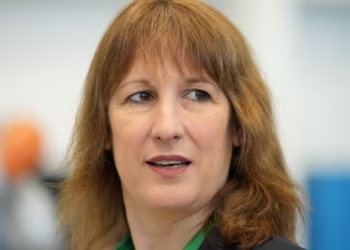
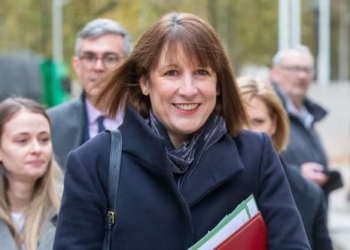
Chancellor Rachel Reeves commented that the findings illustrate both progress and the continuing need for action. She stressed that removing ceilings on women’s ambition allows organisations to make better decisions, foster innovation, and achieve stronger overall performance, which benefits the national economy. Reeves highlighted that fully inclusive participation at every level strengthens companies’ strategic capabilities, ultimately driving sustainable economic growth and competitiveness.
Seema Malhotra, minister for equalities, observed that women have moved from the periphery into the core of the boardroom over the past 15 years, reflecting the success of business-led voluntary initiatives. She also emphasised government actions supporting gender equality, including the Employment Rights Act, enhanced sexual harassment legislation, and improved gender pay gap transparency. Expanded childcare provision and free breakfast clubs also form part of initiatives designed to enable female leaders to participate more fully in the workforce.
Experts note that cultural and systemic factors remain significant obstacles. Many women continue to face challenges accessing revenue-generating roles essential for progression to chief executive positions. Industries with entrenched male-dominated networks often fail to provide sufficient sponsorship or mentoring, leaving female leaders reliant on individual company initiatives. Consequently, systemic reforms combined with targeted corporate programs are widely viewed as necessary to achieve sustainable progress.
While progress has been uneven, examples of effective practice offer hope. Companies like Burberry demonstrate that structured succession planning, mentoring, and visible senior female leaders can enhance representation at the top. Observers stress that replicating these strategies across industries with fewer women in leadership could significantly improve overall performance and encourage broader cultural change.

Additionally, the report underscores the importance of monitoring and accountability. Transparent reporting of gender statistics, alongside voluntary and mandatory targets, ensures that organisations remain under scrutiny. This approach helps create an environment in which measurable progress is possible, and where companies are incentivised to actively develop female leadership pipelines. Analysts argue that without this visibility, efforts may stall and the momentum toward gender equality could be lost.
The FTSE Women Leaders Review, along with government support, has encouraged dialogue between firms to share best practices, spotlight successful interventions, and set aspirational benchmarks. Campaigners argue that these collaborations are vital for normalising gender diversity at the executive level. They also highlight the role of education and professional development programs that equip women with the skills needed to succeed in senior, high-stakes roles.
Ultimately, while the UK has achieved notable gains in female board representation, the pace of change at the executive level remains slow. Policy initiatives, voluntary business efforts, and cultural shifts are collectively required to ensure that women are fully represented where strategic decisions are made. Observers emphasise that sustained commitment is essential to moving beyond symbolic achievements toward substantive equality in leadership.
Related News:
 CMA Flags Concerns Over Greencore-Bakkavor Merger
 Derby Bounce Centre to Close Amid Car Park Dispute
 Reeves Faces Setback as Labour May Miss Homes Target
 UK Small Business Owner to Challenge L’Oréal in Tribunal
 Trump’s UK Ambassador Urges North Sea Drilling to Strengthen US Ties
 150-Year-Old Arctic Beer to Be Reborn in Scotland
 Court Hears Challenge Over Water Bills Funding Sewage Fixes
 London bagel shop tops Deliveroo’s global orders list
 ABF May Split Primark from Food Division Amid Tough Market
 Rachel Reeves Set to Break Labour Pledge and Raise Income Tax
 UPS Cargo Plane Crash in Kentucky Kills Seven
 Thinktanks Urge Rachel Reeves to Reform UK Tax System
 Gopichand Hinduja, UK’s Wealthiest Business Leader, Dies
 M&S Profits More Than Halve After Cyber-Attack
 Company linked to Michelle Mone owes £39m in tax
 Tony Blair think tank warns Rachel Reeves must cut taxes if manifesto broken
 Oprah enjoys Meghan’s jam on English muffins
MPs Press Rachel Reeves to Hike Gambling Taxes
Oprah enjoys Meghan’s jam on English muffins
MPs Press Rachel Reeves to Hike Gambling Taxes
 NHS Takes Over Nuffield Hospital in ‘Windfall’ for London Care
 North Sea oil workers must lose weight or face job loss
 Cuts to home insulation funding threaten UK climate goals
 Warning as Britons prepare to spend £4 billion this Black Friday
 Troubled drinks giant Diageo names former Tesco boss to lead turnaround push
 Millionaires group urge Reeves to introduce wealth tax to ‘lift kids out of poverty’
 Borough Market Clash Sparks Influencer Backlash
 UK toy market enjoys bumper year as ‘kidults’ fuel demand
 Reeves’s Tax U-Turn Triggers Fresh Jitters in UK Markets
 Global markets drop amid tech sell-off and China slowdown
 PM Highlights UK Business at G20 in South Africa
 Eurotunnel Investment Halted as UK Rates Soar
 Mossmorran Plant Closure Hits Cowdenbeath Hard
 UK Energy Bills to Rise Slightly in January
 UK Government Borrowing Higher Than Expected
 UK Taskforce Unveils Plan to Streamline Nuclear Reactor Rules
 Steel billionaire Lakshmi Mittal reportedly leaves UK
 Minister Denies Budget Leaks Have Harmed UK Economy
 English Mayors Set to Introduce Tourist Taxes
 Black Friday Footfall Falls as UK Shoppers Hold Back Amid Economic Concerns
 Starmer Says Labour’s Economic Plan Needs Years to Deliver
 Virgin Media Fined £23.8m Over Telecare Safety Failures
 Rising Water Bills Lift Troubled Thames Back to Profit
 Bet365 Boss Nets £280m Despite Profit Drop
 Sainsbury’s CEO leads business honours in New Year list
 UK Car Sales Pass 2 Million as Chinese Brands Surge
 Starmer Faces Parliamentary Battles Over UK-EU ‘Reset’ Plan
 Phoenixism Costs UK Taxpayers Millions in Recruitment Sector
 3,000 Jobs at Risk Without UK Helicopter Order
 China Dependence Threatens UK Energy Supply Chains and Jobs
 South East Water chief faces £400,000 bonus amid outages
 ScottishPower Tops List of Worst UK Energy Suppliers
MPs warn AI financial risks threaten UK stability
ScottishPower Tops List of Worst UK Energy Suppliers
MPs warn AI financial risks threaten UK stability
 MPs warn AI financial risks threaten UK stability
 City & Guilds pay surge sparks backlash amid £22m cuts
 UK Government Borrowing Drops to £11.6bn in December
 UK Disposable Income Growth Transforms Eleven Towns and Cities
 AI job losses UK: Britain faces sharper employment shock
 Most young adults in UK fear uncertain jobs and economic future
 Royal Mail delivery delays affect 16 million during Christmas
 Labour Must Revive High Streets to Avoid Election Collapse
 Households in England Face Rising Water Bills in April
 UK New Car Discounts Near £6,000 as Prices Are Slashed
 Study Finds One in Seven England Takeaways Are Dark Kitchens
 Riverford sales surge as UK organic market booms
 Barclays drops Global Counsel after Mandelson link scrutiny
 UK average home price exceeds £300,000 milestone, Halifax reports
 UK Experts Raise Alarm Over Machinery Export to Armenian Firm
 Barclays CEO Reacts to Epstein Fallout Amid Legal and Profit Pressures
 Elliott Takes LSEG Stake, Pressures Strategy Shift
 UK Housing Market Shows Early Recovery Signs
 UK economy struggles as growth stalls at 0.1% in late 2025
 Aberdeen Chosen for GB Energy HQ at Marischal Square
 Bank of England Urged to Cut Rates to Spur Growth
 Royal Mail Blames Poor Weather and Sickness for Delayed Deliveries
 UK Unemployment Rate Climbs to 5.2% Peak
 UK shelves £110m border project amid trade strain
 British Steel wins Turkey rail boost
 UK Inflation Surprise Sparks Early Rate Cut Hopes
 UK Sees Record £30.4bn Budget Surplus, Boosting Reeves’ Position
 UK Job Vacancies Hit Five-Year Pandemic Low
 SNP Charging £750 per Ticket for Business Event Featuring ‘Beer and Blether’ with Stephen Flynn