Published: 26 February 2026. The English Chronicle Desk. The English Chronicle Online.
On 27 August 2013, a tall, spirited nine-year-old girl with long, well-brushed hair boarded an overnight coach in Barcelona. Nada Itrab was bright and observant. At school, she regularly came top of her class. Even now, she carried a notebook, eager to record the things she would discover on this trip. She had been given a camera, too – a cheap, lilac-coloured digital model which, since she was unused to luxuries, seemed to her like a treasure. In eight hours, Nada would be at Barajas airport in the Spanish capital, Madrid. She would take her first flight, heading for Bolivia’s largest city, Santa Cruz de la Sierra.
To her, the trip was an adventure, like something from the storybooks that she read at her local library in L’Hospitalet de Llobregat, a city just south of Barcelona. The daughter of undocumented immigrants from Morocco, Nada had lived there since she was four. Only one other person was travelling with Nada. Grover Morales was a neighbour with a saintly air. In La Florida, the poor neighbourhood in which he and Nada’s family lived, Morales made a point of greeting everyone, regardless of race or faith. He read religious books, not just the Christian Bible, but also the Torah and the Qur’an. He made Nada’s family food. He had installed a bath for them with his own hands. For Morales, a Bolivian man in his mid-30s, this was a business and family trip. He was going home to pick up jewellery and bring it back to sell, or so he said. He offered to take Nada as a reward for her excellent schoolwork. They would be back in a week. Her parents signed a notarised document permitting Nada to travel with him.
A Journey That Turned Into A Nightmare
Nada was excited. When she returned for the new school year a few weeks later, she would not have to pretend, as she usually did, that her family had spent the summer at the seaside rather than eking out their little money at home. She would have a real story to tell. But she was also nervous. She knew things about Morales that others did not. At the cybercafe where her family used the internet, she had found a video of him entering a trance in his place of worship, with his hair whipping across his face as he worked himself up to an ecstatic frenzy. That scared her. As a nine-year-old, she also did not understand the weird, unsettling things he occasionally did when her parents left them alone. Why did he end some rough-and-tumble games by lying, fully clothed on top of her? But this trip was approved by her parents. Surely, nothing bad would happen.

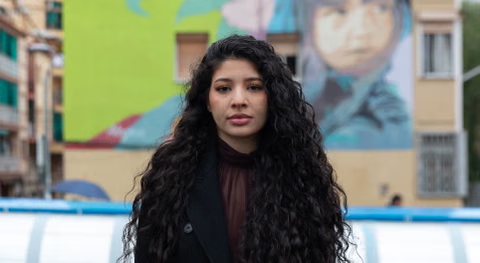
The security camera pictures from Barajas airport capture the moment that Nada and the white-shirted Morales line up to board the plane. The image of this bright child waiting in her spotty dress at the airport is heartbreaking. The best that can be said about what followed is that she survived. That alone is a triumph – a tribute to Nada, along with a small number of others who came to her rescue. Nada is now 21 – a serious, hard-working law student at Barcelona University. As she grew up, she found very few people were interested in asking her what happened after she stepped into that aircraft. It is only in recent years that she herself has begun to find out the full details of a nine-month-long ordeal that she tried very hard to forget.
It is a process she has chosen to undertake publicly. In some ways, the hours we have spent talking over the past few months form part of her process of recovery, but they also reflect Nada’s own ambition to confront the stigma and campaign against the global trafficking of children. “I don’t want to just be the girl who got kidnapped,” she told me. Staring into the camera at the immigration desk at the airport in Santa Cruz, Nada flashed a tired smile, her hair ragged from the trip. On the airport bus into the city, she stared out of the window. In Spain, Nada and her parents lived in a neighbourhood that was a byword for poverty, crime, drugs and despair. But, to Nada, Santa Cruz seemed even grubbier, shabbier, noisier. Children her age sold wares on the roadside. As they waited for a second bus to Morales’ home town of Cochabamba, they argued about her passport. Morales had kept hold of it. Now he claimed it was lost, and blamed her. They would have to stay longer while he got her a new one, he said. It was then that Nada realised she had been tricked. She wept loudly and banged at the bus window, crying for her mother.
The Reality Of Captivity In Bolivia
Morales had claimed to be wealthy, but his mother’s home outside Cochabamba was a dump. They spoke Quechua, an Indigenous language that Nada didn’t understand. Morales and Nada moved into a ramshackle two-storey brick building on a dirt road in Cochabamba that belonged to his absent brother Fidel. A woman called Cristina and her two daughters rented the downstairs. Morales rang Nada’s parents twice briefly. On one call Nada was able to tell her panicked mother that her passport had gone. On the other she blurted out an urgent request. Could she please tell her teacher that she had chickenpox? That way, the school would not strike her off its books. One night she dreamed that Morales was on top of her and, when she awoke, she found his hands on her thighs. Nada screamed and rushed to the window, hoping that someone might hear her cries for help.
Nada was tall for her age, about the same height as Morales, but he was stronger and dragged her back. Today she recalls it as “the worst night of my life”. Over the next few weeks, during the day Nada would skip rope with Cristina’s daughters and borrow their Barbie. At night the abuse continued. Morales never let Nada out of his sight, so when his phone rang a week or two later, she overheard the voice of a Bolivian policeman, demanding that he turn himself in and hand her over to the authorities. Unbeknownst to her, Nada’s parents had reported her missing, sparking a police hunt on two continents. Yet this call made her life worse. Morales took out his sim card and smashed the phone. Even a nine-year-old child could see what was happening. He was now a fugitive from justice, and Nada was his captive.
The morning after, Morales ordered Nada to grab a few of her things and shortly after, they boarded a long-distance bus. Morales behaved as if they were Bonnie and Clyde, two fugitives who were joyfully on the run together. He also gave her a new name. She was now Evelyn and would pose as his niece. He made her cover her head with headscarves and wear long dresses. Nada told me such stories as if from a distance, like a bemused spectator. “I use the logical part of my mind to repress the emotional side,” she said. “I can tell all this so coolly because I don’t feel it.” During our conversations, her tone shifted only once, when describing how she had suddenly realised, on the day Morales changed her name, that she was powerless, no longer herself. She cried a few tears, but rapidly pulled herself together, apologising.
Survival In The Amazon Jungle
After more than six hours driving north-east, the bus dropped Nada and Morales near a town called Entre Ríos. From there, they hitchhiked to a rural settlement known as Villa Unión. Morales used his knack for starting conversations with strangers, then drawing them into his confidence. Within two days, he persuaded a farmer, Santos Rodríguez, to employ them and they moved into his house, with his wife and two daughters. The next morning Nada was given a machete. She should have been starting back at school in L’Hospitalet. Instead, she began working from dawn to dusk, clearing fields, weeding pineapple crops and hacking at the encroaching forest. She washed their clothes in a creek. When Morales thought she wasn’t working hard enough, he beat her with a belt.
Morales told Nada they were earning money to pay for her passport. She had always applied herself to schoolwork and now she did the same to farm labouring. “I thought that was my only way out,” she told me. Nada learned to fish in the creek, make fire by rubbing sticks together and deal with snakes. If the snakes were small, the trick was to step on their head, grab their tail and hurl them away. If they were big, she called Morales or the other farm workers, who hacked at them with machetes. Apart from strength and experience, the men had an additional advantage: boots. Morales had only bought her rubber sandals. On Saturdays, Morales would take her to a place of worship that belonged to a controversial messianic Andean religion called Aeminpu, the Evangelical Association of the Israelite Mission of the New Universal Covenant.
Founded by a former Peruvian shoemaker, this fiercely conservative religion preaches a mishmash of beliefs, fixates on the Ten Commandments and sees signs of the apocalypse everywhere. One Saturday, Morales groomed himself carefully. Nada remembers watching a ceremony in which he stood on the stage and a man in a white tunic wafted incense. Words were intoned in Quechua. Men hugged him. Morales looked happy. Nada asked what had happened. “Now you are my wife,” he said. He became mean, jealous and more violent. At night, he raped her. One evening, as she washed in the river, he pushed her head under water and held it there. He repeated the action three times. Another day, she dared question his belief in God. Enraged, he struck her right foot with a machete, opening a hole down to her sole. They doused the wound in gasoline. She still has the scar.
The Intense Global Search For Nada
In the evenings, Morales made her repeat out loud the Ten Commandments. In the mornings, she had to tell him her dreams, which he would interpret. In her spare time, Nada drew birds, plants and flowers in her notebook. She labelled them in three languages – Spanish, Catalan and English. It was like schoolwork, which made her feel better. She clung on to her optimism. This would all be over one day, and she could go back to her family, and to school. In late December 2013, four months into her ordeal, Nada and Morales returned to his brother Fidel’s house in Cochabamba. As Nada listened to drunken neighbours celebrate New Year and calendars flipped to 2014, Lt José Miguel Hidalgo of Spain’s Civil Guard police was anxiously awaiting permission to fly to Bolivia.
At 45, Hidalgo was a lead detective in the homicide, extortion and kidnapping squad at the elite investigative Central Operative Unit (UCO) in Madrid. Nada’s case had landed on Hidalgo’s desk after her parents went to the Catalan police in the early hours of 5 September and tearfully tried to explain what had happened. In Spain, international investigations must go through a national police force such as the Civil Guard, so the two forces worked together. The Catalans tracked down Morales’s brother Fidel – owner of the Cochabamba house – who also now lived in the Barcelona area. Wiretaps were placed on Nada’s parents’ phones, and on those of his brother.
Confronting The Trauma and Moving Forward
Nada’s parents said they had trusted Morales. They believed that he wanted to dress her in jewels to smuggle back into Spain, but seemed confused. Even today, Nada is not sure whether Morales fooled them, or if they effectively sold her. Maybe both things are possible. They were undocumented immigrants living in the shadows of Spanish society. Her father – who drank, raged and bullied his wife – worked odd jobs for cash. Her mother cleaned houses. They squatted in a repossessed flat, with no running water and electricity stolen from the grid. Water was fetched from a public tap in the cemetery across the road. Nada used to push a shopping trolley there with her mother, to fill plastic bottles. As he investigated the case, Hidalgo’s concern for Nada grew.

He discovered that Morales had fled to Spain in 2005 using false documents to avoid trial in Bolivia for raping two half-sisters, aged 11 and 14. Worse still, it took four months for Hidalgo and a colleague to receive permission to travel – slowed by bureaucracy and fraught relations between a rightwing Spanish government and Bolivia’s leftwing president, Evo Morales. On 28 January, Hidalgo and a colleague finally reached Bolivia and two days later, police raided Fidel’s house in Cochabamba. When they arrived, they were greeted by Cristina, who informed them that Morales and Nada had left the previous day. “It was like in the movies,” said Hidalgo, when we met recently at the Civil Guard headquarters in Madrid. “You get so close, and then they disappear.”
In Cochabamba, Nada had watched Morales buying more farm tools and realised they were about to move again. He also bought her a guitar and a music book to learn Aeminpu songs. She was scared of him, so studied diligently. Within a week, she could strum and sing – but Nada hated that guitar. When they departed, on the morning of 29 January 2014, he made her carry it. More precious things, like some earrings her mother gave her, were left behind. As Hidalgo was making his way to Fidel’s house in Cochabamba, Morales and Nada were starting a journey deep into the rainforest by bus, taxi and on foot. Inside the forest, the trees grew so tall and dense that it was dark even during the day.
Rescue And The Long Road To Recovery
The men here carried guns. The green coca plants stretched out in neat long rows. Apart from that, the village felt remote in both distance and time. “Like something from the 12th century,” Nada recalled. Now she worked full-time in the plantations, picking coca leaves on day wages. It was her job to collect their pay from the farmers they worked for, and she secretly stashed away small sums of money, with the idea of buying herself a ticket home. Aircraft and helicopters occasionally flew overhead. Often, these were transport for the cocaine trade. Police were afraid to come here, and rarely did so. There was no escape. On 13 February 2014, Hidalgo and his colleague flew back to Spain frustrated. They had missed Nada by 24 hours and now she had disappeared again.
Three weeks later, on 2 March, Cristina received a call from Morales. Police were tapping her phone, and listened in. The conversation was mostly in Quechua but, suddenly, they heard a girl start speaking Spanish. It was Nada, asking about the maize she had planted in Cristina’s garden. She sounded upset when Cristina said that they had already eaten it. The call at least proved Nada was alive. Cristina’s phone showed that Morales had rung from a solar-powered public telephone deep in the Yungas de Totora region, an 18-hour hike from the nearest road. A police unit set out on 4 March, prepared to camp overnight and cross three large rivers, but a wooden bridge over the last river had been swept away. As they trudged back the next day, Nada turned 10 years old.
Hidalgo returned to Bolivia, arriving in Cochabamba on 7 March. Bolivian colleagues warned that the only way to reach her was by helicopter, but local narcos would shoot at any aircraft passing over their fields. They would have to do a deal. Over lunch at a restaurant in Cochabamba, Hidalgo sat down to negotiate with local leader Angel León, who held sway over the coca growers. “He took it as a matter of honour,” Hidalgo said, who also bought the farmers 500 kilos of sugar as part of the deal. León agreed to instruct his men to capture Morales and hold on to Nada. Police could then fly in, load them up, and immediately fly away. That night, Nada and Morales were in their cabin when they heard men wading across the river.
Soon a posse of rifle-carrying farmers appeared at their door, looking menacing in the gloom. Nada hid in a corner, sick with panic. Morales looked even more scared. The men tied Morales’s hands together, locked him in a wooden crate and told Nada to follow them. First, she grabbed her camera, notebook and money. A farmer took her into his family cabin, cradling his gun as he watched over her. She remained terrified. The following morning, an army unit provided two helicopters to take Hidalgo and a Bolivian police squad to rescue Nada. They took off at 11am, flying above the thick forest canopy. Twenty-five minutes later Hidalgo made out a clearing with a few houses. A Bolivian police officer pointed to a girl standing in the field with a bright blue headscarf.
 Hidalgo knew that for the operation to work, it had to be fast. “In and out, without cutting the engines,” the pilots at the Chimore airbase had told him. On the ground, Nada did not understand what was happening. The village was in a state of tension, the men at their cabin doors. The noise of the first helicopter grew louder and louder, until it landed in the field and a policewoman in a blue uniform ran towards her. “Are you Nada?” Nobody had called her by that name for months. She barely had time to reply when another helicopter landed. A tall man jumped out and asked the same question. It was Hidalgo. Hidalgo noticed that her voice had a marked Bolivian lilt and her skin was blistered with mosquito bites.
She began to cry. When they took off a few minutes later, Nada looked down, transfixed by the sight of the lush rainforest from above. The next 10 days went by in a flurry of activity. Nada was flown to Cochabamba, where she was given a bed at a state children’s home. There were new clothes, medical checks, interviews with police and prosecutors, outings to see the sights. Nada shared the dormitory with a group of teenage girls who brushed and styled her long, dark hair daily. No attempt was made to put Nada in contact with her parents, who were now being investigated by public prosecutors for allegedly risking their daughter’s life. Hidalgo consulted his wife, then bought Nada a colourful Monster High rucksack.
She was delighted. He was impressed by the girl’s resilience and intelligence. One of her main concerns was whether she would have to repeat the school year. “She was very bright, lively and grasped things really quickly,” he told me. She also translated basic Quechua words for him. To her, Hidalgo seemed like the sort of father she had only seen in movies – protective and caring. During the flight back to Spain, Hidalgo noticed that she slipped his uneaten bread roll into her pocket. She was still in survival mode. On 17 March 2014, seven months after she left Spain, 10-year-old Nada Itrab stepped off a flight at Barcelona airport, dragging her new rucksack behind her and clasping Hidalgo’s hand.
Related News:
 George Clooney and Amal Clooney Receive French Citizenship
 Shock US Raid: Maduro Pleads Not Guilty in Manhattan Court
 UK and France Agree Troop Deployment Plan for Ukraine
 Capitol Attack Anniversary Sparks Deep Political Divide
 EU Weakens as Trump Targets Venezuela and Greenland
 Saudi Officials Report Zubaidi Flee Before Yemen Peace Talks
 Venezuela Oil Deal Opens Tensions with US Control
 UK Targets in New York Bomb Threat Hoax: Man Jailed
 Trump Plans Venezuela Meeting, Warns of Cartel Land Strikes
 Gambia Supreme Court Hears Case to Overturn FGM Ban
 Trump Labels Renee Good a ‘Paid Agitator’ After Minneapolis ICE Killing
 Indonesia blocks Grok chatbot over sexual content risk
 US Citizens Warned to Venezuela Flee Amid Paramilitary Threats
 UK urges peaceful Iran transition amid escalating protests
 British skier killed in La Plagne avalanche tragedy
 UK Guantánamo Settlement Paid to Tortured Detainee
 Mandelson apologises over Epstein ties after public scrutiny
 Trump targets Iran trade with 25% tariff warning
 Rudd successor: Defence chief and former ministers considered
 Russia Moves to Bypass Sanctions, Securing India Oil Imports
 US Senate rejects resolution limiting Trump military powers
 Venezuela regime claims release of political prisoners signals new era
 Friedman Uninvited From 2024 Adelaide Writers’ Week
 Trump Calls Greenland Critical for US Security After Denmark Talks
 Gulf states warn Trump Iran strikes risk wider Middle East war
 Machado Trump medal gesture reshapes Venezuela power struggle
 Greenland defence seen as shared Nato duty amid troop arrivals
 Gulf states warn Trump Iran strikes risk wider Middle East war
 Geopolitical football: Iran, Trump and the World Cup clash
 Canada-China trade gains momentum in new strategic partnership
 Trump Receives Machado’s Nobel Medal in White House Meeting
 Iran unrest slows under brutal crackdown and global tensions
 Trump Allies Pursue $200m European Gas Pipeline Deal
 Syria President Declares Victory as Ceasefire Reached with SDF
 US Considers Asylum for British Jews Amid Rising Antisemitism
 Starmer Challenges US Over Controversial Greenland Deal
 Chinese tourists drop sharply over Taiwan tensions
 Spoof “Make America Go Away” Caps Rally Denmark Over Greenland
 Trump slams UK ‘stupidity’ over Chagos Islands, eyes Greenland takeover
 More Than 100 Islamic State Inmates Escape Amid Syrian Clashes
 Trump Tightens Grip on EU and UK Energy Supply
 Shinzo Abe’s killer receives life sentence in Japan
 Starmer Resists Matching Trump Amid Greenland Tensions
 Netanyahu Accepts Trump’s ‘Board of Peace’ Invitation
 UK declines Trump’s ‘board of peace’ over Putin concerns
 Silence and Unity Mark Bondi Terror Attack Memorial
 Russia Strikes Kyiv and Kharkiv as Peace Talks Enter Day Two
 China General Under Investigation Amid Leadership Purge
 Philippines ferry disaster leaves 15 dead, dozens missing
 Israel Conditions Gaza Rafah Reopening on Hostage Search Completion
 Turnbull urges Albanese to confront Trump’s global ‘bully’ politics
 India-EU Free Trade Deal Marks Historic Economic Shift
 Iran Death Toll Crisis Exposed: Bodies, Mass Graves, and Concealment
 Crisis Looms as Liberals Debate Sussan Ley Future
 Cambridge Faces Scrutiny Over Arms Investment Transparency
 Files Link Andrew to Epstein Dinner After Prison Release
 Thousands Protest ICE Operations in Nationwide US Day of Action
 US-Cuba Negotiations Shift as Oil Blockade Looms
 Trump softens stance on Chagos Islands deal after Starmer call
 Epstein UAE Emails Shake British Royal Andrew’s Legacy
 Europeans oppose US after Greenland threat, poll shows
 Christchurch Shooter Seeks to Overturn Guilty Plea in Appeals Court
 Minnesota Nurse Saves Refugees, Witnesses Tragedy Decades Later
 Christchurch gunman seeks to vacate guilty plea
 UK Experts Raise Alarm Over Machinery Export to Armenian Firm
 Liberal Fallout: Taylor Challenge Casts Shadow Over Sussan Ley’s Leadership
 Infantino Faces Russia Threat and Trump Concerns at Uefa Congress
 Concerns rise for Canberra boy amid Iran detention fears
 Ukraine, Russia Meet in Geneva Ahead of War Anniversary
 UK, US Medics Barred from Gaza Amid Rising Aid Concerns
 Sydney Businessman Falsely Claimed Security Advice Came From Kevin Rudd
 Al-Aqsa Tensions: Status Quo at Jerusalem’s Holy Site Collapses
 Drives Mumbai Residents Crazy Over ‘Musical Road’
 Caribbean Leaders Urge Dialogue Amid US Oil Embargo on Cuba
 Brazilian Politician Brothers Sentenced for Marielle Murder
 Cuba Kills Exiles in Speedboat Attack from US Waters
 Kerala Set to Be Renamed Keralam in English Records
 Anthony Albanese Must Uphold Rights for All Australians
 Woman Executed in Somalia Sparks Debate on Justice System
 US Accused of Exploitation Over Zambia Health Aid