Published: March 5, 2026 | The English Chronicle Desk | The English Chronicle Online
A group of students and supporters gathered in Manchester to mourn Iran’s Supreme Leader, Ayatollah Ali Khamenei, following reports that he was killed during coordinated US and Israeli strikes on Tehran. The vigil, held in the university district of the city, drew both mourners and counter-protesters, highlighting the deep divisions surrounding the Iranian leader’s legacy and the ongoing Middle East crisis.

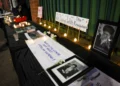
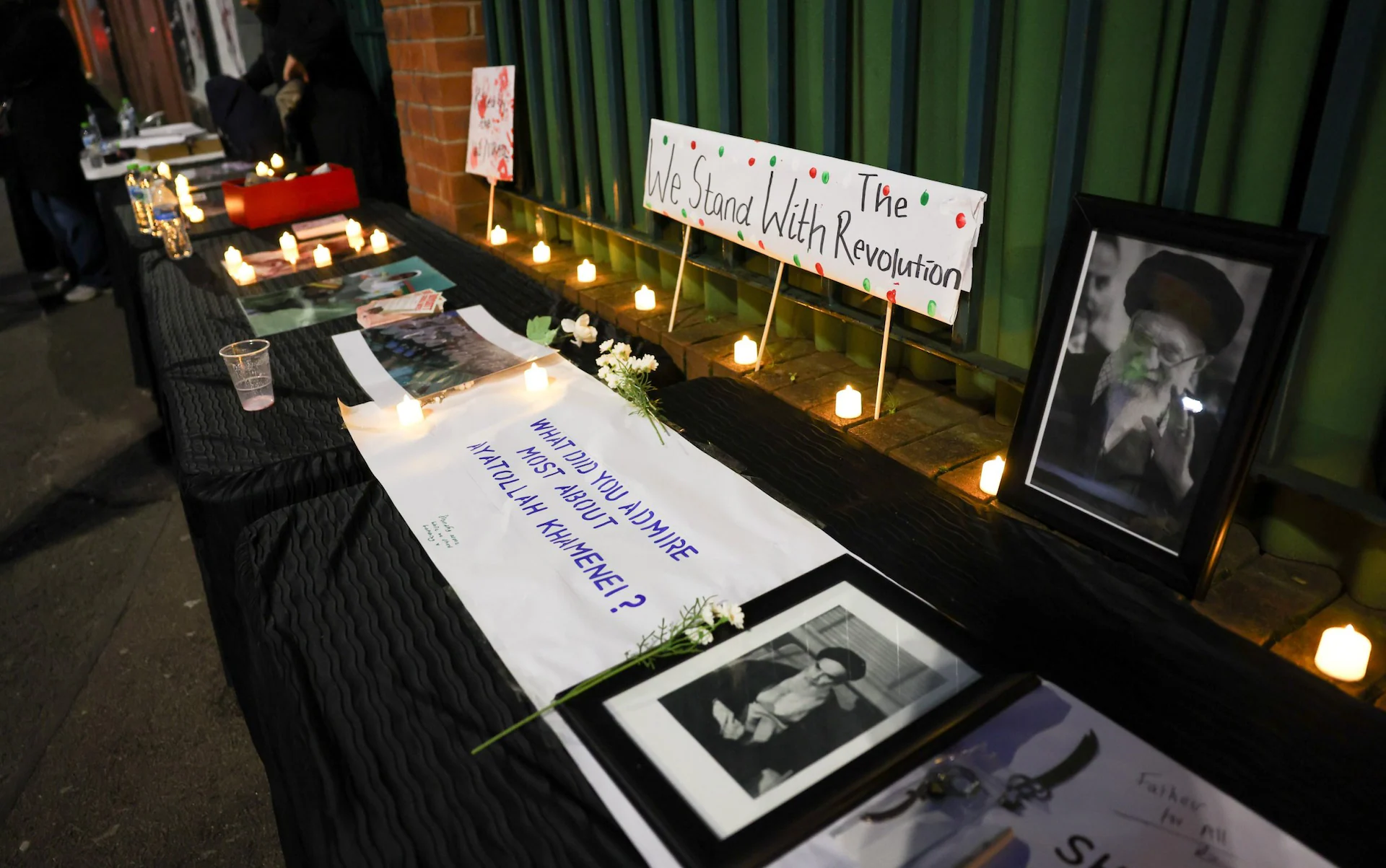
The candlelit gathering took place on Sidney Street near Oxford Road, an area close to several university campuses. Around 100 participants attended the vigil, many holding photographs of the Ayatollah and displaying the flag associated with the current Iranian regime. A sombre atmosphere marked the event as people lit candles and placed images of the Iranian leader on a table draped in black cloth.
Some mourners held handwritten messages expressing loyalty to the late leader. One sign read: “You can kill a man but you can’t kill an ideology,” while another message beside a photograph declared support for Ayatollah Khamenei and described him as a symbol of resistance.
The vigil was reportedly supported by individuals linked to the Friends of Islamic Centre of Manchester, according to promotional material circulated ahead of the event. Organisers said the gathering was intended to allow members of the community to express grief and solidarity following the death of the Iranian leader.
However, the memorial quickly became the focal point for opposing demonstrations. A much larger group of counter-protesters—estimated between 300 and 400 people—assembled nearby to celebrate the Ayatollah’s death and condemn the Iranian regime.
The counter-protest had a markedly different atmosphere from the vigil. Participants waved British and Israeli flags as well as the pre-1979 Iranian national flag associated with the monarchy that ruled before the Islamic Revolution. Some demonstrators played music and danced in the street, while others burned photographs of the Ayatollah.
Police maintained a significant presence throughout the evening to prevent clashes between the two groups. Greater Manchester Police closed parts of the street to traffic and erected barriers to keep the opposing demonstrations separated.
Assistant Chief Constable Chris Sykes said the authorities were aware that the events in the Middle East were deeply emotional for many people in the region’s diaspora communities living in Britain.
“The events in the Middle East are significant for those in Greater Manchester with ties to Iran and the wider region,” he said. “It is understandable that these evoke a range of views and emotions.”
Police also confirmed that they had engaged with organisers of both gatherings in advance and received assurances that the events would remain peaceful.
The vigil in Manchester reflects broader reactions across the United Kingdom following reports of Ayatollah Khamenei’s death. In several cities, small groups of supporters held tributes and prayer gatherings, while critics of the Iranian regime organised celebrations or protests against the cleric’s rule.
The death of the Ayatollah has triggered intense debate in Britain and internationally. Some student societies at universities across the country issued statements expressing condolences and referring to the Iranian leader as a “martyr.” These messages have prompted calls from some politicians and analysts for investigations into the influence of pro-Tehran groups on university campuses.
Critics argue that praising the Iranian leader overlooks his government’s record on human rights and its involvement in regional conflicts. Western governments have long accused Iran’s leadership of suppressing dissent, supporting militant groups abroad and carrying out security operations beyond its borders.
Supporters of the vigil, however, insist the gatherings are expressions of religious or political solidarity rather than endorsements of violence. Several student groups have defended their right to express grief and political views under principles of free speech and academic freedom.
The broader geopolitical context has further intensified the debate. Ayatollah Khamenei was reportedly killed during strikes carried out by the United States and Israel targeting Iranian military infrastructure and leadership figures. The operation has dramatically escalated tensions in the Middle East and triggered retaliatory attacks across the region.
In Britain, reactions have been mixed. Some Iranian expatriates and dissidents celebrated the news, seeing it as a potential turning point for political change in Iran. Others expressed grief or concern about the instability that could follow the removal of the country’s long-serving supreme leader.
The events in Manchester therefore became a visible example of these sharply contrasting perspectives within diaspora communities. For mourners gathered at the vigil, the Ayatollah represented a religious and political figure worthy of tribute. For their opponents across the street, he symbolised decades of repression and conflict.
Despite the strong emotions on both sides, the demonstrations concluded without major incidents. Police confirmed that both groups dispersed peacefully after the event, although officers remained in the area for several hours as a precaution.
The episode illustrates how global conflicts can resonate far beyond their immediate geographic boundaries. Universities and diaspora communities often become spaces where international political struggles are reflected in local debate and activism.

As the wider crisis in the Middle East continues to evolve, similar demonstrations and counter-demonstrations may occur in other cities with large international communities. For authorities, maintaining public safety while protecting the right to protest remains a delicate balance.
In Manchester, the candlelight vigil and the celebratory counter-protest offered a stark reminder that the legacy of the Ayatollah—and the future of Iran—remains deeply contested far beyond the borders of the Middle East.
Related News:
 Police Assessing Stansted Airport Private Flights Over Epstein Ties
 Muslim Group Wants Mosques to Be Used as Polling Stations Ahead of UK Elections
 UK Must Act with Courage and Clarity on Israel-Palestine Conflict, Says Foreign Affairs Committee Report
 Starmer and Trump to Meet in Scotland Amid Growing Gaza Ceasefire Pressure
 MPs Call on UK Government to Delay Biometric Visa Checks for Gaza Students Amid Humanitarian Crisis
 Radioactive Leak at UK’s Nuclear Warhead Base Sparks Outcry Over Safety and Secrecy
 Mutual Inconvenience: Why Alaska Was Chosen for the Trump-Putin Summit on Ukraine
 “I Don’t Expect to Live a Normal Life”: How a Leeds Teenager Became the Target of a Chinese Bounty
 Ministers Accused of Defamation Over Palestine Action Ban and Mass Arrests
 Is the UK Ready to Put Boots on the Ground in Ukraine? Assessing Military Capacity and Challenges
 Protests Expected as Israeli Arms Firms Join Global Defence Trade Fair in London
 UK Home Office to Launch French Beach Signage to Warn Asylum Seekers of Risks
 UK Immigration Figures: Separating Facts from Perceptions
 Far-Right Rally in London Draws Record Crowds Amid Clashes with Police
 Thousands Gather in London to Protest Donald Trump’s Second UK State Visit
 Trump Urges UK to “Call Out the Military” to Secure Borders Amid State Visit
Trump’s UN Speech Criticises London and UK Policies, Draws Far-Right Attention
Trump Urges UK to “Call Out the Military” to Secure Borders Amid State Visit
Trump’s UN Speech Criticises London and UK Policies, Draws Far-Right Attention
 UK Fighter Jet Purchase Could Breach Nuclear Treaty, Warns CND
 A Third of EU Citizens in UK Report Discrimination by Public Bodies Post-Brexit
 Jailed Georgian Opposition Leaders Warn UK of Iranian Links to Ruling Party
 Russia repeatedly targets UK military satellites, warns Space Command chief
 Pro-Palestine March to Proceed in London Despite Calls to Cancel After Manchester Attack
 UK Universities Warn Students Ahead of 7 October Pro-Palestine Protests
Starmer Considers Stricter Measures on Pro-Palestinian Protest Chants
UK Universities Warn Students Ahead of 7 October Pro-Palestine Protests
Starmer Considers Stricter Measures on Pro-Palestinian Protest Chants
 Public Trust in SNP Hits Historic Low Amid NHS Concerns
 Tony Blair Met Jeffrey Epstein at Downing Street in 2002
 Johnson Suggests Mandelson Linked to China Spy Controversy
 Witness statements reveal the CPS China spy row collapse in the UK
 Large scale Chinese spying in UK sparks political storm
 Nigel Farage Calls Vladimir Putin ‘A Very Bad Dude’
 Rachel Reeves signals welfare reform ahead of key budget
 Prince Andrew met alleged Chinese spies during Pitch@Palace China trips
 Kosovo agrees to host Britain’s refused asylum seekers
 Plaid Cymru Triumphs in Caerphilly, Ending Labour Century-Long Hold
 Rachel Reeves to lead UK trade push in Saudi Arabia amid rights debate
 British Woman in Iran ‘Losing Hope’ Amid Ongoing Detention
 Johnson Approved China’s London ‘Super-Embassy’ in 2018
 BBC Journalist Held and Interrogated in Vietnam
 BBC director-general and news chief resign amid bias row
 New review urges UK to repatriate Shamima Begum, others from Syria
 Rama Rebukes Mahmood for Targeting Albanian Families
 Russian Vessel Used Lasers on RAF Pilots, UK Claims
 Britain Demands Israel Reverse Ban on Aid Groups
 US Africa aid remarks spark anger after leaked State email
 Starmer China visit raises human rights pressure on Beijing
 Emails Show Epstein Funded Mandelson’s Husband After Jail
 Cory Bernardi joins One Nation for SA election
 Starmer Condemns ‘Depraved’ Russian Strikes on Ukraine
 Russia Trolls Savage ‘Finished’ Keir Starmer After Mandelson Scandal Explodes
 Starmer Weighs Fast-Tracking Defence Boost
 Snow and Rain Warnings as Cold Snap Continues in the UK
 ‘Just Push Us Into the Sea’: The Frustration of an Area Failed by Politics
 Last‑ditch Call to Save Police Front Counters in London
 Britain’s Special Needs Spending Crisis Will Be Labour’s Ruin
 Britain’s Reliance on China Makes Us ‘Weak Link in the West’, Warn MPs
 Trump Warns Over Chagos Islands Deal
 Trump and Chagos Deal Rift Over Iran Strikes
 How Much Could Andrew’s Arrest Hurt the Royal Family?
 Andrew Mountbatten-Windsor Arrest After FBI Radar
 UK Has Not Given US Permission to Use RAF Bases for Iran Strikes
 Break from Wintry Weather as UK Temperatures to Climb to 14 °C
 Fury as Jobless-Migrant Households Receive Benefits Worth £10bn – ‘We Need to End This’
 Australian PM Says Former Prince Andrew Has Suffered ‘Extraordinary Fall’ but That Won’t Prompt Republic Referendum
 Schools in England to Get Budget for Children with Special Needs as Part of SEND Overhaul
 What’s Next for Andrew Mountbatten-Windsor’s Ex-Wife, Sarah Ferguson?
 Farage Chagos Islands Row Sparks Fury
 Trump Tariffs Threat Spark UK and EU Alarm
 Town Vigil Marks Four Years of Ukraine War
 New Zealand Backs Removing Andrew From Royal Line of Succession
 Inside Kyiv’s resolve as conflict nears five‑year mark
 What to Watch for During Trump’s State of the Union Address
 Green Party Triumphs in Gorton and Denton By‑Election
 UK Allows US Base Use Amid Iran Tensions
 Britain’s Position and Trump Vows to Press On in Iran Conflict
 Starmer Speaks to Trump After UK Joins Defensive Operation
 UK Will Allow US to Use Bases to Strike Iranian Missile Sites, PM Says
 Cooper: Joining US Strikes on Iran ‘Not in Britain’s Interest’
 Sarwar Rejects Father’s Tribute to Iran’s Supreme Leader
 Trump Rebukes Starmer Over Iran Strikes Row
 Why Aren’t Our Dirtiest Roads Getting Cleaned?