Published: 06 March 2026. The English Chronicle Desk. The English Chronicle Online.
The future of the Nissan Sunderland plant has become a major concern within the British automotive sector this week. Reports suggest the Japanese carmaker fears its flagship UK factory could face closure under proposed European industrial rules. Industry leaders say the situation highlights growing uncertainty surrounding trade relations between Britain and the European Union.
According to reports circulating across industry and policy circles, executives from Nissan privately warned the UK government about the potential risks. The company reportedly expressed concern that new European subsidy plans could exclude British-built electric vehicles. If these proposals become law, the Nissan Sunderland plant could struggle to compete within the continent’s evolving electric vehicle market.
The warning centres on the European Commission’s proposed Industrial Accelerator Act, introduced as part of a broader strategy to strengthen the continent’s green technology sector. European policymakers say the measure aims to protect manufacturers from intense global competition, particularly from rapidly expanding Chinese electric vehicle producers. However, critics argue the proposed rules may unintentionally penalise manufacturers located outside the European Union, including the United Kingdom.
Under the current proposal, certain public subsidies would only apply to electric vehicles assembled inside the EU. These incentives are intended to accelerate electric vehicle adoption and support Europe’s transition toward cleaner transportation. Yet industry figures say the rules could leave British manufacturers excluded from a significant portion of the market.
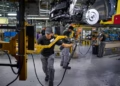
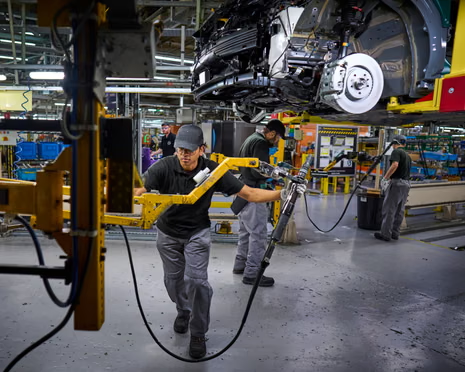
The Nissan Sunderland plant, located in northeast England, represents one of the most important manufacturing sites in the UK automotive industry. The factory currently employs around six thousand workers and has the theoretical capacity to produce six hundred thousand vehicles annually. Despite that impressive capacity, production levels remain below their peak following recent shifts in global demand.

Nissan has not publicly confirmed any intention to close the facility. Nevertheless, sources familiar with internal discussions suggest the company is seriously evaluating the potential consequences of the EU proposal. One senior industry executive reportedly described the situation as an “existential threat” if British factories lose access to European incentives.
The potential impact extends beyond Nissan itself. The Nissan Sunderland plant forms a crucial part of Britain’s wider automotive ecosystem, supporting thousands of additional jobs across supply chains and local communities. Many suppliers depend on the factory’s production schedules and future investment plans.
Industry representatives have therefore reacted with strong concern about the direction of the European proposals. The Society of Motor Manufacturers and Traders, which represents the UK automotive sector, warned that the plans could undermine decades of economic integration between Britain and Europe.
Mike Hawes, the organisation’s chief executive, said the proposed Industrial Accelerator Act could discriminate against vehicles built in Britain. He noted that the automotive trade relationship between the UK and EU is worth nearly seventy billion pounds annually. Any barriers affecting that relationship could therefore have serious economic consequences.
Hawes also suggested the proposal might conflict with the existing Trade and Cooperation Agreement signed after Brexit. That agreement established the current framework governing trade between the UK and European Union. If the subsidy rules disadvantage British-built vehicles, industry leaders believe it could challenge the spirit of that agreement.
One particular area of concern involves corporate vehicle fleets. These fleets account for a significant proportion of new car purchases across Europe and strongly influence the second-hand car market. Under the current proposal, financial support for corporate fleets may apply only to vehicles assembled within the EU.
If that requirement remains unchanged, vehicles manufactured in the UK could become ineligible for subsidies available to European competitors. For manufacturers like Nissan, which export large numbers of vehicles to continental markets, that limitation could significantly affect sales.
Concerns about the proposal are not limited to Britain. Germany’s influential automotive association, the VDA, has also expressed reservations about the new rules. Industry leaders there worry that protectionist policies could increase production costs and trigger retaliatory measures from trading partners.
Hildegard Müller, the president of the VDA, said the current proposal may fail to deliver the intended industrial benefits. She warned that restrictive subsidy policies could weaken competitiveness rather than strengthen it. Higher costs for manufacturers could ultimately affect drivers across Europe.
Meanwhile, European officials insist the proposal remains under discussion and may change during negotiations. Both the European Parliament and member states must approve the legislation before it becomes law. That process often involves amendments and compromises between national governments and policymakers.
A spokesperson for the European Commission said the Industrial Accelerator Act still allows cooperation with trusted partners outside the EU. However, the spokesperson confirmed that some financial support schemes would remain limited to vehicles produced within the bloc. That distinction has become the central point of tension for British manufacturers.
Experts say the broader issue reflects the complex economic realities created after Brexit. Although the UK and EU remain closely connected through trade agreements, industrial policies are increasingly diverging. As governments compete to build strong domestic clean technology sectors, subsidy rules have become particularly sensitive.
Professor Simone Tagliapietra, a senior fellow at the Brussels-based think tank Bruegel, believes the final legislation may ultimately adopt a more flexible approach. He noted that earlier drafts emphasised a strict “Made in Europe” model. Recent revisions, however, appear to move toward what he described as a “Made with Europe” concept.
Such an approach could allow cooperation with partners that maintain close trade relationships with the EU. Analysts say this framework might reduce the risk faced by factories like the Nissan Sunderland plant. Nevertheless, uncertainty remains while negotiations continue in Brussels.
The UK government is now working with industry leaders to better understand their concerns. Officials have begun discussions with car manufacturers, trade groups, and European counterparts to explore possible solutions. Maintaining smooth automotive trade remains a priority for British economic policy.
Business Secretary Peter Kyle recently travelled to Brussels to raise the issue with European officials. During the visit, he argued that Britain should be treated as a trusted partner within the continent’s green technology strategy. Government representatives believe closer cooperation would benefit both economies during the electric vehicle transition.
Supporters of the Sunderland facility say the factory has long demonstrated its value to the European market. Since opening in 1986, the plant has become one of the most productive car manufacturing sites in Europe. Its vehicles are exported across the continent and beyond, helping support thousands of British jobs.

The plant also plays a key role in Britain’s ambitions to lead the electric vehicle revolution. Nissan previously confirmed plans to develop new electric models at the site as part of its long-term investment strategy. Those plans include partnerships with battery manufacturers and suppliers in the surrounding region.
For workers and communities around Sunderland, the current debate therefore carries deep economic significance. Many families depend directly or indirectly on the plant’s continued success. Any uncertainty about its future naturally raises concern throughout the region.
Despite the warnings circulating this week, industry experts emphasise that no final decisions have been made. The European legislation remains under negotiation, and political discussions are continuing on multiple levels. Businesses, governments, and trade groups all hope a compromise can be reached.
For now, the Nissan Sunderland plant stands as a symbol of the complex challenges facing modern industrial policy. Balancing domestic priorities with international trade relationships has become increasingly difficult in a rapidly changing global economy. The coming months may determine whether cooperation prevails or new barriers reshape Europe’s automotive landscape.
As negotiations continue, both Britain and the European Union appear aware of what is at stake. The future of one factory may represent a broader test of how closely the two economies can remain connected in the electric age.
Related News:
 Tories Push to Dilute Labour’s Workers’ Rights Bill
 Wales May Introduce Four-Day Work Week After Elections
 Trump’s UK Ambassador Urges North Sea Drilling to Strengthen US Ties
 Rachel Reeves Set to Break Labour Pledge and Raise Income Tax
 Thinktanks Urge Rachel Reeves to Reform UK Tax System
 Company linked to Michelle Mone owes £39m in tax
MPs Press Rachel Reeves to Hike Gambling Taxes
Company linked to Michelle Mone owes £39m in tax
MPs Press Rachel Reeves to Hike Gambling Taxes
 Cuts to home insulation funding threaten UK climate goals
 Millionaires group urge Reeves to introduce wealth tax to ‘lift kids out of poverty’
 Canada Passes Carney’s First Budget in Tight Parliamentary Vote
 PM Highlights UK Business at G20 in South Africa
 English Mayors Set to Introduce Tourist Taxes
 India’s Labour Law Overhaul Sparks Fierce Debate
 Carney’s Alberta Pipeline Deal Sparks Immediate Pushback
 Starmer Says Labour’s Economic Plan Needs Years to Deliver
BBC bosses ‘right to stick by their guns’ against Trump, says minister
Starmer Says Labour’s Economic Plan Needs Years to Deliver
BBC bosses ‘right to stick by their guns’ against Trump, says minister
 Closer EU Trade Ties ‘Strategic Necessity’ for UK Firms
 Austrian Airlines Halts Tehran Flights Amid Political Unrest
 Starmer links foreign trips to tackling cost of living crisis
 Mark Carney Walks Diplomatic Tightrope on China Visit
 Government Unveils Northern Powerhouse Rail Plans
 China Dependence Threatens UK Energy Supply Chains and Jobs
 MPs warn AI financial risks threaten UK stability
 MPs warn AI financial risks threaten UK stability
 Trump Fed bid heads to Supreme Court
 Starmer Plans UK-China Visit Amid Business and Diplomatic Goals
 UK Government Borrowing Drops to £11.6bn in December
 Labour Must Revive High Streets to Avoid Election Collapse
 Keir Starmer meets Xi to strengthen UK-China economic relations
 UK food industry urges transition if post-Brexit rules reset
 AstraZeneca China Investment Signals Strategic Shift Abroad
 EU Signals Open Mind on UK Customs Union Talks
 Barclays drops Global Counsel after Mandelson link scrutiny
 Unsustainable gaps in franchise policing, MPs warn
 UK shelves £110m border project amid trade strain
 Sanders Condemns Billionaire ‘Greed’ in California Tax Debate
 Tim Wilson Backs RBA Dual Mandate Amid Inflation Debate
 UK Sees Record £30.4bn Budget Surplus, Boosting Reeves’ Position
 SNP Charging £750 per Ticket for Business Event Featuring ‘Beer and Blether’ with Stephen Flynn
 Tax Reform Tensions Deepen Amid Bill Kelty’s Capital Gains Tax Challenge
 Ministers Urged to Ban Crypto Political Donations
 Reeves Must Back Defence Plan or Face Dismissal, Says Unite Chief
 OBR Reform Row Deepens Before Spring Forecast
 Kemi Badenoch Unveils ‘Golden Rule’ to Halve Spending Cuts for Deficit Reduction at Tory Conference
 Reeves Faces Setback as Labour May Miss Homes Target
 Army Officers Orders to Cut Ties with Men-Only Clubs
 Ryanair Chief UK Economy ‘Doomed’ Under Labour
M&S Profits More Than Halve After Cyber-Attack
BBC to Apologise Over Edited Trump Speech Amid Backlash
Ryanair Chief UK Economy ‘Doomed’ Under Labour
M&S Profits More Than Halve After Cyber-Attack
BBC to Apologise Over Edited Trump Speech Amid Backlash
 Britain deploys RAF specialists to assist Belgium with drone threats
 Reeves rejects £1bn plea for NHS redundancy payouts
 PM Condemns Leaks, Vows Loyalty to Ministers and Stability
 Greene Pushes Epstein Files Amid Trump Fallout
 Shadow Fleet at Sea: Europe’s Battle Against Illicit Oil Shipping
 Khaleda Zia Death in Bangladesh: First Female PM Dies at 80
 US Senate rejects resolution limiting Trump military powers
 UK Ministers Drop Foreign Student Targets for Global Education Push
 No Gas Boiler Ban as UK Warm Homes Plan Backs Heat Pumps
 Shinzo Abe’s killer receives life sentence in Japan
 Sussan Ley leadership milestone shakes Liberal future
 EU Says US Ties Have Suffered ‘Big Blow’ After Greenland Crisis
 Police response times face strict new national limits
 US Dollar Hits Four-Year Low Amid Market Turmoil
 UK New Car Discounts Near £6,000 as Prices Are Slashed
 Australia’s Opposition Coalition Reunites After Rift
 BT Names New Openreach Chief Amid Major Fibre Expansion
 Could Manchester Lead the UK’s Economic Revival?
 Australian Families Leave Syrian Camp for Home
 Farage to Name Jenrick as Reform Chancellor Pick
 Civil Service Pay: Union Urges Ministers to End ‘Barking Mad’ Limits
 Antonia Romeo appointment sparks criticism
 Farage Chagos Islands Row Sparks Fury
 UK Job Vacancies Hit Five-Year Pandemic Low
 UK Youth Unemployment Surges Amid Tax Changes
 Reform UK targets workers’ rights repeal
 Strong Rebound for UK Housing Market Sees 6% More Homes
 Russian Trade Routed Through British Islands Exposed
 Mandelson Arrest: Met Apologises to Hoyle
 Germany Faces Backlash Over Scrapped Renewable Heating Mandate
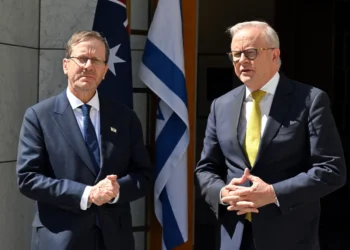 Herzog Asio meeting sparks security storm