Published: 28 August 2026. The English Chronicle Desk. The English Chronicle Online
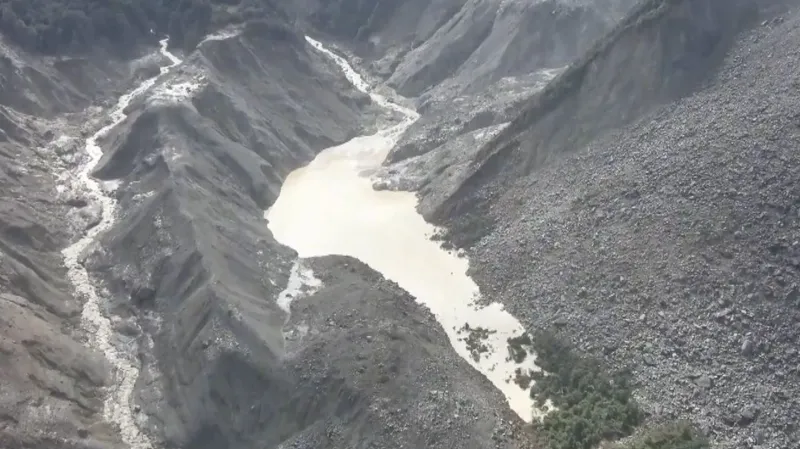
China has warned of a “high risk” that a newly formed barrier lake near the Nepal-Tibet border could breach its banks and unleash another potentially destructive flood downstream, adding to fears in a region already devastated by a deadly flash flood.
The warning comes days after a catastrophic flood swept through valleys along the Nepal-China border, killing hundreds of people and leaving hundreds more missing. Scientists believe the initial disaster was triggered by the collapse of part of a mountain glacier into a river, sending a powerful surge of water and debris downstream.
Now authorities are closely monitoring a large body of water that has accumulated behind a natural debris barrier. A sudden breach could send another wave of water into areas that have already suffered extensive damage.

According to China’s state broadcaster CCTV, an estimated 2.5 million cubic metres of water had accumulated in the barrier lake by Friday. Officials expected another three million cubic metres of water to flow into the lake between Thursday and the weekend, creating what authorities described as a high risk of a breach.
The situation has been made more complicated by forecasts of heavy rain in the coming days. Additional rainfall could increase pressure on the natural barrier and make it more difficult for emergency teams to control the situation.
A barrier lake forms when landslide material, rocks, ice or other debris blocks the normal course of a river. Water then accumulates behind the obstruction. Such lakes can remain stable for a period, but if the barrier becomes saturated, erodes or is overtopped, the accumulated water can be released rapidly.
The lake in question formed near the confluence of the Chhochen Khola and Purepu Tsangpo rivers, several kilometres upstream from Gyirong Port, a major crossing connecting Nepal and China.
The area has been particularly vulnerable since the devastating flood earlier in the week.
China’s Ministry of Water Resources said the barrier lake had begun overflowing on Thursday. The continuing overflow prompted emergency officials to exercise caution, with many Chinese rescue workers stopping at a village about 7km from Gyirong Port.
CCTV reported that the lake was “overflowing non-stop” at the time, raising concerns that additional flooding or debris flows could occur downstream.
The development temporarily disrupted rescue operations in an area where emergency teams were already attempting to locate missing people and assess the damage caused by the first disaster.
By Friday afternoon, however, Chinese state media reported that the risk posed by the upstream barrier lake had come under control and that rescue operations had resumed.
Authorities have deployed engineering teams to monitor water levels and atmospheric conditions around the lake. Drones have also been used to deliver equipment and supplies, allowing emergency personnel to support operations in difficult mountainous terrain.
The lake is located near Langtang Lirung, a major Himalayan peak from which the collapsed glacier is believed to have originated. Its position upstream from Gyirong Port means that any major release of water could have consequences for communities and infrastructure farther down the valley.
The latest warning highlights the continuing dangers facing the region even after the immediate force of the original flood has passed.
The initial disaster struck with little warning. Scientists have said that part of a glacier near Langtang Lirung likely collapsed into a river, creating a massive surge that carried water, rock, mud and other debris downstream.
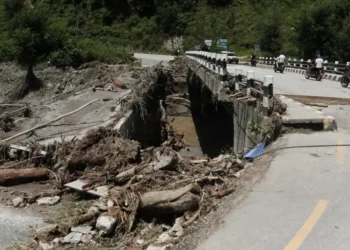
The resulting torrent devastated parts of Nepal and Tibet. Villages were inundated, roads and bridges were destroyed and infrastructure was swept away. The disaster also struck an area popular with trekkers, tourists and pilgrims travelling through the Himalayan border region.
Hundreds of people have died in Nepal, while many others remain unaccounted for. On the Tibet side alone, Chinese state media has reported that more than 550 people are missing, with foreign nationals accounting for a substantial proportion of those unaccounted for.
The prospect of a second flood has therefore created additional anxiety for communities already dealing with the loss of family members, damaged homes and disrupted communications.
Nepali authorities have issued their own warnings about the possibility of further flooding. They have raised concerns that debris and other blockages could obstruct waterways along the Bhote Koshi and Trishuli rivers.
People have been urged to remain away from rivers until authorities determine that the danger has passed.
The warnings are particularly important because rivers in the Himalayan region can change rapidly following landslides and glacial collapses. A blockage upstream can temporarily reduce water flow before a sudden release creates a powerful downstream surge.
For emergency teams, such conditions make rescue work particularly difficult. Roads may be damaged or completely inaccessible, while unstable slopes and continuing rainfall can create additional landslide hazards.
The use of drones and engineering teams reflects the effort to monitor the changing conditions without unnecessarily exposing rescuers to unstable terrain.
The latest events have also drawn renewed attention to the relationship between Himalayan hazards and a changing climate. Glaciers and high-altitude landscapes are particularly sensitive to changes in temperature and precipitation, although determining the precise contribution of climate change to any individual glacier collapse requires detailed scientific investigation.
Scientists studying the disaster have stressed that the initial flood was associated with a collapse of ice and rock rather than the earthquake that was initially suspected in early reports.
The combination of a glacier collapse, steep Himalayan terrain and large quantities of loose debris created the conditions for an exceptionally powerful flow.
The formation of the new barrier lake demonstrates how one geological event can generate a chain of hazards. A glacier collapse can trigger a flood, the flood can move enormous quantities of sediment and rock, and that debris can subsequently block another river, creating a new body of water with the potential to cause another flood.
That sequence is now at the centre of emergency planning along the border.
Authorities are watching the lake’s water level while also monitoring rainfall and atmospheric conditions. The immediate objective is to determine whether the natural barrier can withstand the additional water entering the basin.
If the barrier remains stable, controlled overflow could allow emergency operations to continue. If it fails suddenly, however, a large volume of water could be released in a short period, potentially carrying mud, rocks and other debris with it.
The risks are particularly serious because the surrounding terrain is mountainous and confined. Water released in an upper valley can accelerate rapidly as it moves through narrow channels, leaving communities downstream with limited time to respond.
For residents and families affected by the first flood, the uncertainty is difficult to separate from the ongoing search for missing relatives.
Rescue workers are simultaneously dealing with the aftermath of the original disaster and preparing for the possibility that another major event could occur.
The warnings also underline why authorities in both Nepal and China have been urging people to avoid river channels and follow official safety instructions.

The situation remains fluid. Although Chinese state media said by Friday afternoon that the immediate risk from the upstream barrier lake had been brought under control, continued inflows and forecast rainfall mean that monitoring remains necessary.
The scale of the water already accumulated behind the natural barrier illustrates the potential consequences should conditions deteriorate.
For the Himalayan communities affected by this week’s disaster, the threat has therefore not ended with the first flood. Search and rescue operations continue amid damaged infrastructure, unstable terrain and difficult communications, while authorities remain alert to the possibility of another sudden release of water.
The newly formed lake is a stark reminder of the unpredictable chain of events that can follow a major glacier or landslide collapse. As emergency teams continue their work, the priority remains protecting communities downstream, locating missing people and preventing a second disaster from compounding an already devastating loss of life.
Related News:
 Venezuela Quake Death Toll Surpasses 4,000
 Wildfires Force Mass Evacuations in France And Spain
 Powerful 7.7-Magnitude Earthquake Hits Eastern Indonesia
 Wildfires rage across Europe as hundreds arrested in France
 Nepal-Tibet Flood Leaves 270 Dead and 1,400 Missing
 Nepal Flood Death Toll Tops 300 as Second Flood Feared