Published: 10 November 2025. The English Chronicle Desk. The English Chronicle Online.
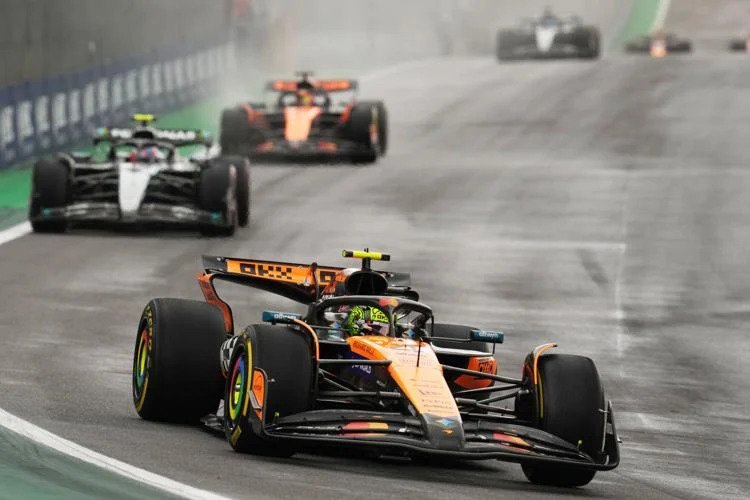
Lando Norris delivered a spectacular performance at the Brazilian Grand Prix, closing in on the Formula 1 world championship with an emphatic victory at Interlagos. The British driver’s flawless weekend not only saw him win from pole position in both the sprint and main races but also capitalized on misfortunes for his closest rival, Oscar Piastri, who was penalized 10 seconds, finishing only fifth. The result gives Norris a 24-point advantage over Piastri in the championship standings, while Max Verstappen trails by 49 points, with just 83 points left across the final three rounds in Las Vegas, Qatar, and Abu Dhabi.
The Brazilian GP weekend was a perfect showcase of Norris’s skill, composure, and mental fortitude. After an early-season setback at Zandvoort where a mechanical failure left him trailing Piastri by 34 points, Norris has executed a remarkable turnaround. A 58-point swing over the subsequent six rounds has put him firmly in control of the title race, demonstrating resilience and consistency under intense pressure. The Sao Paulo double-header, starting with the sprint race on Saturday, saw Norris assert his dominance from the outset. He converted his pole position advantage into a commanding lead in the main race, navigating the chaotic opening laps and rolling starts with precision.

The Sunday main event began with early drama. Gabriel Bortleto’s crash on lap six caused a rolling start, but Norris handled the disruption flawlessly, holding off Kimi Antonelli’s charge and establishing a gap that would ultimately prove unassailable. Meanwhile, Piastri’s hopes were severely dented after a 10-second penalty for leaving insufficient space during an overtaking maneuver dropped him from second to eighth, limiting his recovery to fifth place by the finish. “He left me with no space,” Piastri protested, but the penalty was enforced at his pit-stop, effectively curbing his championship challenge.
Max Verstappen’s race was nothing short of remarkable. After a disappointing qualifying session that placed him 16th on the grid, Red Bull undertook an extensive overnight overhaul, including a new engine, allowing Verstappen to remain in contention. A pit-lane start, combined with an early suspected puncture on lap seven, forced him into a tactical recovery. Displaying trademark aggression and skill, Verstappen carved through the field, briefly leading on lap 51, but a second pit stop on lap 34 for soft tyres reset his position to fourth. He ultimately overtook George Russell in a thrilling battle with eight laps remaining, but Kimi Antonelli held firm for second, denying Verstappen a podium finish that could have significantly tightened the title race.
Norris’s control of the race was defined by his impeccable starts and racecraft. From the very first bend, he demonstrated awareness, precision, and confidence, holding off Antonelli and establishing a buffer that allowed him to manage tyre wear and race pace efficiently. The win was built not only on speed but also on strategic intelligence, as Norris’s team flawlessly executed pit stops and tyre management, ensuring minimal disruption from on-track incidents.
The broader implications for the championship are significant. Norris’s 24-point lead over Piastri means that, going into the final three rounds, he can afford to finish behind the Australian in individual races and still maintain a lead, making him the strong favourite for the title. Verstappen, despite his late charge in Brazil, remains 49 points adrift, mathematically still in contention but facing an increasingly uphill battle. The pressure now falls squarely on Piastri to deliver perfection across the remaining rounds, while Norris can continue to rely on consistency and composure to secure the championship.
In addition to the tactical brilliance and competitive intensity, the Brazilian Grand Prix underlined Norris’s growth as a complete driver. Questions surrounding his championship mentality earlier in the season appear answered, with his ability to remain composed under pressure, defend his position against aggressive challengers, and capitalize on rivals’ misfortunes proving crucial. The Sao Paulo victory also highlighted Norris’s seamless integration with his team, who have been instrumental in translating strategic decisions into results on the track.
Verstappen’s race, although ultimately falling short of a podium, demonstrated the Red Bull driver’s relentless competitiveness. Rising from near the back of the grid to finish third, his drive was a testament to skill, determination, and strategic ingenuity, ensuring that even in adversity, Verstappen remains a formidable force in Formula 1. The duel between Antonelli, Russell, and Verstappen added layers of drama to the race, but Norris’s unchallenged pace allowed him to dominate and underline why he is now the man to beat.

Norris’s performance in Brazil cements his position as a genuine championship contender. With a commanding lead, flawless execution across two races, and the psychological advantage of having demonstrated dominance over key rivals, Norris has placed himself firmly in the driver’s seat heading into the decisive final stages of the season. The Brazilian GP will be remembered not only as a milestone in Norris’s career but also as a masterclass in combining speed, strategy, and mental resilience.
As the season now moves to Las Vegas, Qatar, and Abu Dhabi, all eyes will be on Norris to see whether he can maintain his form and claim the long-coveted championship. With his skill, composure, and team support, the British driver has positioned himself as the favourite, while Piastri and Verstappen must summon exceptional performances to overturn his advantage. Brazil has provided a dramatic and definitive statement: Lando Norris is not merely in contention; he is the driver to beat.
Related News:
 Tension and Turmoil at Aston Villa v Maccabi Match
 Ronaldo Confirms Final World Cup and Plans Retirement
 Manchester City Announce Their Return in Style with Haaland Double and Debut Goals at Wolves
 FIFA Eyes Biennial Club World Cup from 2029, Plans Possible Expansion
 Germany and Northern Ireland Set for Crucial World Cup Qualifier Clash in Cologne
 Serbia Humiliated 0-5 by England in World Cup Qualifier
 Man City 2-0 Napoli: Haaland Reaches 50 Champions League Goals After Red Card Turns Tide
 Rashford’s Brilliance Stuns Newcastle as Barcelona Claim Champions League Victory
 Tributes Pour In as Former Liverpool Women Manager Matt Beard Dies Aged 47
 Liverpool Vs outhampton Set for Carabao Cup Clash at Anfield
 Ferguson Fires Scotland to Dramatic Comeback Win Over Greece
 England Thrash Wales as Rogers, Watkins and Saka Shine Bright
 Tuchel Criticises ‘Silent Wembley’ After England Win
 Clarke’s Anger Overshadows Scotland’s Historic Win
 Kane’s Double Seals England’s World Cup Qualification
 Barnes Inspires Newcastle to Champions League Triumph Over Benfica
City shine with PlayStation-style football to overwhelm Villarreal
Barnes Inspires Newcastle to Champions League Triumph Over Benfica
City shine with PlayStation-style football to overwhelm Villarreal
 Fabio Wardley stuns Joseph Parker to earn Usyk title shot
 Tottenham shine at Everton but Frank wary of title push
Matty Cash seals Villa win as City falter again at Villa Park
Tottenham shine at Everton but Frank wary of title push
Matty Cash seals Villa win as City falter again at Villa Park
 British Woman in Iran ‘Losing Hope’ Amid Ongoing Detention
 BBC Journalist Held and Interrogated in Vietnam
 Sarr Double Sinks Young Liverpool in Carabao Cup
 Nwaneri and Saka Secure Arsenal Win Over Brighton
 Woltemade Hot Streak Fires Newcastle Past Spurs
 The diet that can significantly ease symptoms of IBS
 Kieffer Moore Hat-Trick Ends Coventry’s Unbeaten Run
 Salah & Gravenberch Lead Liverpool to Win Against Villa
 Dyche Criticises Corner Decision as Forest Draw with United
 Caicedo Shines as Chelsea Edge Spurs in Chaotic Derby
 Trump Speaks on Prince Andrew’s Royal Scandal Fallout
 Granit Xhaka Rescue Earns Everton Draw at Sunderland
 Liverpool Edge Real Madrid 1-0 in Champions League Thriller
 Van de Ven Stunner Lifts 10-Man Spurs to UCL Glory
 Merino Shines as Arsenal Beat Slavia 3-0 Without Gyokeres
 Top Christmas Books Reads: Classics to Cozy Romcoms
 UPS Cargo Plane Crash in Kentucky Kills Seven
 Just Stop Oil Protesters Convicted Amid Climate Defence Row
 Burn and Joelinton Head Newcastle to Victory Over Bilbao
 Foden shines as Man City dismantle Dortmund in dominant display
 Garnacho Spares Chelsea From Shock Champions League Loss in Baku
 British Grandmother to Return Home After Death Sentence in Bali
 Bellingham has ‘the edge’ among England No 10s
 Arteta Left Frustrated as Sunderland Deny Arsenal Late Win
Chelsea Cruise Past Wolves to Go Second in the Premier League
Man City Masterclass on Guardiola’s Milestone Day Exposes Liverpool Woes
Arteta Left Frustrated as Sunderland Deny Arsenal Late Win
Chelsea Cruise Past Wolves to Go Second in the Premier League
Man City Masterclass on Guardiola’s Milestone Day Exposes Liverpool Woes
 England cannot afford to be in awe of the All Blacks, warns Jamie George
 BBC director-general and news chief resign amid bias row
 VAR Must Rein Its Neck In to Save Football’s Spirit
 Trescothick Hints Pope Will Keep Number Three Spot
 Mary Earps’s Manchester United Return Faces Mixed Reception
 Sam Kerr Stars in Chelsea Return with Champions League Double
 This kid is something else: Alex Scott’s rise to England call-up
 Anthony Joshua Faces Backlash Over Proposed Jake Paul Fight
 England Maintain Perfect World Cup Qualifying Record with Win Over Serbia
 Former Lion Heskey Warns of Shortage of England Strikers
 Osimhen doubles as Nigeria reach CAF World Cup final
 Tears of Joy as Ireland Stun Hungary to Stay in World Cup Race
 Haaland Heroics and Portuguese Rampage Seal World Cup Qualification
 Irish Hero Parrott Says Goal Brought First Tears in Years
 Scotland Fans Reflect on France ’98 as World Cup Looms
 Nigeria Misses World Cup Again After Play-Off Loss
 Mark Wood Bowls Rapid Nets Spell, Ashes Test Hopes Rise
 Spain Qualify for 2026 World Cup After Dramatic Draw
 Scotland End 28-Year Wait With Stunning World Cup Qualification
 Cristiano Ronaldo Joins Trump, Bin Salman at State Dinner
 Haiti Qualifies for World Cup Despite Coach Never Visiting Country
 Rama Rebukes Mahmood for Targeting Albanian Families
 Russian Vessel Used Lasers on RAF Pilots, UK Claims
 Scotland Fans Celebrate Historic World Cup Qualification
 Barcelona Returns to Camp Nou vs Athletic Bilbao
 Rogers Double Aston Villa as Leeds Slip Deeper into Trouble
 Moyes Defends Gueye After Dramatic Everton Bust-Up
 India, Pakistan to Clash in T20 World Cup 2026 Group Match
 Mbappe Scores 4 as Real Madrid Edge Olympiakos
 Man City Lose, Champions League Risk
 Gerrard warns Liverpool’s terrible run could worsen
 Jac Morgan to Miss Six Nations Start After Surgery
 Alexander Isak ends drought as Liverpool stop rot with win at West Ham
 Mbappe rescues Real Madrid with a penalty at Girona