Published: 02 December 2025 Tuesday
The English Chronicle Desk
The English Chronicle Online
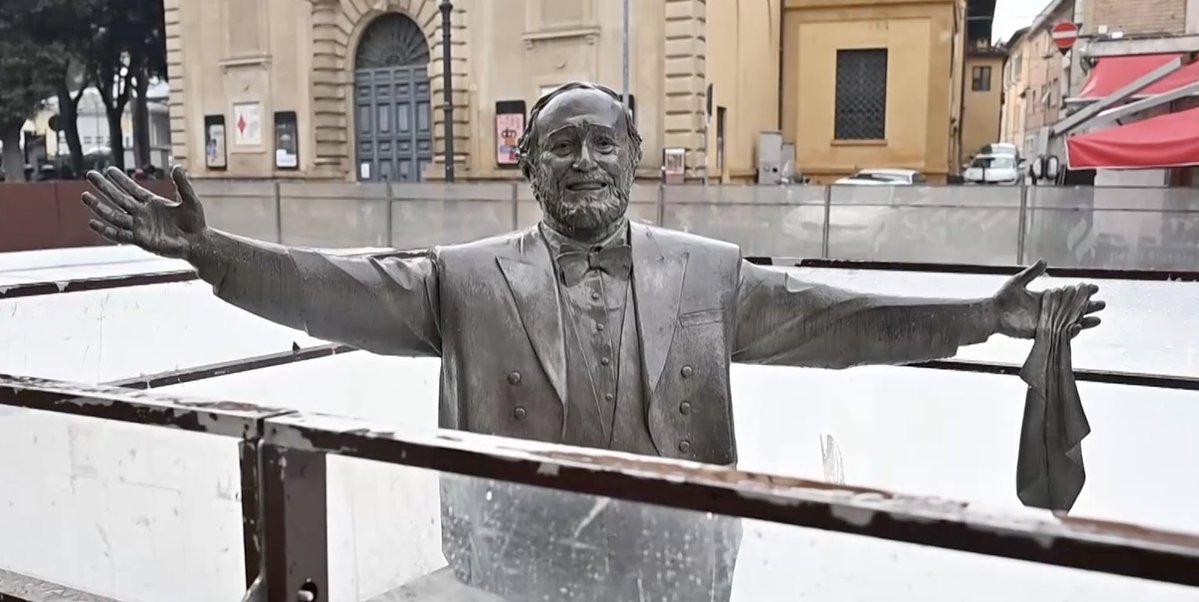
The Italian town of Pesaro has found itself at the centre of an unexpected controversy after a statue of legendary opera star Luciano Pavarotti was left submerged knee-deep inside a festive ice rink, prompting widespread criticism and an emotional response from the late singer’s family. What was intended to be a cheerful Christmas attraction in the historic Piazza del Popolo quickly turned into a public relations disaster, leading the town’s mayor to issue a formal apology and acknowledge that the local council had made a serious error in judgment.
The incident began when city officials approved the construction of a temporary ice rink as part of Pesaro’s seasonal celebrations. Designers were tasked with building the attraction in the central square without disrupting the life-size bronze statue of Pavarotti that had been unveiled only months earlier, in April 2024. However, during the construction process, organisers found they needed to redesign the layout, and the statue ultimately became part of the rink’s structure — encased within its perimeters and effectively frozen into place up to the knees, surrounded by clear perspex walls.

The decision triggered immediate criticism from residents, opera fans, and cultural observers across Italy, but none more sharply voiced than that of Pavarotti’s widow, Nicoletta Mantovani. Speaking to local media, she said she was “angry and upset,” describing the placement of the statue inside an ice rink as an act that “ridicules” the memory of one of Italy’s most internationally celebrated artists. Mantovani, who attended the statue’s unveiling alongside the couple’s daughter, Alice, earlier this year, expressed disbelief that the town would allow such treatment of a figure who helped bring global recognition to Italian musical heritage.
“I didn’t expect a town would allow this treatment of the memory and image of a person who made Italy great around the world,” she said in an interview with Il Resto del Carlino, adding that the council had made a “poorly executed, absurd decision.”
Compounding the situation was an earlier attempt at light-hearted humour by Pesaro’s mayor, Andrea Biancani. Before the rink officially opened on 29 November, he posted a digitally altered image on social media showing Pavarotti’s statue playing ice hockey, accompanied by the hashtag #DaiUnCinqueAPavarotti, which translates to “Give a high-five to Pavarotti.” The post, meant to inject festive spirit into the town’s preparations, was met with a harsh backlash once residents saw the actual ice rink and realised the statue had been physically incorporated into the structure.
Faced with mounting criticism, Mayor Biancani issued an apology to Mantovani and the Pavarotti family, admitting the council had not anticipated the public reaction and had indeed erred in its planning. He said that initial architectural plans assured him the statue would remain untouched, and that he only learned later that the structural layout had been modified, resulting in the statue’s entrapment. Despite the outcry, Biancani noted that dismantling the ice rink or relocating the statue was now impossible so close to the holiday season.
“It will not happen again,” he promised, adding that the town would be more cautious in future event planning, particularly when the arrangement involves cultural landmarks or tributes to important national figures.

Local media quickly dubbed the scandal “Pavarotti on Ice,” a phrase that spread rapidly across social networks and became symbolic of the disconnect between the council’s festive intentions and the public’s sense of cultural respect. Critics argued that the statue’s placement inside the rink trivialised Pavarotti’s legacy, turning a solemn tribute into an unintended spectacle.
The statue, crafted in bronze and intended to celebrate Pavarotti’s longstanding ties to Pesaro, was not chosen by chance. The famed tenor, considered among the most influential opera stars of the 20th century, had owned a villa in Pesaro and was named an honorary citizen. He and Mantovani frequently spent holidays in the seaside town, which became a retreat from the pressures of his global career.
Pavarotti’s contributions to music remain monumental. Known for his unparalleled vocal power, warmth, and charisma, he reached unprecedented levels of international fame through performances both on opera stages and in widely broadcast arena concerts. His participation in the Three Tenors — alongside Plácido Domingo and José Carreras — introduced opera to a global mainstream audience, with performances watched by millions across continents.
Perhaps his most iconic moment came during the 1990 FIFA World Cup in Italy, when his interpretation of “Nessun Dorma” from Puccini’s Turandot became an instant classic and cemented his status as a symbol of Italian culture. His final public performance took place in February 2006 at the opening ceremony of the Winter Olympics in Turin, a powerful appearance given shortly before he was diagnosed with pancreatic cancer. Pavarotti died the following year at age 71, leaving behind four daughters from his two marriages.

Mantovani eventually rebuilt her life, remarrying in 2020 to financial adviser Alberto Tinarelli. Yet she has remained a strong guardian of Pavarotti’s legacy, often speaking at exhibitions, concerts, and dedications in his honour. For her, the Pesaro incident represents not just a misstep in planning but a symbolic failure to respect Italy’s artistic heritage.
Meanwhile, the town of Pesaro faces growing debate over cultural preservation and the responsibilities of public authorities. Many locals have argued that historical and artistic symbols should never be altered, obscured, or incorporated into temporary attractions. Others have said that while the council’s actions were misguided, the intense public reaction reflects the deep affection Italians hold for their cultural icons.
As the holiday season begins, the statue remains inside the rink, visible to skaters and onlookers. While the mayor has insisted that the scene cannot be altered this year, the controversy has sparked renewed discussion about how cities should balance festivities with cultural sensitivity. For many, the hope is that the incident will serve as a reminder that even well-intentioned initiatives must be weighed carefully when they involve figures whose legacies transcend local boundaries.
The episode has also highlighted the modern reality that cultural missteps can quickly escalate into national debates in the age of social media. What may have once been a minor local oversight has now been amplified into an international story, prompting reflection not just in Pesaro but across Italy about how best to honour cherished public figures.
Despite the council’s assurances and public apology, the image of Pavarotti standing frozen in an ice rink — a position he never would have envisioned — may linger long after the Christmas decorations come down. Yet supporters hope that once the ice melts and the rink is dismantled, focus will return to the achievements of a man whose voice and artistry continue to resonate around the world.
Related News:
 From Lego to Pokémon: How Adults Are Driving UK Toy Market Growth
 Australia to Ban Social Media for Kids Under-16 Starting December
 Director Michael Caton-Jones Reflects on Career and Beginnings
 TikTok Star Jessie Yendle Mocked by KFC
 Miss Mexico Wins Miss Universe After Walkout Drama
 Chef Skye Gyngell, Slow Food Pioneer, Dies Aged 62
 Rusty Bond-Era Aston Martin Restored to £1m Glory
 Jilly Cooper: The Bonkbuster Queen Who Redefined Romantic Fiction
 Derby Bounce Centre to Close Amid Car Park Dispute
 Prunella Scales: From Fawlty Towers Icon to Beloved Canal Explorer
 Hospice Cuts Raise Alarm Across England Amid Funding Crisis
 Charlie Kaufman: They told me Being John Malkovich would never get made
 UK launches search for first-ever ‘town of culture’ to highlight overlooked areas
 Hollywood Is an Industry of Looney Tunes Pretending to Be Normal
 Who is Rama Duwaji? What Zohran Mamdani’s wife has said about Gaza and ICE as he’s elected NYC mayor
 Oprah enjoys Meghan’s jam on English muffins
 Lola Petticrew: ‘Calling it the Troubles minimises what it really was’
 Amber Davies Shines on Strictly – Time to Drop the West End Debate
 Seven Conditions That Automatically Qualify You for a Free Bus Pass
 Shouting Works Best to Deter Gulls, UK Study Finds
 David Szalay’s ‘Flesh’ Wins 2025 Booker Prize
 Princess of Wales Hosts Festive Christmas Service at Abbey
 PM Condemns Leaks, Vows Loyalty to Ministers and Stability
 Son Reveals UK Couple in Iran Resort to Hunger Strike for Help
 Akon Arrested in Georgia Over Outstanding Warrant
 Princess of Wales Hosts Carol Service Celebrating Love for All
 Pat Butcher Returns to EastEnders in Touching Dementia Storyline
 Two in Three Women in UK Armed Forces Report Harassment
 Bataclan Anniversary: France Remembers but Jihadist Danger Lingers
 UK Asylum Reforms: Temporary Refugee Status and Faster Deportations
 Yungblud Pauses Tour Over Health Concerns, Apologises to Fans
 Five Young People Killed in Tragic Dundalk Road Crash
 Owner Hits Out at Amazon After Pet Hurt During Delivery
 Mother Watches in Horror as Teen Daughter Dies on Tracks
 Seven Countries, One Winner: Europe’s Best Christmas Market
 Mum and Three Children Killed in Jealous Ex’s Fire
 Van Dwellers Face Eviction After Park Misuse Sparks Outcry
 Commuters warned as yellow snow and ice alert hits Northern Ireland
 Paramilitary Murals and Memorials Persist on Public Housing Land
 Court to Hear Challenge to Wimbledon Expansion Plan
 Snow and Ice Cause Travel Chaos in North Yorkshire
 Woman Meets Boy Whose Life She Saved with Kidney
 Senedd Suspends Politician Over Offensive Racial Slur
 Covid Doctor’s Emotional Farewell Letter to Family
 New Miss Universe Crowned Amid Controversy in Thailand
 Raccoons Could Become America’s Next Pet
 UK Energy Bills to Rise Slightly in January
 South African Women Call Purple Protest Over Gender Violence
 Sony, Warner, Universal Sign AI Music Deals With Klay
 Rookie Driver Hollie McRae Flips Car but Walks Away Safe
 Vicki Fears Losing Motability Car
 Planned Palestinian Flag Raising at Belfast City Hall Faces Delay Amid Legal Concerns
 Sudanese Family Vows to Stay After Racist Graffiti
 Rosalía Inspires Young Listeners to Discover Classical Music
 Australians Angry as BOM Website Revamp Backfires
 Five-Year-Old Dies After Rare Tonsil Surgery Complication
 Scotland Gains 33 New Towns – Life in Growing Communities
 Machynlleth High Street Left Without Christmas Lights
 Second homes curbs quashed in Gwynedd legal ruling
 Belfast’s Elle Vosque finishes runner-up on Drag Race UK
 Fury After Hong Kong’s Deadliest Fire in Decades
 Southeast Asia floods claim 241 lives, rescue efforts continue
 Search underway for British man overboard off Tenerife
 Hong Kong Orders Probe Into Deadly 151-Death Fire
 UK Criticises Gaza Aid Delays as Tents Arrive After Year
 More Patients Now Contacting GPs Online, Data Shows
 Franklin Turtle, Sabrina Carpenter Slam US Social Media Use
 Post Office Scandal Compensation Tops £1 Billion as Victims Finally See Justice
 Army Barracks to House Migrants as Hotels Phase Out
 Kate Winslet to Narrate Film Highlighting King’s Environmental Mission
 Army Officers Orders to Cut Ties with Men-Only Clubs
 Britain deploys RAF specialists to assist Belgium with drone threats
 Reeves rejects £1bn plea for NHS redundancy payouts
 Saka Solidifies Role as Tuchel’s Key England Lieutenant
 December Run-Off in Chile as Election Produces No Winner
 Zelenskyy Signs Fighter Jet Deal Amid Russian Drone Attacks
 Stroke Patient Mistaken for Drunk, Care Delayed
 Shadow Fleet at Sea: Europe’s Battle Against Illicit Oil Shipping
 Inside the Helpline Protecting Missing Children in the UK
 US Suspends Afghan Immigration After White House Shooting