Published: 03 April 2026. The English Chronicle Desk. The English Chronicle Online.
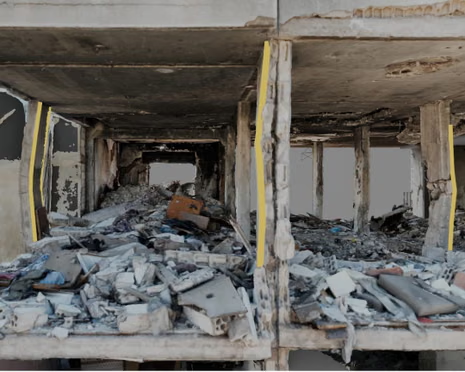
The pursuit of justice often begins within the quiet halls of international legal institutions today. A prominent Lebanese-French artist has now initiated a landmark legal complaint in a Paris court. This move follows a devastating Israeli bombing of his family residence located in central Beirut. The attack tragically claimed the lives of his elderly parents and a dedicated domestic worker. Legal experts suggest this specific strike might officially constitute a serious and punishable war crime. This filing represents a rare instance of an individual seeking accountability for such military actions. It marks the first time a French court has reviewed a case regarding these strikes.
The artist behind this significant legal action is the highly respected and acclaimed Ali Cherri. His family home was built by his grandparents many decades ago in a quiet neighborhood. This building was destroyed by an Israeli strike just hours before a negotiated ceasefire began. That ceasefire was intended to end the intense conflict between Hezbollah and Israeli military forces. During that thirteen-month war, nearly four thousand people lost their lives within the Lebanese borders. Cherri now demands a full investigation to uncover the absolute facts of this lethal event. He hopes to name the specific individuals responsible for the deaths of his beloved family.

The victims of the strike included his father, Mahmoud Naib Cherri, who was eighty-six. His mother, Nadira Hayek, was seventy-six years old at the time of the fatal explosion. Their employee, Birki Negesa, also perished alongside four other innocent civilians in the residential block. There was no prior evacuation warning issued to the residents before the heavy bombs fell. The powerful explosion damaged three entire floors of the apartment building in a single moment. Cherri stated that his family believed they were living in a safe and protected area. His parents worked incredibly hard throughout their lives to ensure their children had better futures.
Amnesty International conducted a very thorough investigation into this specific strike earlier this past February. Their researchers concluded there was no evidence of any military target within the residential building. Consequently, the organization stated the attack should be investigated formally as a possible war crime. Forensic Architecture, a UK-based group, assisted in preparing the detailed legal complaint for the court. They created a complex three-dimensional model of the struck building to analyze the munitions used. Their experts identified the weapon as a GBU-39, which is a highly precise guided bomb. This specific munition is produced by the United States and used frequently by Israeli forces.
The analysis of the strike highlights the extremely targeted nature of the guided weapon used. This precision suggests the Israeli army holds direct responsibility for the resulting civilian loss of life. Amnesty International believes this civil complaint offers a rare opportunity for true international legal accountability. Heba Morayef, a regional director for Amnesty, highlighted the pattern of humanitarian law violations occurring. She noted that Israeli forces usually enjoy a general sense of impunity for their actions. An investigation by French prosecutors would allow a European court to examine these military operations. This case carries immense weight as fighting between Israel and Lebanon has recently started again.
Cherri observes similar cases of civilian deaths being repeated across his home country right now. On the second of March, Hezbollah launched rockets toward Israel, sparking a new aerial campaign. This renewed invasion of Lebanon has already resulted in over one thousand and three hundred deaths. One tragic casualty was Mohammed Shehab, a photographer who helped model the Cherri family home. He was killed in a strike on his own house on the eleventh of March. That attack also killed his infant daughter and left his wife in a critical condition. Forensic Architecture noted the circumstances of his death were strikingly similar to the Cherri case.
Despite the challenges, Cherri feels a deep responsibility to pursue this difficult legal process today. He refuses to simply accept the role of a victim without seeking some form of justice. Many Lebanese citizens lack the resources or the standing to bring such cases to court. By stepping forward, he represents countless others who have suffered through these many violent conflicts. He remains realistic about the chances of seeing a criminal conviction for those involved. However, the act of naming the crime remains a vital part of the healing process. Documenting the truth is a necessary step toward preventing future tragedies for other innocent families.

The legal world is watching this development closely to see how French authorities will respond. International law often struggles to hold state actors accountable for actions taken during active wars. Yet, the presence of French citizenship provides a unique jurisdictional hook for this particular case. The outcome could set a major precedent for how civilian casualties are handled in Europe. It challenges the notion that military necessity can always justify the loss of civilian life. For the Cherri family, this is not just about law but about personal memory. They want the world to remember the people who lived inside that destroyed Beirut home.
The global community continues to debate the ethics of using advanced guided munitions in cities. While these weapons are marketed as precise, their impact on residential areas remains absolutely catastrophic. The destruction of the Cherri home serves as a stark reminder of these modern risks. As the case moves forward, more details about the decision-making process may finally come out. This transparency is exactly what the survivors of the strike have been seeking for years. Each step in the courtroom brings them closer to a formal acknowledgment of their pain. Justice may be slow, but the filing of this suit is a brave beginning.
The English Chronicle will continue to monitor the progress of this historic war crimes case. Our reporters are committed to providing updates as the French war crimes unit reviews evidence. The voices of those affected by conflict deserve to be heard on the global stage. This story is a testament to the resilience of those seeking truth amid great loss. We recognize the importance of holding all parties to the highest standards of international law. The eyes of the international legal community remain fixed on the proceedings in Paris today. Only through such rigorous inquiry can the cycle of violence perhaps be slowed or stopped.
Related News:
 Gambia Supreme Court Hears Case to Overturn FGM Ban
 Iran Death Toll Crisis Exposed: Bodies, Mass Graves, and Concealment
 Files Link Andrew to Epstein Dinner After Prison Release
 Thousands Protest ICE in New York Against Trump Deportation Campaign
 Concerns rise for Canberra boy amid Iran detention fears
 Brazilian Politician Brothers Sentenced for Marielle Murder
 Anthony Albanese Must Uphold Rights for All Australians
 Woman Executed in Somalia Sparks Debate on Justice System
 Uganda Crackdown: Two Women Arrested for Public Kissing
 Slovenia Election: A Nation at a Crossroads
 Police Seek Immunity in Indigenous Custody Death Case
 Manila Transport Crisis: Fuel Costs Hit Breaking Point
 UN Warns Israeli Death Penalty Bill Could Be a War Crime
 Spain Faces Backlash Over Xenophobic Chants in Egypt Draw
 A Global Voice For Justice: Stephen Lewis Dies At Age 88
 Canadian Mother and Daughter Released From ICE Detention
 Bondi Nanny Adriana Rivas to Face Extradition to Chile
 Queensland Youth Justice Debate: The Data Behind the Law
 Gaza Child Arrives in UK for Life-Changing Care
 Brisbane Rideshare Driver Faces Serious Assault Charges
 Tragedy in the Channel as Four Lives Lost in Boat Sinking
 Kyiv and Odesa Mourn After Deadly Wave of Russian Strikes
 France Urges Release of Elderly Widow Held by ICE
 Trump Weighs Sending Afghan Allies to the Congo
 Prominent Voices Challenge Palestine Action Ban
 Standoff Over Syria: Australia Defies Trump Repatriation Plea
 Desperation in Odisha: A Brother’s Grim Bank Protest
 Activists allege abuse after Gaza flotilla seizure
 Australia Faces Rising Tide of Modern Antisemitism
 Security Failures and the Road to the Bondi Inquiry
 Mexico’s Missing: State Complicity in a Growing Crisis
 Nobel Laureates Demand Release of Activist Narges Mohammadi
 Plea for Mercy: The Battle to Bring Ahmed al-Doush Home
 Court Upholds Landmark Win for Transgender Rights
 Taliban Codifies Strict New Marriage and Divorce Legislation
 Israeli Strikes in Lebanon Kill 10 Amid Ceasefire Strain
 US judge dismisses Kilmar Abrego Garcia indictment
 Former ICC prosecutor condemns US sanctions
 Trump Faces Legal Blow Over Global Tariffs
 Silenced Stitches: The Cost of Memory in Hong Kong
 Vision Lost Amid the Rubble of Modern Conflict
 Controversial London Property Show Sparks Legal Fury
 US Supreme Court Rejects Trump Attack on Birthright Law
 Gaza Doctor Unrecognisable After Brutal Israeli Detention
 UK Charity Funds Illegal Hebron Settlement Expansion
 Taliban global ties grow as rights fears mount
 Friedman Uninvited From 2024 Adelaide Writers’ Week
 New Zealand Covid Response Praised Despite Lingering Scars
 The Price of Hubris: Trump, Netanyahu, and the ‘Easy’ War
 Trump and Tehran Find Common Ground in Landmark Ceasefire
 Own an Entire Australian Town for the Price of a UK Flat
 Melania Trump Denies Ties to Epstein and Ghislaine Maxwell
 Reeves Slams Trump Over Iran War Lack Of Exit Plan
 Trump’s Presidency: A House of Cards Collapsing?
 US Forces Seize Iranian Ship Near Hormuz Blockade
 Trump Starts $166bn Tariff Refund Process
 Investigation: Offshore Loans and Sanctions
 Cross-Border Crisis Shatters Fragile Afghan Peace
 The Burning Lens: An Iranian Artist’s Visual Resistance
 FIFA Confirms Global Ban for Benfica Star Prestianni
 One Nation Candidate’s Surprising Ties to Independents
 Putin Signals War End as Russian Momentum Stalls
 Romania’s Judicial Crisis: A System Under Siege
 Scepticism and tight security as Beijing braces for Trump
 Philippine Senator Flees After Days Under Senate Siege
 Secrecy Down Under: Albanese Faces FoI Scandal
 Tony Abbott Returns as New Liberal Party President
 Discontent grows around Putin amid war strain
 Teaching Machines Right From Wrong in the Digital Age
 Oman Defies US Pressure Over Strategic Strait of Hormuz
 Ex-CIA Agent Accused of $40m Gold Theft and Fake Spy Unit
 Aukus Deal Facing Fierce Backing and Historic Criticism
 Tragic Loss of Australian Sprinter Jemma Stapleton
 Trump Urged to Condemn UFC Fighter Over Obama Slurs
 Russian Tanker Captain Remanded in UK Court After Channel Seizure
 US Military Pacific Boat Strike Kills Three People
 Trump’s Mount Rushmore Speech: A Divisive Anniversary
 Trump Swaps Planes Amid Iran Tensions
 Yemen Accuses Iran of Violating National Sovereignty
 Houthis Strike Saudi Arabia as Middle East Tensions Rise