Published: 07 April 2026. The English Chronicle Desk. The English Chronicle Online.
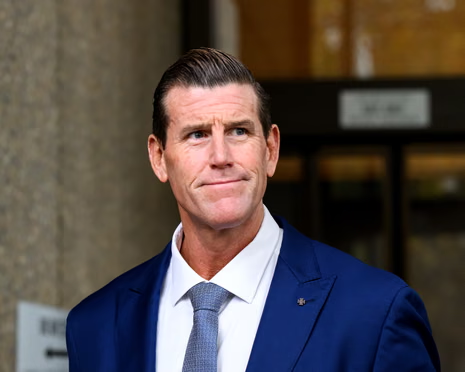
The morning air at Sydney Airport carried a heavy weight of history this Tuesday morning. Australia’s most decorated living soldier found himself surrounded by federal police officers during a routine arrival. Ben Roberts-Smith was arrested shortly after his domestic flight from Brisbane landed at the busy terminal. This dramatic scene marks a significant turning point in a saga that gripped the entire nation. Authorities have spent years investigating the actions of elite special forces within the rugged Afghan landscape. The Australian Federal Police and the Office of the Special Investigator confirmed the arrest very shortly after. They announced that the former soldier faces five counts of war crime murder in local courts. These charges stem from three separate incidents involving the deaths of several unarmed Afghan civilian men. Prosecutors allege that Roberts-Smith was either directly responsible or ordered subordinates to carry out killings. The maximum penalty for these serious offences under Australian law is a term of life imprisonment.
For many years the public viewed Roberts-Smith as a symbol of ultimate national heroism and bravery. He received the Victoria Cross for his actions during the intense battle of Tizak in 2010. His image once graced many recruitment posters and he was even named Father of the Year. However, the shadows of the past began to catch up with him through investigative journalism reports. Several newspapers published allegations that he had crossed ethical lines during his multiple tours of duty. He vehemently denied these claims and chose to sue the media outlets for defamation of character. That legal battle became one of the most expensive and high-profile cases in Australian legal history. The court eventually ruled against him after hearing testimony from many former members of his unit. A judge found that several of the murder allegations were true to a civil standard. This finding did not carry criminal weight but it paved the way for current police charges.

The specific incidents mentioned in the charges provide a haunting look at modern desert warfare tactics. One allegation involves a location known as Whiskey 108 during a mission back in late 2009. Investigators claim two Afghan men were found hiding inside a tunnel at a bombed-out compound site. One of the men was elderly while the younger man reportedly used a prosthetic leg limb. Both individuals surrendered to the Australian troops and were unarmed at the time of their capture. It is alleged that Roberts-Smith ordered a junior soldier to execute the elderly Afghan man immediately. He then allegedly killed the disabled man himself using a high-powered machine gun at very close range. The court previously heard that the prosthetic leg was taken as a trophy by other soldiers. This item was later used as a drinking vessel at an unauthorized base bar in Afghanistan. Such details have deeply shocked the Australian public and the wider international military community today.
Another tragic incident at the heart of the case involves an Afghan farmer named Ali Jan. This event took place in 2012 near the village of Darwan during a routine patrol mission. Roberts-Smith allegedly kicked the handcuffed man off a steep cliff into a rocky dry riverbed below. Ali Jan survived the initial fall but was badly injured and unable to escape his captors. The prosecution claims Roberts-Smith then ordered another soldier to shoot the injured man quite dead. Witnesses described how the body was then dragged away to a nearby field by the soldiers. A third incident at Syahchow involves the deaths of two more civilians during a separate operation. Commissioner Krissy Barrett stated that none of these victims were participating in any active combat hostilities. They were reportedly under the control of the Australian Defence Force when they were killed. The Commissioner emphasized that the investigation was conducted with extreme care and professional legal standards.
The Director of Investigations for the Special Office noted the massive challenges of this complex probe. Investigators had to piece together events that occurred over a decade ago in a foreign land. They faced significant hurdles because they could not access the original crime scenes in modern Afghanistan. There were no official post-mortem reports or forensic site plans available for the legal team. They could not perform blood spatter analysis or recover projectiles from the dusty ground in Syahchow. Despite these physical limitations, the team interviewed many witnesses to build a very credible case. Ross Barnett stated that the seriousness of the charges deserved nothing less than a full investigation. He acknowledged that the families of the victims might not even know about the recent arrest. The distance between Australia and these remote villages makes communication and victim support extremely difficult.
The political reaction to the arrest has been one of very careful and measured silence. Prime Minister Anthony Albanese spoke to reporters in Canberra shortly after the news broke this morning. He stated he had no intention of prejudicing what is now a serious legal matter. The Prime Minister noted that the case is currently before the courts for further judicial review. This stance reflects the sensitive nature of prosecuting a former national hero for such crimes. It also highlights the independence of the Australian judicial system from direct political influence or pressure. The arrest follows the 2023 charging of another former soldier for similar crimes in Afghanistan. It suggests a broader effort to address systemic issues within the elite Special Air Service Regiment. Many people believe these trials are necessary to maintain the integrity of the armed forces.

Ben Roberts-Smith has consistently maintained his innocence throughout all the previous civil and high court proceedings. His legal team has argued that his actions were within the rules of military engagement. They claim the allegations are based on the testimony of jealous or disgruntled former military colleagues. However, the evidence presented in the defamation trial proved to be too substantial to ignore. The full bench of the Federal Court and the High Court both rejected his appeals. His fall from grace has been a long and painful process for the Australian public. He was once invited to the most prestigious events and held positions of great influence. Now he must prepare for a criminal trial that will scrutinize every detail of his service. The outcome of this case will likely define the legacy of Australia’s involvement in Afghanistan.
As the legal proceedings begin, the international community is watching the Australian justice system very closely. This case represents one of the few times a Western nation has prosecuted its own heroes. It sends a clear message that no individual is above the law regardless of their rank. The principles of the Geneva Convention are being tested in a very public and modern forum. For the families of Ali Jan and the other victims, this brings a hope. They have waited many years for any form of official acknowledgement of their deep personal loss. The legal journey ahead will be long and will likely involve many more months of testimony. For now, the man who was once a hero waits for his day in court. The English Chronicle will continue to provide updates as this historic trial unfolds in Sydney. Every citizen deserves to know the truth about the actions taken in their national name. Justice must be seen to be done for both the accused and the victims.
Related News:
 EU Weakens as Trump Targets Venezuela and Greenland
 Venezuela Oil Deal Opens Tensions with US Control
 US Citizens Warned to Venezuela Flee Amid Paramilitary Threats
 Gulf states warn Trump Iran strikes risk wider Middle East war
 Machado Trump medal gesture reshapes Venezuela power struggle
 Greenland defence seen as shared Nato duty amid troop arrivals
 Gulf states warn Trump Iran strikes risk wider Middle East war
 Trump Receives Machado’s Nobel Medal in White House Meeting
 Iran unrest slows under brutal crackdown and global tensions
 Syria President Declares Victory as Ceasefire Reached with SDF
 US Considers Asylum for British Jews Amid Rising Antisemitism
 Thousands Protest ICE Operations in Nationwide US Day of Action
 Epstein Files Reveal Trump Officials’ Emails with Financier
 Thousands Protest ICE in New York Against Trump Deportation Campaign
 Sydney Protest Pepper Spray Clash During Herzog Visit
 Cuba Kills Exiles in Speedboat Attack from US Waters
 Yvette Cooper: UK Must Follow Principles, Not US Pressure
 Saudi Arabia Urging US to Keep Up Iran Attacks
 Washington Enlists Musk to Battle Global Hostility Online
 Macron Urges Stability as Trump Jolts Nato and Iran
 Trump Address Sparks Global Backlash Over Iran War Tactics
 Macron Rebukes Trump Following Mockery of His Marriage
 Trump Sets Tuesday Deadline for Iran to Reopen Vital Strait
 Tragic End to Outback Search as Floods Claim a Life
 Bondi Nanny Adriana Rivas to Face Extradition to Chile
 Trump and Tehran Find Common Ground in Landmark Ceasefire
 Netanyahu Vows Continued Lebanon Strikes Amid Peace Talks
 Trump Predicts Rapid Return to Peace Talks in Pakistan
 Reeves Slams Trump Over Iran War Lack Of Exit Plan
 US and Iran Pursue Extension of Ceasefire via Pakistan
 Pope Leo Calls for Global Unity Following Trump Criticism
 Trump Brokers Ten Day Ceasefire to Halt Lebanon Conflict
 Mexico, Spain and Brazil call for Cuba dialogue amid crisis
 Ukraine Urges UK to Seize Russian Oil Tankers
 US Calls Australia Media Law “Foreign Extortion”
 Tragic End to Search for Missing Girl in Alice Springs
 Questions Remain Over The Tragic Bondi Massacre
 Activists allege abuse after Gaza flotilla seizure
 Ukraine strikes Tuapse as oil disaster worsens
 Global order shifts amid Trump-era turmoil
 Australia pushes Pacific security pact amid China tension
 Indiana Republicans Defy Trump in Key Vote Test
 Middle East Crisis Escalates as Oil Routes Shake Markets
 FIFA Confirms Global Ban for Benfica Star Prestianni
 New South Wales Wetland Rescue Legislation Passes
 Tensions Emerge in Netanyahu-Trump Alliance
 Putin Declares Russia Victory at Scaled Victory Day Parade
 US and Mexico Face Heatwave as Floods Batter South Africa
 The Long Way Home: Australia’s High-Stakes Virus Mission
 Trump Warns Iran Ceasefire Is Now on Life Support
 Putin Signals War End as Russian Momentum Stalls
 Scepticism and tight security as Beijing braces for Trump
 UN Faces Crucial Vote on Landmark ICJ Climate Ruling
 US-Mexico Crisis: Cartel Allegations Push Ties to Brink
 Netanyahu Calls Early Election Amid Coalition Turmoil
 Philippine Senator Flees After Days Under Senate Siege
 Solomon Islands Elects China Critic Matthew Wale as Leader
 Tragedy in the Maldives: Inside the Deep Sea Rescue
 US Ebola Case Sparks Urgent Global Screening Measures
 Xi Hosts Putin in Beijing Days After Landmark Trump Summit
 Fragile Truce Shattered as Violence Escapes Diplomatic Control
 The Hunt for Bato: Inside the Hunt for the Fugitive Senator
 Israeli Strikes in Lebanon Kill 10 Amid Ceasefire Strain
 Zelenskyy warns over Oreshnik threat as Kyiv hit
 Hunger increasingly weaponised in global conflicts
 Discontent grows around Putin amid war strain
 Former ICC prosecutor condemns US sanctions
 Bondi Tragedy Survivors Face Online Abuse After Inquiries
 Japan Suffers Plastic Shortage Due to Middle East Crisis
 Venezuela Opposition Steers Uncharted Path Forward
 Aukus Deal Facing Fierce Backing and Historic Criticism
 Thai Princess Bajrakitiyabha Passes Away at 47
 Sentenced to 30 Years: Former Leader’s Secret Drone Plot
 Kyiv Heritage Blazes After Night of Brutal Russian Strikes
 Iran To Propose New Shipping Fees In Strait Of Hormuz
 Trump’s Iran Legacy Hangs on Tehran Deal
 High Drama in Tehran Over Secret Nuclear Letters
 Houthis Strike Saudi Arabia as Middle East Tensions Rise
 Taliban global ties grow as rights fears mount
 Seoul proposes historic peace talks to replace Korean War armistice