Published: 12 April 2026. The English Chronicle Desk. The English Chronicle Online.
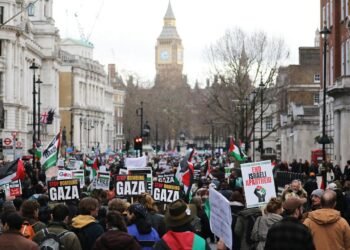
More than 500 people were arrested during a large-scale protest in London, marking one of the most significant public demonstrations in recent months concerning civil liberties, protest rights, and government authority. The arrests followed a gathering in Trafalgar Square, where hundreds assembled to oppose the proscription of the activist group Palestine Action, after a high court ruling declared the ban unlawful earlier this year.
The protest drew a wide cross-section of participants, ranging in age from 18 to 87, according to the Metropolitan Police. By midnight, officers confirmed that 523 individuals had been detained, making it one of the largest coordinated arrest operations linked to a single protest in the capital in recent times. The demonstration remained largely peaceful, with participants sitting on the ground or in folding chairs, holding placards expressing opposition to what they described as unjust government measures.

Many of the signs carried by demonstrators featured messages defending free speech and criticising perceived injustices. Some individuals wore symbolic costumes, including outfits inspired by historical suffragettes, while others displayed masks depicting political figures such as Keir Starmer. The visual display underscored the protest’s attempt to connect contemporary political concerns with broader historical struggles for rights and representation.
At the centre of the demonstration stood organisers from Defend Our Juries, who coordinated the gathering and openly criticised the police response. They argued that the arrests were carried out despite clear legal warnings and a recent high court judgment that challenged the government’s classification of the group under existing laws. According to the organisers, the actions of law enforcement reflected an increasingly restrictive approach to protest in Britain.
Police activity intensified shortly after early afternoon, as officers began detaining individuals located at the edges of the crowd. Witnesses reported seeing protesters being physically carried away, including elderly participants and individuals with visible disabilities. Among those present was Mike Higgins, a blind disabled protester whose previous arrests have drawn public attention and sparked debate over the proportionality of policing tactics at demonstrations.
The atmosphere throughout the afternoon remained tense yet largely non-violent. Protesters maintained a seated presence, raising banners and chanting slogans, while police officers moved systematically through the crowd. One elderly woman, supported by walking sticks, was escorted away by officers, highlighting concerns raised by observers about the handling of vulnerable participants during enforcement operations.
Statements from law enforcement emphasised the legal framework guiding their actions. Officers cited provisions under the Terrorism Act, which criminalises support for proscribed organisations. Prior to the protest, police commanders had warned that attendance at such demonstrations could result in arrest if individuals were deemed to be expressing support for banned groups. These warnings were reiterated as the situation unfolded.
However, the legal context surrounding the protest remains complex and contested. Earlier this year, the high court ruled that the government’s decision to proscribe Palestine Action was disproportionate and unlawful. The judgment stated that the group’s activities did not meet the threshold required to classify it as a terrorist organisation, raising significant questions about the basis for enforcement actions taken under existing legislation.
Despite this ruling, the Shabana Mahmood was granted permission to appeal the decision, creating a period of legal uncertainty. The appeal is scheduled to be heard later this month, and its outcome is expected to have far-reaching implications for protest law and the definition of extremism in the United Kingdom.
Initially, the Metropolitan Police indicated that it would pause arrests related to the group following the high court’s decision. However, this stance was later revised after the appeal process was authorised. Officials described their earlier position as temporary, confirming that enforcement would continue while the legal challenge proceeds through the courts.
Protest organisers and legal observers have strongly criticised this shift, arguing that it undermines the authority of judicial decisions and creates confusion about the rule of law. Representatives from Defend Our Juries described the situation as surreal, claiming that arrests were being carried out in contradiction to established legal findings and expert advice from leading lawyers.
Voices from within the protest also reflected a broader sense of frustration and determination. Participants spoke about their motivations, framing the demonstration as a defence of civil liberties and moral responsibility. Some individuals, including former detainees and activists, emphasised their commitment to continuing their campaign despite legal risks and personal consequences.
International perspectives have also influenced the debate. The UN human rights chief, Volker Türk, previously expressed concern over the proscription, describing it as a chilling development for freedom of expression. Such statements have added an additional layer of scrutiny to the UK government’s approach, placing domestic policy within a global human rights context.
Legal experts suggest that the case highlights a broader tension between national security considerations and the protection of democratic freedoms. While governments retain the authority to restrict organisations deemed dangerous, the threshold for such actions must be carefully defined and consistently applied. The current dispute illustrates the challenges of balancing these competing priorities in a rapidly changing political environment.
The protest also raises questions about the future of public demonstrations in Britain. In recent years, new legislation and policing strategies have altered the landscape for activists, with increased emphasis on maintaining public order and preventing disruption. Critics argue that these measures risk eroding fundamental rights, while supporters contend they are necessary to ensure safety and stability.

As the legal process continues, the events in Trafalgar Square are likely to remain a focal point in discussions about protest rights and government accountability. The outcome of the upcoming appeal hearing will play a crucial role in determining how similar cases are handled in the future and whether current enforcement practices will be upheld or revised.
For those who participated in the demonstration, the arrests represent more than a legal issue. They symbolise a broader struggle over the boundaries of dissent and the role of citizens in holding authorities to account. Whether this moment leads to meaningful change or further division will depend on how institutions respond in the coming weeks.
The scale of the arrests and the intensity of the debate underline the significance of the issue at hand. As Britain continues to navigate complex political and social challenges, the balance between security, justice, and freedom remains a defining question for its democratic institutions.
Related News:
 It’s time to come clean on the China spy case
 French Taxi Driver Cleared in David Lammy Theft Case After Fare Dispute
 Met Police Culture Makes Racial Harm ‘Inevitable’
 Remaining rebel Labour MPs have whip restored
 Murder Probe Continues After Arrest Release
 Tasers Introduced in UK Prisons to Combat Rising Violence and Protect Staff
 Police Advised to Disclose Ethnicity of Suspects in High-Profile Cases
 Jailed Georgian Opposition Leaders Warn UK of Iranian Links to Ruling Party
 UK Police to Gain New Powers to Manage Repeated Protests, Home Office Announces
 Boris Johnson Breached Rules on Post-Office Business Contacts
 China Spy Case Hearing Reveals Key Gaps in Prosecution
 Five More Prisoners Freed by Mistake in Essex Week
 Nearly 48,000 Zombie Knives Removed from UK Streets in a Year
 Afghan man charged with murder after west London knife attack
 Reform Councillor Defects to Tories Over ‘Uncomfortable’ Policies
 Experts Question HMRC Over Possible Child Benefit Privacy Breach
 FBI Director Kash Patel Defends Girlfriend Amid Government Jet Claims
 Man Charged Over Cambridgeshire Train Stabbing
 Phillipson urges careful review of gender recognition guidance
 Just Stop Oil Protesters Convicted Amid Climate Defence Row
 Company linked to Michelle Mone owes £39m in tax
 British Grandmother to Return Home After Death Sentence in Bali
 Eleven Arrested After Pro-Palestine Protest at Villa Match
Boris Johnson accused of undermining BBC leadership
Eleven Arrested After Pro-Palestine Protest at Villa Match
Boris Johnson accused of undermining BBC leadership
 Tim Davie resigns as BBC director general amid bias claims
 ‘Reckless’ cuts to victims’ services will cost more than they save
 BBC Faces Backlash as Reform UK Withdraws from Film
 Palace to reinstate hyphen in Andrew’s surname
 British state supplied victims to ‘worst sex offender in history’
 Victims’ commissioner Baroness Newlove dies aged 63
 Major Rent Reform Ends No-Fault Evictions in England
 Peers Flood Assisted Dying Bill with 942 Amendments
 ‘Fake Admiral’ Sparks Outrage at Remembrance Event
 UK Unveils Fast-Track Deportation and Asylum Overhaul
 UK Asylum Overhaul Sparks Debate Over Human Rights and Deportations
 UK Asylum Reforms: Temporary Refugee Status and Faster Deportations
 UK Candidate Moved to Safe House After Election Threats
 Mahmood Defends Tough Overhaul of UK Asylum System
 Paralegal Fired After Exposé on Illegal Worker Scam
 Dan Wootton Rejects Catfishing Allegation in Court
 Scottish Ministers Express Alarm Over UK Asylum Reforms
 South African Detained After Neo-Nazi Rally in Australia
 Westminster Advances Legacy Bill Amid Criticism
 Minister Defends Tough New Asylum Reform Plan
 UK Net Migration Falls Sharply After ONS Revisions
 Serial Rapist and Former Cop Found Guilty Again
 Trump Signs Bill Releasing Justice Department Files on Epstein
 Most Tories Expect to Support a Farage-Led Government
 Gardener Guilty of Brutal Attack on Teacher Partner
 Ex-Classmate Accuses Farage of Dishonesty on Racism Claims
 Peers Get Extra Time to Debate Assisted Dying Bill
 Ex-Brexit MEP Rejects Claim of Pro-Russia Payments
 Twelve Prisoners Released in Error, Two Still Missing
 Plans to Limit Jury Trials Face Retreat After Mounting Opposition
 Woman Jailed for Life After Killing E-Bike Rider in Tragic Mistaken Identity Case
 ‘It’s a Complete Scandal’: Aristocrat’s Fight for Prison Children
 Police response times face strict new national limits
 Tim Walz urges Trump to withdraw federal agents immediately
 UK and EU Signal Fresh Push for Defence Cooperation Talks
 Files Link Andrew to Epstein Dinner After Prison Release
 Civil Service Pay: Union Urges Ministers to End ‘Barking Mad’ Limits
 Proposed Law Leaves Gap for Children of Convicted Paedophiles
 Labour Lawyers Blocked From Briefing MPs on Jury Trials
 Starmer Defends Workers’ Rights Amid Rising Green Threat
 Prevent Failings Exposed After Southport Attack
 Harmeet Dhillon Faces Scrutiny in DOJ Role Debate
 Starmer Faces Pressure Over Mandelson Vetting Scandal
 NHS Safety Fears as Nurses Cover Doctor Gaps
 Crackdown Backfires on UK Climate Protesters
 Cartel crackdown raises fears of fresh violence
 Asylum deal sparks fears over Syria deportations
 UK may ban protests amid rising antisemitism fears
 Victim says non-custodial rape sentence ‘rock in my face’
 Gunman Killed After White House Security Shootout
 Irish Gangland Figure Fails in Dublin Election Bid
 Tagging Scheme Risks Public Safety
 Pradhan Resigns Amid Protests
 Westminster Council Threatens Charing Cross Soup Kitchen
 BBC Warned About Missing Clothes of Murder Victim
 Cambridge Professor Jason Arday Found Dead at Home