Published: 31 January 2026. The English Chronicle Desk. The English Chronicle Online
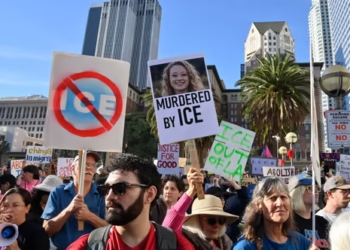
Thousands of protesters filled streets across the United States on Friday during a coordinated national day of action opposing federal immigration enforcement. Demonstrations targeted Immigration and Customs Enforcement, widely known as ICE, and demanded the withdrawal of agents from Minnesota following the recent killings of Renee Good and Alex Pretti. Organisers described the protests as a response to what they see as unchecked enforcement powers and a lack of accountability within the current immigration system.
The protests unfolded in major cities and smaller communities, reflecting growing national anger over immigration raids and enforcement tactics. Rallies took place in Philadelphia, New York, Columbus, Boise, and several other cities, with crowds gathering outside city halls, courthouses, and state buildings. Students in multiple states walked out of schools and universities, joining a broader movement calling for civil resistance and public pressure.
Friday’s actions were framed by organisers as a “no work, no school, no shopping” day. The aim was to apply economic and social pressure while drawing attention to immigration enforcement practices. Protest leaders said such measures were necessary to force political leaders to act, particularly as debates over homeland security funding continue in Washington.

Minnesota remained at the centre of the demonstrations. The state has seen weeks of protests after ICE significantly increased operations in Minneapolis. Tens of thousands had already rallied there the previous week, braving freezing temperatures to oppose the federal presence. On Friday, some local businesses closed entirely, while others stayed open but redirected profits to community support efforts.
In Minneapolis, several cafes and small retailers adopted alternative business models for the day. Some donated all revenue to mutual aid funds, while others offered free food and warm spaces for protesters. Organisers said these gestures reflected community solidarity and resistance to what they describe as state violence.
New York City saw one of the largest turnouts. Thousands marched through Manhattan in bitter winter conditions, chanting slogans against ICE and holding signs calling for reform. Protesters ranged widely in age, from students to elderly residents, many wearing heavy coats and gloves as they filled the streets.
On the west coast, demonstrations spread across California. Protesters gathered in San Francisco, Oakland, and Los Angeles, where tensions rose later in the evening. In downtown Los Angeles, a protest outside a federal building escalated after some demonstrators threw bottles and spray-painted slogans on the walls.
Authorities in Los Angeles declared a tactical alert as clashes intensified. According to local media, law enforcement officers used chemical irritants to disperse a crowd of about 200 people outside the Metropolitan Detention Center. The facility, which houses immigration detainees, has become a recurring focal point for protests.
Video footage shared online appeared to show protesters toppling a small structure and dragging a large dumpster to block a building entrance. Officers holding clear riot shields marked “police” stood their ground as objects were thrown. Organisers later stressed that the wider movement remains committed to nonviolent action.
Protest leaders say the demonstrations respond directly to several recent deaths linked to immigration enforcement operations. These include the killings of Renee Good and Alex Pretti in Minneapolis, Keith Porter in Los Angeles, and Silverio Villegas González in Illinois. Campaigners argue these incidents reveal systemic problems requiring urgent reform.
Student groups have played a leading role in organising the protests, particularly in Minnesota. Many of Friday’s national organisers are students at the University of Minnesota, who say their local actions inspired wider mobilisation. They argue that what began as a regional protest has now become a national movement.
Kidus Yeshidagna, president of the Ethiopian Students Union at the university, said the goal was to force national attention. He explained that economic pressure, walkouts, and boycotts were tools to demand accountability and legislative change. He urged lawmakers across the country to recognise the scale of public anger.
Yeshidagna was also involved in organising last week’s Minnesota shutdown, when thousands filled the streets despite extreme cold. He said students and community members felt compelled to act again, believing momentum was building rather than fading.
High school students also joined the movement in large numbers. In Tennessee, students in Knoxville walked out of classes to join an “ICE Out” protest organised by local activists. Videos showed teenagers chanting and holding signs while marching through city streets.
Sophie Pedigo, a senior at a Knoxville high school, said students should not feel unsafe in educational spaces. She said schools should be places of learning, not fear, and described immigration enforcement practices as deeply troubling. Her comments echoed sentiments shared by many young protesters nationwide.
School closures were reported in several states. In Tucson, Arizona, more than 20 schools closed as staff joined the strike or stayed home. Online footage also showed walkouts in cities including San Antonio and Salt Lake City, with hundreds of students participating.
In New York, hundreds of high school students marched toward a downtown park as part of the coordinated action. Volunteers with advocacy groups prepared public spaces, clearing snow and setting up areas for large crowds expected at rallies later in the day.
Activists say the rapid spread of the protests reflects shifting political attitudes. Manolo De Los Santos, executive director of the People’s Forum in New York, said ideas once considered unrealistic are now gaining traction. He described the concept of a general strike as newly relevant in the American political context.
Immigration advocates argue that the protests expose broader concerns about civil liberties and government accountability. Murad Awawdeh, president of the New York Immigration Coalition, criticised the administration’s approach, saying enforcement has focused on punishment rather than safety.
Family members and neighbours of those killed have reportedly contacted student groups to express support. Organisers say this has strengthened their resolve and reinforced their belief that the movement reflects community voices, not outside agitation.
Friday’s protests took place against a backdrop of political uncertainty in Washington. A partial government shutdown looms as lawmakers debate federal spending, particularly funding for the Department of Homeland Security. Senate Democrats are limiting DHS funding to push for reforms, including restrictions on ICE operations.
Proposed measures include banning agents from wearing masks, requiring warrants for arrests, and increasing independent oversight. The House of Representatives is expected to vote on a $1.2 trillion funding package on Monday, with the outcome likely to shape the next phase of protests.

For many demonstrators, the shutdown threat highlights deeper political failures. Protest leaders argue that repeated funding crises reflect an unwillingness to address structural problems within immigration policy and law enforcement oversight.
As night fell on Friday, protests continued in several cities, while others dispersed peacefully. Organisers vowed to maintain pressure in the coming weeks, saying the movement will not end with a single day of action.
Whether the demonstrations lead to concrete policy change remains uncertain. What is clear is that opposition to ICE operations has reached a new level of visibility, driven by students, community groups, and families demanding accountability.
The nationwide protests signal a moment of reckoning in the immigration debate. As lawmakers return to Congress, they face a public increasingly willing to disrupt daily life to demand change.
Related News:
 Trump Receives Machado’s Nobel Medal in White House Meeting
 China-critical UK academics face ‘extremely heavy’ pressure from Beijing
 US Justice Department Files Lawsuit Against California Over Partisan Voting Maps
 Trump Deploys DHS to Charlotte in Major Arrest Operation
 Congress Approves Release of Epstein Files, Trump Expected to Sign
 Texas Governor Faces Lawsuit From CAIR
 Putin Intensifies Territorial Demands Before US Talks
 US National Guard Member Killed in DC Shooting
 Trump to Recheck Green Cards from 19 Nations After DC Attack
 Trump to pause migration from ‘third-world countries’
 Chinese & Japanese Boats Clash Near Disputed Islands
 Putin Meets US Envoy Amid Key Ukraine Peace Talks
 US Defence Chief on Drug Boat Strike: “Did Not See Survivors”
 Franklin Turtle, Sabrina Carpenter Slam US Social Media Use
 Russia losses Ukraine war peace talks intensify amid rising deaths
 Shock US Raid: Maduro Pleads Not Guilty in Manhattan Court
 Trump Escalates Minnesota Immigration Surge Amid Rising Tensions
 Trump Says US Will Act on Greenland ‘Whether They Like It or Not’
 Greenland Faces Pivotal Summit Over Arctic Power Struggle
 Trump Threatens Strong Action If Iran Executes Protesters
 Machado Trump medal gesture reshapes Venezuela power struggle
 Iran unrest slows under brutal crackdown and global tensions
 US Considers Asylum for British Jews Amid Rising Antisemitism
 EU Says US Ties Have Suffered ‘Big Blow’ After Greenland Crisis
 Russia Strikes Kyiv and Kharkiv as Peace Talks Enter Day Two
 Trump officials continue false claims after Alex Pretti shooting
 UK and EU Signal Fresh Push for Defence Cooperation Talks
 Files Link Andrew to Epstein Dinner After Prison Release
 Emails Show Epstein Funded Mandelson’s Husband After Jail
 Partial US Government Shutdown Hits Homeland Security Funding
 Trump Administration Dismisses 17 Immigration Judges, Sparking Debate Over Judicial Independence
 British Woman in Iran ‘Losing Hope’ Amid Ongoing Detention
 Johnson Approved China’s London ‘Super-Embassy’ in 2018
 French Taxi Driver Cleared in David Lammy Theft Case After Fare Dispute
 Just Stop Oil Protesters Convicted Amid Climate Defence Row
 BBC to Apologise Over Edited Trump Speech Amid Backlash
 Britain deploys RAF specialists to assist Belgium with drone threats
 Trump Urges Herzog to Grant Netanyahu Full Pardon
 Major Rent Reform Ends No-Fault Evictions in England
 Peers Flood Assisted Dying Bill with 942 Amendments
 Oklahoma Governor Grants Last-Minute Clemency to Death Row Inmate
 Greene Pushes Epstein Files Amid Trump Fallout
 December Run-Off in Chile as Election Produces No Winner
 Canada Passes Carney’s First Budget in Tight Parliamentary Vote
 Shadow Fleet at Sea: Europe’s Battle Against Illicit Oil Shipping
 Pentagon Officials in Ukraine to Discuss War End
 Venezuela Threatens Nobel Winner Machado with Fugitive Status
 Peers Get Extra Time to Debate Assisted Dying Bill
 Two National Guard Soldiers Critically Injured Near White House
 Georgians Defy Government Crackdown After Year of Protests
 India’s Labour Law Overhaul Sparks Fierce Debate
 ICC to Rule on Duterte’s Provisional Release
 Tokyo court rules Japan’s same-sex marriage ban constitutional
 EU plans $105bn Ukraine aid using frozen Russian assets
 Global campaign launched to free Palestinian leader Barghouti
 American Mother Extradited From UK to U.S. on Murder Charges
 Zelenskyy Accuses Russia of Sabotaging Peace Talks
 US Cities Erupt in Protests Against Trump’s Venezuela Military Action
 Albanese Opens Door to Bondi Royal Commission Amid Rising Pressure
 Capitol Attack Anniversary Sparks Deep Political Divide
 Iran Protesters Defy Crackdown as Violent Clashes Intensify
 Homeland security agents deployed amid Minneapolis protests
 Plans to Limit Jury Trials Face Retreat After Mounting Opposition
 Trump targets Iran trade with 25% tariff warning
 US Clears Nvidia AI Chip Sales to China in Policy Shift
 US Senate rejects resolution limiting Trump military powers
 Gulf states warn Trump Iran strikes risk wider Middle East war
 Greenland defence seen as shared Nato duty amid troop arrivals
 EU weighs response amid Greenland tariff crisis with Trump
 Syria President Declares Victory as Ceasefire Reached with SDF
 ICE street raids expose a chilling future for public freedoms
 Trump slams UK ‘stupidity’ over Chagos Islands, eyes Greenland takeover
 Shinzo Abe’s killer receives life sentence in Japan
 American democracy faces crisis after Trump’s return
 Andrew Hastie Emerges as Leadership Rival to Ley
 Starmer China visit raises human rights pressure on Beijing
 Arizona border shooting leaves suspect hospitalised after agent pursuit
 Videos reveal earlier clash before Alex Pretti shooting
 NSW Inquiry Targets “Globalise the Intifada” in Public Spaces
 Cambridge Faces Scrutiny Over Arms Investment Transparency