Published: 24 February 2026
The English Chronicle Desk
The English Chronicle Online
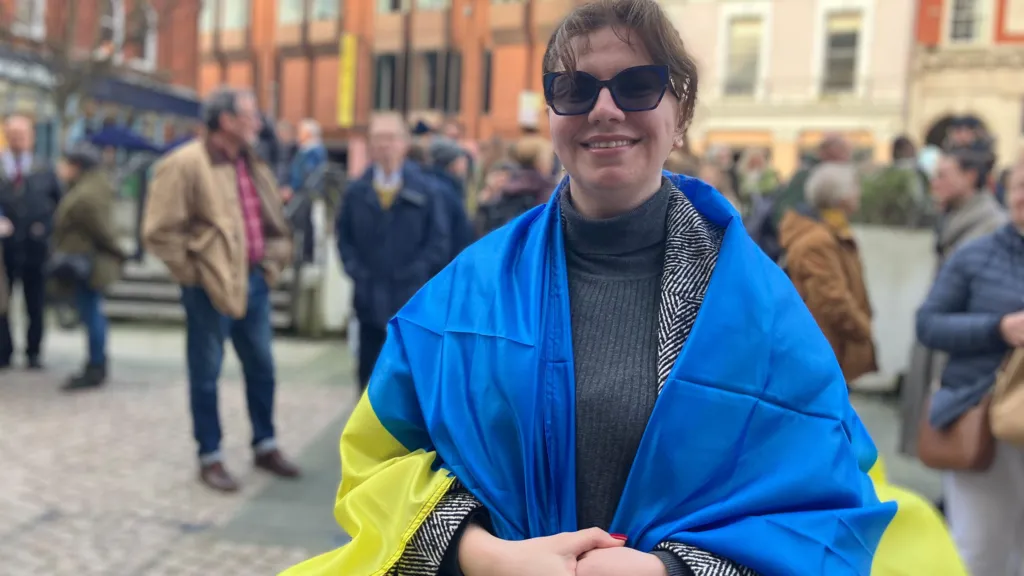
A solemn vigil has been held in a British town square to mark four years since the start of Russia’s full-scale invasion of Ukraine, bringing together members of the local Ukrainian community, civic leaders and residents in a quiet show of remembrance and solidarity.
The gathering took place on the anniversary of 24 February 2022, when Russian forces launched a large-scale assault ordered by President Vladimir Putin, dramatically escalating a conflict that had already been simmering since 2014. Since then, the war has reshaped European security, displaced millions and left tens of thousands dead or injured.

Under fading evening light, participants stood in silence, many holding candles and blue-and-yellow flags. A temporary memorial featuring photographs of destroyed cities and fallen soldiers was placed at the centre of the square. Organisers said the vigil was designed not as a political rally, but as a moment for reflection on the human cost of the conflict.
Local Ukrainian residents spoke about family members still living in cities regularly targeted by missile and drone strikes. Several described the emotional toll of watching events unfold from afar, balancing daily life in the UK with constant concern for relatives in Ukraine. One speaker noted that anniversaries intensify feelings of separation and uncertainty.
The mayor addressed the crowd, reaffirming the town’s support for displaced Ukrainians who have resettled in the area under UK sponsorship schemes. Since the invasion, thousands of Ukrainians have arrived in Britain through humanitarian visa programmes, many hosted by local families. Community volunteers present at the vigil said integration efforts — including language classes, employment support and school placements — remain ongoing.
Religious leaders from different denominations offered prayers for peace. A local church bell tolled four times to symbolise the four years of conflict. The names of several Ukrainian towns heavily affected by fighting were read aloud, including Mariupol, Bakhmut and Kherson, cities that have become synonymous with destruction and resistance.
The war began with rapid advances by Russian forces toward Kyiv, Ukraine’s capital. However, Ukrainian troops mounted a determined defence under President Volodymyr Zelenskyy, preventing the city’s capture. Subsequent phases of the war have included shifting front lines in the east and south, long-range strikes and a protracted war of attrition.
International support for Ukraine has remained a central factor in sustaining its defence capabilities. Western governments have provided military equipment, financial assistance and humanitarian aid. At the same time, the conflict has triggered economic ripple effects, including energy price volatility and supply chain disruption.
At the vigil, speakers emphasised the continuing humanitarian dimension. Organisers highlighted fundraising initiatives for medical supplies and winter support packages. A collection point was established near the square for donations of essential goods to be sent to Ukraine through established charities.
Attendees described a shared sense of resilience. Some held placards bearing messages calling for peace and justice. Others stood quietly, heads bowed. The mood was restrained, marked by reflection rather than protest.
For many present, the anniversary represents both endurance and uncertainty. Four years into the conflict, diplomatic breakthroughs remain limited. Periodic negotiation efforts have failed to produce a comprehensive settlement, and fighting continues along extended front lines.
Local councillors noted that the town’s Ukrainian population has become part of the social fabric. Schools have enrolled Ukrainian pupils, cultural events have introduced traditional music and cuisine, and community ties have strengthened through shared experience. The vigil, organisers said, symbolised that connection.
Security experts observe that prolonged conflicts risk fading from public attention as global crises compete for focus. Commemorative events such as this serve to maintain awareness and reaffirm solidarity beyond headlines. They also offer space for collective processing of grief and uncertainty.
As candles flickered in the cold evening air, a minute’s silence was observed for civilians and soldiers who have lost their lives. The gathering concluded with a rendition of the Ukrainian national anthem, sung softly but audibly across the square.

The fourth anniversary does not signal closure. For those with family in Ukraine, the war remains an immediate reality. For the host community, the vigil reinforced a commitment to stand alongside those affected.
Four years after the invasion began, the conflict continues to shape lives far beyond the battlefield. In this town square, remembrance served both as tribute and as a reminder that the consequences of war extend across borders and generations.
Related News:
 UK Must Act with Courage and Clarity on Israel-Palestine Conflict, Says Foreign Affairs Committee Report
 Starmer and Trump to Meet in Scotland Amid Growing Gaza Ceasefire Pressure
 Minister Dismisses Legal Concerns Over UK’s Pledge to Recognise Palestinian State
 MPs Call on UK Government to Delay Biometric Visa Checks for Gaza Students Amid Humanitarian Crisis
 Radioactive Leak at UK’s Nuclear Warhead Base Sparks Outcry Over Safety and Secrecy
 ‘I’m collateral damage’: ex-minister Tulip Siddiq on her Bangladesh corruption trial
 Mutual Inconvenience: Why Alaska Was Chosen for the Trump-Putin Summit on Ukraine
 “I Don’t Expect to Live a Normal Life”: How a Leeds Teenager Became the Target of a Chinese Bounty
 Ministers Accused of Defamation Over Palestine Action Ban and Mass Arrests
 UK Defence Secretary Says Allied Troops ‘Ready to Act from Day One’ if Ukraine Ceasefire Agreed
 Is the UK Ready to Put Boots on the Ground in Ukraine? Assessing Military Capacity and Challenges
 Protests Expected as Israeli Arms Firms Join Global Defence Trade Fair in London
 UK Home Office to Launch French Beach Signage to Warn Asylum Seekers of Risks
 Charlie Kirk Killing Used to Mobilise UK’s Largest Far-Right Rally in Decades
 UK Immigration Figures: Separating Facts from Perceptions
 Far-Right Rally in London Draws Record Crowds Amid Clashes with Police
 Thousands Gather in London to Protest Donald Trump’s Second UK State Visit
 UK and Ireland Set to Unveil New Proposals to Address Northern Ireland’s Troubles Legacy
 Trump Urges UK to “Call Out the Military” to Secure Borders Amid State Visit
Tulip Siddiq Raises Concerns Over Alleged ‘Fake’ Documents in Bangladesh Corruption Trial
Trump Urges UK to “Call Out the Military” to Secure Borders Amid State Visit
Tulip Siddiq Raises Concerns Over Alleged ‘Fake’ Documents in Bangladesh Corruption Trial
 UK Recognises State of Palestine in Push to Preserve Hope for Peace
 UK’s Recognition of Palestine: Symbolic Step or Real Change?
Trump’s UN Speech Criticises London and UK Policies, Draws Far-Right Attention
UK’s Recognition of Palestine: Symbolic Step or Real Change?
Trump’s UN Speech Criticises London and UK Policies, Draws Far-Right Attention
 UK Fighter Jet Purchase Could Breach Nuclear Treaty, Warns CND
 A Third of EU Citizens in UK Report Discrimination by Public Bodies Post-Brexit
 Jailed Georgian Opposition Leaders Warn UK of Iranian Links to Ruling Party
 Russia repeatedly targets UK military satellites, warns Space Command chief
 Pro-Palestine March to Proceed in London Despite Calls to Cancel After Manchester Attack
 UK Universities Warn Students Ahead of 7 October Pro-Palestine Protests
Starmer Considers Stricter Measures on Pro-Palestinian Protest Chants
UK Universities Warn Students Ahead of 7 October Pro-Palestine Protests
Starmer Considers Stricter Measures on Pro-Palestinian Protest Chants
 Public Trust in SNP Hits Historic Low Amid NHS Concerns
 Tony Blair Met Jeffrey Epstein at Downing Street in 2002
 China’s Mega Embassy in London Faces Further Delay
 Johnson Suggests Mandelson Linked to China Spy Controversy
 Minister Blames Deputy for Collapse of China Spy Case
 Shabana Mahmood Warns Border Failings Are Eroding Trust in States
 Witness statements reveal the CPS China spy row collapse in the UK
 Large scale Chinese spying in UK sparks political storm
 Nigel Farage Calls Vladimir Putin ‘A Very Bad Dude’
 Rachel Reeves signals welfare reform ahead of key budget
 Prince Andrew met alleged Chinese spies during Pitch@Palace China trips
 Kosovo agrees to host Britain’s refused asylum seekers
 Plaid Cymru Triumphs in Caerphilly, Ending Labour Century-Long Hold
 Rachel Reeves to lead UK trade push in Saudi Arabia amid rights debate
 British Woman in Iran ‘Losing Hope’ Amid Ongoing Detention
 Johnson Approved China’s London ‘Super-Embassy’ in 2018
 BBC Journalist Held and Interrogated in Vietnam
 Zohran Mamdani becomes New York City’s first Muslim mayor
Zohran Mamdani names all-female transition team for NYC mayoralty
Zohran Mamdani becomes New York City’s first Muslim mayor
Zohran Mamdani names all-female transition team for NYC mayoralty
 Second world war veterans honoured as King leads Remembrance Sunday
 BBC director-general and news chief resign amid bias row
 New review urges UK to repatriate Shamima Begum, others from Syria
 Rama Rebukes Mahmood for Targeting Albanian Families
 Russian Vessel Used Lasers on RAF Pilots, UK Claims
 Ireland Boosts Ukraine Aid as Zelensky Visits Dublin
 Britain Demands Israel Reverse Ban on Aid Groups
 US Africa aid remarks spark anger after leaked State email
 Barron Trump police call heard in London assault trial
 Trump Pulls Canada from His Controversial ‘Board of Peace’ Plan
 Starmer China visit raises human rights pressure on Beijing
 UK and EU Signal Fresh Push for Defence Cooperation Talks
 Emails Show Epstein Funded Mandelson’s Husband After Jail
 Cory Bernardi joins One Nation for SA election
 Starmer Condemns ‘Depraved’ Russian Strikes on Ukraine
 Russia Trolls Savage ‘Finished’ Keir Starmer After Mandelson Scandal Explodes
 US Healthcare Needs Fixing, But There’s No Agreement on How to Do It
 Starmer Weighs Fast-Tracking Defence Boost
 Police Assessing Stansted Airport Private Flights Over Epstein Ties
 Britain’s Reliance on China Makes Us ‘Weak Link in the West’, Warn MPs
 Trump Warns Over Chagos Islands Deal
 Trump and Chagos Deal Rift Over Iran Strikes
 How Much Could Andrew’s Arrest Hurt the Royal Family?
 Andrew Mountbatten-Windsor Arrest After FBI Radar
 UK Has Not Given US Permission to Use RAF Bases for Iran Strikes
 Australian PM Says Former Prince Andrew Has Suffered ‘Extraordinary Fall’ but That Won’t Prompt Republic Referendum
 Farage Chagos Islands Row Sparks Fury
 No Gas Boiler Ban as UK Warm Homes Plan Backs Heat Pumps
 Police response times face strict new national limits
 Could Manchester Lead the UK’s Economic Revival?
 Australian Families Leave Syrian Camp for Home