Published: 25 February 2026. The English Chronicle Desk. The English Chronicle Online.
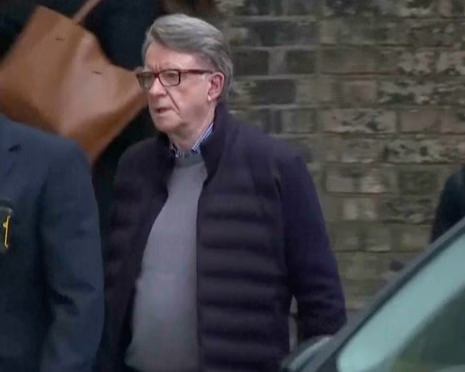
Peter Mandelson has sharply criticised police following his arrest, insisting the claims against him were entirely unfounded and motivated by a misunderstanding regarding his intentions to leave the country. Lawyers representing Mandelson stressed that his detention by the Metropolitan Police Service on Monday was prompted by a false suggestion he might relocate abroad, highlighting the absence of any substantive evidence to justify the intervention. According to Mandelson’s legal team, Scotland Yard had previously agreed that he would voluntarily attend an interview under caution next month concerning allegations linked to sharing sensitive information with convicted sex offender Jeffrey Epstein. Despite this prior arrangement, police arrested him after receiving information claiming he intended to travel to the British Virgin Islands, with the force citing this intelligence as sufficient to warrant immediate action. Following his release on bail in the early hours of Tuesday, Mandelson reportedly communicated with friends that the assertions suggesting he was preparing to flee were “complete fiction,” questioning who might be behind such allegations. His lawyers emphasised that Mandelson’s priority remains full cooperation with authorities to clear his name, rejecting any suggestion of deliberate obstruction or evasion.
The arrest has reignited scrutiny over Mandelson’s controversial tenure as the United Kingdom’s ambassador to Washington, which ended last September amid concerns about his associations with Epstein. This episode also coincided with his resignation from the Labour Party and departure from the House of Lords, events that collectively fuelled months of intense media coverage and reputational challenges. Officials at Downing Street are reportedly preparing for the imminent publication of a Cabinet Office due diligence report, which is expected to outline serious reputational risks connected to Mandelson’s appointment. The report is anticipated to detail the prime minister’s prior awareness of the Epstein connection, with sources suggesting that initial responses, including reliance on advice from Mandelson’s friend Morgan McSweeney, could be viewed as inadequate. The scrutiny surrounding Mandelson’s arrest now places additional pressure on the government to navigate a delicate balance between transparency and protecting ongoing investigations.

The Metropolitan Police reportedly received intelligence indicating that Mandelson might be intending international travel, with the British Virgin Islands cited as a potential destination. Although the territory maintains an extradition agreement with the UK, the information was considered credible enough by detectives to justify his temporary detention. Upon release, police imposed restrictions on Mandelson’s overseas travel as part of his bail conditions, although the precise measures, including whether he surrendered his passport, remain unclear. The legal statement issued by Mandelson’s firm, Mishcon de Reya, reinforced the assertion that the arrest was unnecessary, reiterating that the former peer had agreed to a voluntary interview in early March. The lawyers insisted the arrest arose solely from an unsubstantiated suggestion of permanent relocation abroad, describing the claim as entirely without truth.
In the hours following his release, Mandelson reportedly sent messages to friends, describing the police action as improvised and reiterating that the idea he would abandon his family, home, and pets was “complete fiction.” The messages conveyed disbelief at the sources behind the arrest and questioned whether a particular individual or group had instigated the intelligence. Allegations linking Lord Speaker Michael Forsyth to providing information to Scotland Yard were strongly denied, with parliamentary authorities asserting no such communication occurred. The public denials aim to remove speculation regarding political figures’ involvement in the intelligence that led to Mandelson’s detention.
This latest development has rekindled debate over the prime minister’s decision to appoint Mandelson despite knowledge of his continued ties to Epstein, prompting government sources to admit that the appointment was a mistake. Officials have emphasised that prior knowledge of these connections, absent during the original appointment, now appears more significant given the subsequent controversy. The Cabinet Office document is expected to contain sensitive details concerning Mandelson’s selection for the ambassadorial role, offering insight into the handling of high-profile appointments amid reputational risks. While the government has limited capacity to disclose certain details due to the ongoing police investigation, pressure from MPs has previously led to the release of historical documents relating to Andrew Mountbatten-Windsor’s appointment as a trade envoy in 2001, establishing a precedent for transparency.
Parliamentary oversight and scrutiny of public appointments have been intensified by these incidents, with historical documents providing examples of how ministerial approvals were sometimes formalities following palace requests. The expected releases related to Mandelson and Mountbatten-Windsor are likely to provide unprecedented insights into the government’s handling of individuals linked to Epstein, though officials caution that delays are inevitable due to the police inquiry and logistical challenges in reviewing documents stored in paper form. The Department for Business and Trade is leading the review for Mountbatten-Windsor documents, navigating complex protocols to ensure no material prejudices ongoing investigations, a process mirrored by the Cabinet Office in prioritising Mandelson files.
Authorities indicated that the first tranche of Mandelson-related documents is being prepared for imminent release, focusing on material unrelated to national security or ongoing criminal inquiries. This approach contrasts with other documents whose disclosure will require more extensive checks, ensuring they do not compromise ongoing investigations. Volunteers from within the Cabinet Office have been recruited to expedite the review, reflecting the high level of attention the files command. Meanwhile, police investigating Mountbatten-Windsor concluded searches at a Berkshire property, highlighting the seriousness of ongoing investigations into alleged misconduct in public office. The dual scrutiny of Mandelson and Mountbatten-Windsor underscores the broader challenge facing UK authorities in balancing transparency with the integrity of complex legal and diplomatic proceedings.

Mandelson’s arrest and subsequent release have renewed public debate about the intersection of politics, diplomacy, and criminal investigations, revealing the delicate nature of high-profile appointments and the consequences of unresolved reputational risks. The incident illustrates the challenges faced by government bodies in responding to intelligence that, while appearing credible, may be misleading or incorrect, and emphasises the importance of careful handling of sensitive information. Legal experts have noted that the prioritisation of voluntary interviews over arrests typically reflects standard practice, making Mandelson’s detention a particularly unusual case. Meanwhile, public attention remains focused on the Cabinet Office report and potential future disclosures, as officials prepare to navigate ongoing parliamentary and media scrutiny. The unfolding events provide a striking example of how reputational concerns, police procedures, and political considerations intersect in high-profile UK cases, highlighting the need for procedural clarity and measured responses.
Peter Mandelson’s public statements and legal team’s assurances suggest that he remains committed to cooperating with investigators and protecting his personal and professional reputation. The case also illustrates how intelligence misinterpretations can lead to highly visible police interventions, drawing attention to the responsibilities of both law enforcement and political authorities in safeguarding the fairness and accuracy of investigative actions. As the situation develops, government and police agencies must continue to weigh transparency against operational security, while the public observes the evolving narrative surrounding Mandelson, his past appointments, and the broader implications for UK governance and diplomatic relations. The focus now remains on the release of critical documents, which will likely shape public perception and influence ongoing discussions about political accountability, procedural propriety, and the responsibilities of individuals in positions of trust.
Related News:
 British Woman in Iran ‘Losing Hope’ Amid Ongoing Detention
 BBC Journalist Held and Interrogated in Vietnam
 Green Party Surges Past Labour in Latest UK Poll
 Celebrities and Charities Demand UK Government Act on Child Poverty
 Trump’s UK Ambassador Urges North Sea Drilling to Strengthen US Ties
 FBI Director Kash Patel Defends Girlfriend Amid Government Jet Claims
 French Taxi Driver Cleared in David Lammy Theft Case After Fare Dispute
 MPs Press Rachel Reeves to Hike Gambling Taxes
 Boris Johnson accused of undermining BBC leadership
 ‘Reckless’ cuts to victims’ services will cost more than they save
 Millionaires group urge Reeves to introduce wealth tax to ‘lift kids out of poverty’
 Starmer Faces Growing Dissent as Labour MPs Weigh Leadership Challenge
 Reeves rejects £1bn plea for NHS redundancy payouts
 Farage appointee to lead Reform youth accused of anti-British views
 Politics latest: Starmer ‘will fight any leadership coup’ as Streeting denies attempt to oust Labour PM
 PM Condemns Leaks, Vows Loyalty to Ministers and Stability
 Major Rent Reform Ends No-Fault Evictions in England
 Peers Flood Assisted Dying Bill with 942 Amendments
 England’s Special Needs Support Faces Breaking Point
 MoD warned over Excel risks before Afghan data breach
 UK Asylum Overhaul Sparks Debate Over Human Rights and Deportations
 UK Candidate Moved to Safe House After Election Threats
 Mahmood Defends Tough Overhaul of UK Asylum System
 UK Warns China After MI5 Issues Espionage Alert
 UK Vulnerable to Attack, Defence Committee Finds
 Labour Faces Historic Decline in Wales
 Rama Rebukes Mahmood for Targeting Albanian Families
 PM Highlights UK Business at G20 in South Africa
 Kate Forbes: Motherhood Harder Than Politics
 Welsh Government Christmas 2020 Lockdown Criticised
 Most Tories Expect to Support a Farage-Led Government
 Labour MP claims devolution bill is ‘blatant discrimination’ against Cornwall
 Millions Face Higher Taxes Under Reeves New Budget
 Peers Get Extra Time to Debate Assisted Dying Bill
 Planned Palestinian Flag Raising at Belfast City Hall Faces Delay Amid Legal Concerns
 Starmer Says Labour’s Economic Plan Needs Years to Deliver
 Culture secretary to review Telegraph takeover by Daily Mail owner
 Andy Burnham Apologises for Past LGBTQ+ Police Discrimination
 Plans to Limit Jury Trials Face Retreat After Mounting Opposition
 Jenrick Reform defection deepens Tory civil war
 Right Must Unite After Jenrick Defection, Urges Rees-Mogg
 UK Ministers Drop Foreign Student Targets for Global Education Push
 MPs warn AI financial risks threaten UK stability
 MPs warn AI financial risks threaten UK stability
 No Gas Boiler Ban as UK Warm Homes Plan Backs Heat Pumps
 Hugh Grant Joins Call for Under-16 Social Media Ban in UK
 Shinzo Abe’s killer receives life sentence in Japan
 Lords Vote Piles Pressure on Starmer Over Social Media Ban
 Planned Troubles Board Game Sparks Outrage in Northern Ireland
 Reform UK Health Plan ‘Would Cost £1.7bn’, Streeting Says
 Police response times face strict new national limits
 Labour policing overhaul sparks fears over growing central control
 Tories criticised after Braverman defection sparks mental health row
 Burnham Westminster return hopes fade amid Labour rift
 Starmer warns of toxic division politics in Reform challenge
 Starmer China visit raises human rights pressure on Beijing
 Labour Must Revive High Streets to Avoid Election Collapse
 Calls Grow for King Charles to Apologise for Crown’s Role in Slavery
 Starmer Signals UK Return to EU Defence Pact Talks
 Palantir contracts face UK halt calls over transparency
 Labour Thinktank Row Deepens Over Journalist Probe Claims
 Sarwar call shakes Labour as No 10 calms fears
 Labour Lord Doyle Apologises Over Paedophile Ties in Political Storm
 Palestine Action Verdict Sparks Debate on Activist Tactics
 Cabinet Secretary Shake-Up Triggers Due Diligence Warning
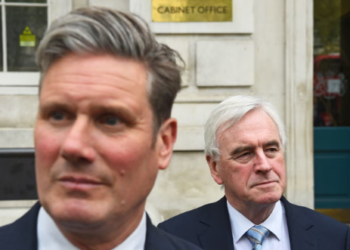 Starmer Faces Inquiry Calls Over Thinktank Probe
 Royal Mail Delivery Crisis Deepens Amid Weather Chaos
 Labour Together probe scandal sparks fresh Cabinet Office investigation
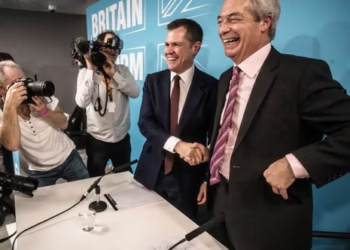 Farage to Name Jenrick as Reform Chancellor Pick
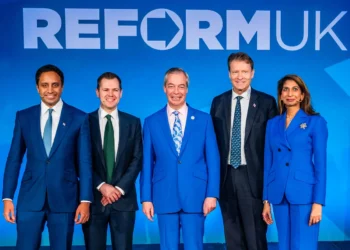 Farage Unveils Reform UK Frontbench Team
 NHS Negligence Ruling Raises Payout Costs
 Civil Service Pay: Union Urges Ministers to End ‘Barking Mad’ Limits
 Antonia Romeo appointment sparks criticism
 Trump and Chagos Deal Rift Over Iran Strikes
 Andrew Mountbatten-Windsor Arrest After FBI Radar
 Farage Chagos Islands Row Sparks Fury
 Trump Tariffs Threat Spark UK and EU Alarm
 Gasfield Deal Sparks Debate Over Fracking in Lincolnshire
 Reform UK targets workers’ rights repeal
 Ministers Urged to Ban Crypto Political Donations