Published: 25 February 2026. The English Chronicle Desk. The English Chronicle Online.
For decades, the “snowball Earth” theory suggested that around 700 million years ago, Earth became entirely frozen. Scientists believed the planet was locked in a global ice shell, leaving no room for seasonal variation or the usual climate fluctuations that drive life. Spring, summer, autumn, and winter were thought to have vanished entirely, replaced by an unchanging icy landscape. However, new research from the west coast of Scotland is rewriting this story, revealing periods of warmth that punctuated the supposed global freeze.
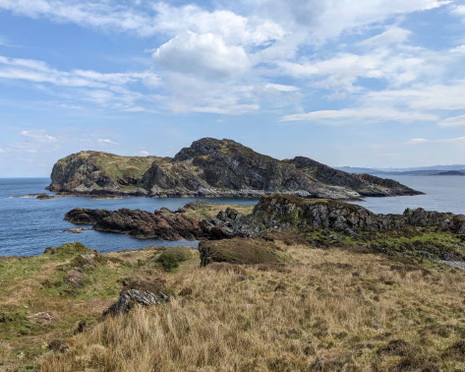
A team from the University of Southampton, led by Thomas Gernon and Chloe Griffin, has examined ancient rocks on the remote islands of the Garvellachs, discovering evidence that challenges long-standing assumptions about Earth’s extreme glacial past. These rocks, deposited during the snowball Earth era, have preserved climate records with extraordinary fidelity. Using microscopic analysis, the team identified 2,600 distinct layers, each representing a year in deep geological history, effectively allowing scientists to observe climate change over millennia.
The meticulous study of these layers showed subtle variations in thickness, indicating short-term climate cycles that resemble modern phenomena. Evidence of solar activity, seasonal changes, and oscillations similar to the El Niño cycle emerged from this frozen record, suggesting the climate was not uniformly static. According to the researchers, these patterns represent brief “slushy” intervals when a small fraction of the oceans thawed, permitting pockets of open water to exist despite the overall icy conditions.

Published in Earth and Planetary Science Letters, the findings illustrate that snowball Earth was not an unbroken period of global glaciation. Instead, there were intermittent periods of relative warmth, lasting several thousand years, when seasonal and solar influences temporarily penetrated the ice. This nuanced perspective provides a fresh understanding of Earth’s climate dynamics and raises important questions about how the planet’s system responded to extreme stress in the past.
The implications of this research extend beyond historical curiosity. Understanding the sensitivity of Earth’s climate system during snowball Earth can inform projections of modern climate responses. The discovery of transient thawing events suggests that even in periods of extreme cooling, feedback mechanisms can introduce variability, potentially offering clues about resilience and tipping points in contemporary climate systems. Scientists studying modern climate change may find analogues in these ancient cycles, helping them refine predictions for future scenarios.
The Scottish rocks also provide insights into the geological processes that occurred under global ice. Layered sediments capture the interaction of ocean currents, ice cover, and atmospheric forces, offering a window into the environmental complexity of a planet that was previously assumed to be uniformly frozen. Gernon and Griffin emphasise that this study demonstrates Earth’s climate system was more dynamic than previously thought, even during the harshest glacial episodes.
Researchers are particularly excited by the level of detail preserved in the Garvellachs rocks. The 2,600 layers allow for reconstruction of climate signals with annual resolution, a rare feat in Precambrian geology. Variations in mineral composition, thickness, and deposition patterns enable scientists to track subtle changes in temperature, ocean chemistry, and ice extent. This unprecedented resolution reveals the interplay of multiple climatic drivers, painting a picture of a world that was frozen, yet periodically alive with environmental motion.
These findings also challenge existing models of snowball Earth that assume an entirely dormant planetary system. For decades, climate simulations depicted a monolithic ice-covered world, leaving little room for hydrological or seasonal processes. By contrast, the Garvellachs evidence shows that even during global glaciation, the system retained the capacity for localized thawing and climate oscillations. The researchers argue that these transient episodes may have been crucial for the eventual recovery from snowball Earth, potentially fostering refuges for microbial life that persisted under extreme conditions.
The broader scientific community has welcomed the study with cautious enthusiasm. Experts note that while snowball Earth periods were undoubtedly extreme, this research underscores the importance of integrating field-based evidence into climate models. Geological records like those in Scotland provide a reality check, reminding theorists that even the most severe climatic events can contain pockets of variability. Such insights may influence how future models of planetary habitability are constructed, particularly for exoplanets or other celestial bodies experiencing glaciation events.
Moreover, the study highlights the continuing importance of field geology in understanding Earth’s past. Laboratory simulations and satellite data offer valuable perspectives, but direct examination of ancient rock formations remains indispensable for uncovering subtle patterns invisible at larger scales. The Garvellachs rocks serve as a testament to the power of meticulous fieldwork and cross-disciplinary collaboration, bringing together geologists, climate scientists, and planetary researchers to reinterpret a pivotal chapter in Earth’s history.
The research also raises intriguing questions about the mechanisms that allowed these brief warm intervals to occur. Scientists are exploring possibilities including volcanic activity, fluctuations in greenhouse gases, and variations in solar radiation, all of which could have created temporary melt conditions. Understanding the triggers and frequency of these thawing events may illuminate not only the dynamics of ancient Earth but also the potential for abrupt climate shifts in our current era.

In addition to their scientific significance, the findings carry broader implications for public understanding of climate history. By demonstrating that Earth’s climate system is both sensitive and capable of dynamic response, the study invites reflection on modern environmental challenges. While snowball Earth represents an extreme case, the evidence of intermittent thawing illustrates that planetary systems are not rigid; they respond to complex feedbacks, sometimes in unexpected ways. This perspective can enrich public discourse about resilience, tipping points, and the long-term consequences of human-driven climate change.
As the debate over snowball Earth continues, the Garvellachs rocks stand as a powerful reminder of the value of direct geological evidence. The discovery of a slushy interlude offers hope for reconciling conflicting theories and underscores the need for careful examination of Earth’s historical record. By bridging paleoclimate science and modern climate research, this study enhances our understanding of how fragile yet adaptable our planet’s system truly is.
Ultimately, the new insights from Scottish rocks encourage scientists to reconsider rigid interpretations of past climate. The snowball Earth era, once seen as a monolithic freeze, appears increasingly complex, marked by subtle rhythms and temporary thawing episodes. By uncovering this hidden variability, Gernon, Griffin, and their colleagues have opened a window onto a planet in motion, even under extreme conditions, highlighting the enduring mystery and resilience of Earth’s climate system.
Related News:
 Reeves Faces Setback as Labour May Miss Homes Target
 Virgin Trains Moves Closer to Challenging Eurostar Monopoly
 Trump’s UK Ambassador Urges North Sea Drilling to Strengthen US Ties
 Ryanair Chief UK Economy ‘Doomed’ Under Labour
 Court Hears Challenge Over Water Bills Funding Sewage Fixes
 ABF May Split Primark from Food Division Amid Tough Market
 Rachel Reeves Set to Break Labour Pledge and Raise Income Tax
 UPS Cargo Plane Crash in Kentucky Kills Seven
 M&S Profits More Than Halve After Cyber-Attack
 Tony Blair think tank warns Rachel Reeves must cut taxes if manifesto broken
 Oprah enjoys Meghan’s jam on English muffins
 MPs Press Rachel Reeves to Hike Gambling Taxes
 Earl of Yarmouth Faces £1.3m Legal Bill Over Family Estate
 North Sea oil workers must lose weight or face job loss
 Warning as Britons prepare to spend £4 billion this Black Friday
 Millionaires group urge Reeves to introduce wealth tax to ‘lift kids out of poverty’
 From Lego to Pokémon: How Adults Are Driving UK Toy Market Growth
 UK toy market enjoys bumper year as ‘kidults’ fuel demand
 New laws to bolster UK’s defences against cyber attacks on NHS, transport and energy
 Skims Eyes Global Expansion After Reaching $5 Billion Value
 Trump Moves to Cut Coffee and Banana Tariffs in Latin America Deals
 Global markets drop amid tech sell-off and China slowdown
 Canada Passes Carney’s First Budget in Tight Parliamentary Vote
 PM Highlights UK Business at G20 in South Africa
 Mossmorran Plant Closure Hits Cowdenbeath Hard
 UK Taskforce Unveils Plan to Streamline Nuclear Reactor Rules
 Steel billionaire Lakshmi Mittal reportedly leaves UK
 India’s Labour Law Overhaul Sparks Fierce Debate
 Starmer Says Labour’s Economic Plan Needs Years to Deliver
 Virgin Media Fined £23.8m Over Telecare Safety Failures
 Rising Water Bills Lift Troubled Thames Back to Profit
 Tesla Warns UK That Weak EV Rules Could Threaten Sales
 BP agrees £7.4bn Castrol sale to US investment firm
 Sainsbury’s CEO leads business honours in New Year list
 FTSE 100 Hits 10,000: UK Market Celebrates Record Year
 UK House Prices Fall Sharply at Year-End, Nationwide Reports
 UK Car Sales Pass 2 Million as Chinese Brands Surge
 Wessex Water chiefs receive £50,000 extra despite government bonus ban
 3,000 Jobs at Risk Without UK Helicopter Order
 German Supermarket Aldi to Open 180 US Stores This Year
 Starmer links foreign trips to tackling cost of living crisis
 China Dependence Threatens UK Energy Supply Chains and Jobs
 Canada-China trade gains momentum in new strategic partnership
 ScottishPower Tops List of Worst UK Energy Suppliers
MPs warn AI financial risks threaten UK stability
ScottishPower Tops List of Worst UK Energy Suppliers
MPs warn AI financial risks threaten UK stability
 MPs warn AI financial risks threaten UK stability
 B&M and The Works Struggle During Christmas Trading
 UK Disposable Income Growth Transforms Eleven Towns and Cities
 US Dollar Hits Four-Year Low Amid Market Turmoil
 Amazon mistakenly signals new global layoffs to employees
 Labour Must Revive High Streets to Avoid Election Collapse
 Households in England Face Rising Water Bills in April
 UK needs new factory to reach 1.3m car target, says industry chief
 UK food industry urges transition if post-Brexit rules reset
 AstraZeneca China Investment Signals Strategic Shift Abroad
 UK New Car Discounts Near £6,000 as Prices Are Slashed
 Study Finds One in Seven England Takeaways Are Dark Kitchens
 Riverford sales surge as UK organic market booms
 Barclays drops Global Counsel after Mandelson link scrutiny
 Telstra AI jobs cuts as automation drive expands
 Europeans Shift Travel Habits as US Trips Lose Appeal
 BT Names New Openreach Chief Amid Major Fibre Expansion
 AI fears hit UK wealth and comparison sites
 Elliott Takes LSEG Stake, Pressures Strategy Shift
 UK Housing Market Shows Early Recovery Signs
 UK economy struggles as growth stalls at 0.1% in late 2025
 Schroders sold to US investor in £9.9bn deal ending family control
 Aberdeen Chosen for GB Energy HQ at Marischal Square
 Bank of England Urged to Cut Rates to Spur Growth
 Lloyds Faces Scrutiny Over Staff Data Use in Pay Talks
 Santos Wins Landmark Greenwashing Case in Court
 Royal Mail Blames Poor Weather and Sickness for Delayed Deliveries
 British Steel wins Turkey rail boost
 Glencore Approves $2bn Payout Despite Profit Slump
 Sanders Condemns Billionaire ‘Greed’ in California Tax Debate
 UK Sees Record £30.4bn Budget Surplus, Boosting Reeves’ Position
 UK Job Vacancies Hit Five-Year Pandemic Low
 UK Youth Unemployment Surges Amid Tax Changes
 Ministers Urged to Ban Crypto Political Donations
 Strong Rebound for UK Housing Market Sees 6% More Homes