Published: 04 March 2026. The English Chronicle Desk. The English Chronicle Online.
The global landscape of civil disobedience is shifting rapidly as legal frameworks are being redefined by high-ranking Trump officials. Recent events in both the United Kingdom and the United States have highlighted a growing tension between religious sanctity and the right to protest. When dozens of demonstrators interrupted a church service in St Paul, Minnesota, earlier this year, it revived a fierce yet enduring debate about whether places of worship are appropriate arenas for dissent. This incident served as a catalyst for a broader legal strategy that many legal experts are now calling the “nuclear option” against political activism.
In demanding the resignation of a pastor who leads a local Immigration and Customs Enforcement field office, demonstrators chanted at Cities church on 18 January. Religious and political leaders condemned the action, fueled by the church’s statement that protesters had frightened children and created a scene marked by intimidation. Since then, the justice department has indicted 39 people, including former CNN anchor Don Lemon, on charges of conspiracy and interfering with the first amendment rights of worshipers. Lemon had been covering the incident as a reporter, making his arrest a flashpoint for international press freedom advocates.
Their arrests sparked outrage among free speech advocates, as many questioned whether the administration had overstepped its authority in using a 1994 law to prosecute protesters and journalists in houses of worship. This strategy, orchestrated by Trump officials, involves the creative application of the Freedom of Access to Clinic Entrances Act. This federal statute was originally designed to protect reproductive health clinics from violence and blockades. However, a specific clause extending these protections to houses of worship is now being utilized in ways the original authors likely never envisioned for political demonstrations.

Mary Ziegler, a professor at the University of California’s Davis School of Law, suggests that the administration is favoring specific viewpoints over others. She notes an increase in prosecutions designed to blur the line between protected speech and criminal intimidation. Using this legal lever to charge church protesters marks a significant reinvention of the statute. Acts of civil disobedience in religious spaces are not a new phenomenon in Western history, but the level of federal intervention currently being observed is unprecedented in its scope and severity.
In 1984, the Reverend D. Douglas Roth delivered searing sermons against corporate evil and led disillusioned steelworkers to picket area churches. The Lutheran minister was defrocked and jailed for 112 days for his actions. More recently, in 2024, pro-Palestinian activists protested an event at a New Jersey synagogue that promoted property sales in the West Bank. The demonstrators clashed with counter-protesters, leading to arrests and further legal scrutiny. What is new in this landscape is the systematic deployment of federal power by Trump officials to target specific movements.
The Face Act has been used almost exclusively to prosecute anti-abortion groups for most of its thirty-year history. Ziegler explains that the current administration has rolled back the use of the law against clinic blockades while expanding its powers against anti-ICE protests. Last January, the administration even pardoned ten anti-abortion advocates who had been previously charged with violating the Act. This perceived inconsistency has led to accusations of a double standard in how federal law is applied to different groups of activists.
In September, the justice department used the law to sue the pro-Palestinian activists involved in the 2024 New Jersey synagogue protest. It marked the first time the Face Act was used to target a demonstration at a place of worship in this specific manner. In late January, the Department of Justice asked a federal judge to indefinitely pause the civil lawsuit so a related criminal investigation could be resolved first. Attorneys for the protesters pushed for the case to proceed or be dismissed entirely, citing a lack of legal merit.
Ziegler acknowledges that freedom of religion should be protected, as should the right to pray without disruption. However, she argues that the proper tool for enforcing that right is local trespassing law rather than federal statutes. The Face Act is considered a nuclear option because the penalties associated with it are so extreme. Charging protesters with a federal felony for what would otherwise be a misdemeanor trespass changes the stakes of political engagement. This shift has sent a chilling effect through various activist communities across the Atlantic.
In response to the Minnesota demonstration, lawmakers in half a dozen states quickly introduced legislation expanding penalties for disrupting religious services. A bill in Oklahoma would direct protesters to maintain at least eight feet of distance from worshippers. New York City lawmakers are debating two bills that would establish protest-free buffer zones around religious sites. These proposals were a direct response to recent demonstrations outside two synagogues holding events to promote property sales in disputed territories. The involvement of Trump officials in promoting these legal templates has been noted by civil rights observers.
A number of moderate Jewish groups in New York have endorsed the bills, while several progressive organizations released a joint statement opposing them. Sophie Ellman-Golan, representing Jews for Racial and Economic Justice, stated that protest rights are an essential part of a functioning democracy. She argues that houses of worship often function as meeting and events spaces where secular political issues are discussed. If a political forum is held inside a religious building, she believes it should not be shielded from the same scrutiny as a public town hall.
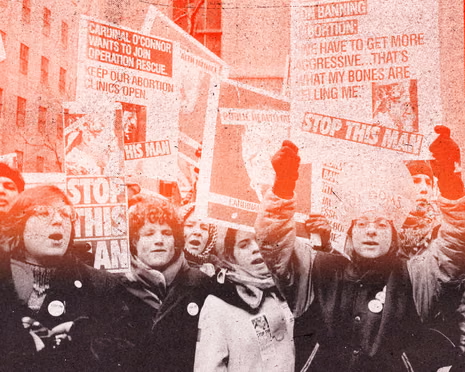
The lasting impact of church protests can be seen in the history of the 1989 St Patrick’s Cathedral demonstration in New York. Dozens of protesters performed a silent “die-in” to target the Catholic Church’s stance on public health education. Despite sharp rebukes from religious leaders at the time, the impact of the action was incalculable. It transformed how the media portrayed activists and paved the way for significant policy changes in healthcare. Sarah Schulman, an activist from that era, argues that the public has a right to respond when religious organizations step into secular politics.

Current data shows a significant demographic shift in those participating in these high-stakes demonstrations. Recent arrests in St Paul and New Jersey indicate that 45% of those charged under these new interpretations are under the age of thirty. Furthermore, statistical reports from civil rights monitoring groups suggest that activists from minority backgrounds are being targeted at a rate 30% higher than their white counterparts in similar protest scenarios. These concrete numbers have added fuel to the fire of those claiming that the law is being applied with a clear bias.
The influence of Trump officials is not limited to the United States, as UK-based advocacy groups are watching these developments with growing concern. There are fears that similar legal “buffer zones” could be implemented around British places of worship that host political speakers. As the legal battles continue to play out in federal courts, the definition of a “house of worship” is being tested. If the space is used for a real estate seminar or a political rally, many argue it loses its protected status under the Face Act.
As we move further into 2026, the resolution of these cases will likely set a global precedent for how dissent is handled in sensitive spaces. The balance between protecting the sanctity of prayer and the necessity of political speech remains precarious. While the administration maintains that it is simply protecting the rights of the faithful, critics see a coordinated effort to silence opposition. The strategy employed by Trump officials remains one of the most controversial legal developments of the current year, ensuring that the debate over the “nuclear option” will continue for months to come.
Related News:
 Shock US Raid: Maduro Pleads Not Guilty in Manhattan Court
 Israel Dossier Sparks Australian Political Interference Concern
 Trump Plans Venezuela Meeting, Warns of Cartel Land Strikes
 Trump Says US Will Act on Greenland ‘Whether They Like It or Not’
 Mandelson apologises over Epstein ties after public scrutiny
 Rudd successor: Defence chief and former ministers considered
 US Senate rejects resolution limiting Trump military powers
 Trump Calls Greenland Critical for US Security After Denmark Talks
 Trump: Iran Killing Has Stopped, Strike Threats Pulled Back
 Machado Trump medal gesture reshapes Venezuela power struggle
 Trump Receives Machado’s Nobel Medal in White House Meeting
 Iran unrest slows under brutal crackdown and global tensions
 Trump Allies Pursue $200m European Gas Pipeline Deal
 US Considers Asylum for British Jews Amid Rising Antisemitism
 Starmer Challenges US Over Controversial Greenland Deal
 Starmer tariffs stance rejects US trade retaliation
 Spoof “Make America Go Away” Caps Rally Denmark Over Greenland
 Trump slams UK ‘stupidity’ over Chagos Islands, eyes Greenland takeover
 UK Presses On With Chagos Handover Despite Trump Criticism
 Kim Jong-un Fires Vice-Premier Over Factory Failures
 Shinzo Abe’s killer receives life sentence in Japan
 Starmer Resists Matching Trump Amid Greenland Tensions
 Netanyahu Accepts Trump’s ‘Board of Peace’ Invitation
 South Korean Ex-PM Jailed 23 Years Over Martial Law Role
 American democracy faces crisis after Trump’s return
 Russia Strikes Kyiv and Kharkiv as Peace Talks Enter Day Two
 Canada Rules Out Free Trade Deal With China Amid US Tensions
 Turnbull urges Albanese to confront Trump’s global ‘bully’ politics
 Snow Threatens Japan Election Turnout Amid Extreme Cold
 Keir Starmer meets Xi to strengthen UK-China economic relations
 Crisis Looms as Liberals Debate Sussan Ley Future
 Cambridge Faces Scrutiny Over Arms Investment Transparency
 Files Link Andrew to Epstein Dinner After Prison Release
 Emails Show Epstein Funded Mandelson’s Husband After Jail
 Thousands Protest ICE Operations in Nationwide US Day of Action
 Epstein Files Reveal Trump Officials’ Emails with Financier
 Thousands Protest ICE in New York Against Trump Deportation Campaign
 Trump-Petro Meeting Sparks Hopes of Diplomatic Detente
 US Must Be Prudent When Supplying Arms to Taiwan, Xi Tells Trump
 Fears of New Arms Race as US-Russia Nuclear Weapons Treaty Expires
 Trump softens stance on Chagos Islands deal after Starmer call
 Epstein UAE Emails Shake British Royal Andrew’s Legacy
 Liberal Fallout: Taylor Challenge Casts Shadow Over Sussan Ley’s Leadership
 Ukraine, Russia Meet in Geneva Ahead of War Anniversary
 Starmer’s Friend Made Millions from Chagos Deal
 Britain’s Reliance on China Makes Us ‘Weak Link in the West’, Warn MPs
 I Saw First‑Hand Why Trump Still Wants More from Greenland
 UK Has Not Given US Permission to Use RAF Bases for Iran Strikes
 Brazilian Politician Brothers Sentenced for Marielle Murder
 Jimmy Lai Freed From Fraud Conviction in Rare Hong Kong Court Victory
 Why the Longest State of the Union Was Surprisingly Hollow
 Tommy Robinson Meets Trump Officials at US State Department
 Blackouts and Emergency Aid: Why the Cuban Revolution Faces Its Biggest Threat Yet
 UK Will Allow US to Use Bases to Strike Iranian Missile Sites, PM Says
 Cooper: Joining US Strikes on Iran ‘Not in Britain’s Interest’
 Trump’s Iran Endgame Unclear After Mixed Messaging on War Aims
 Israel Launches Fresh Strikes on Tehran & Beirut; US Warns “Hardest Hits” Ahead
 UK Must Act with Courage and Clarity on Israel-Palestine Conflict, Says Foreign Affairs Committee Report
 The Fight for Trans Safety Is a Fight for Everyone’s Safety — MPs Must Debate This Crucial Issue
 Rylan Clark Criticizes UK Immigration Policies on This Morning, Sparking Public Debate
 Tanni Grey-Thompson Faces Abuse Over Opposition to Assisted Dying Bill
 Nigel Farage Unveils Controversial Immigration and Welfare Plans at Reform UK Press Conference
 Yvette Cooper Signals Global Momentum Towards Gaza Peace Deal Amid Humanitarian Crisis
 UK border officers deployed to Balkans to tackle migrant smuggling
 UK MPs warn of repeat riots over online misinformation
 Russia’s Latest Push to Win US Favors Shows Deep Desperation
 Trump’s UK Ambassador Urges North Sea Drilling to Strengthen US Ties
 No Gas Boiler Ban as UK Warm Homes Plan Backs Heat Pumps
 Sussan Ley leadership milestone shakes Liberal future
 Police response times face strict new national limits
 Australia’s Opposition Coalition Reunites After Rift
 ‘Trump Will Be Gone in Three Years,’ Top Democrats Tell Europe
 Could Manchester Lead the UK’s Economic Revival?
 Australian Families Leave Syrian Camp for Home
 Civil Service Pay: Union Urges Ministers to End ‘Barking Mad’ Limits
 Ukraine Negotiator Reveals What It Feels Like Facing Russia
 Drugs, Denial, Stigma: Fiji’s HIV Crisis Hits Children
 Russian Trade Routed Through British Islands Exposed
 American Citizen Killed in Cuba Boat Shooting, U.S. Officials Say
 Iran’s Regime Still Intact — Coming Days Will Test Its Survival