Published: 12 March 2026. The English Chronicle Desk. The English Chronicle Online.
Former UK prime minister Gordon Brown has called for the creation of a global tribunal dedicated to crimes against children, arguing that international law must provide stronger protections for young people caught in armed conflict. Writing in the The Guardian, Brown warned that modern warfare increasingly exposes children to violence and that current legal systems fail to deliver justice quickly enough when atrocities occur.
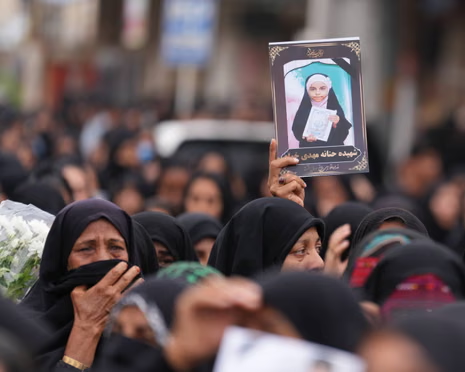
Brown’s proposal comes amid renewed debate over the protection of civilians following a devastating attack on a school during the escalating conflict involving Iran. The strike reportedly hit the Shajareh Tayyebeh school, where hundreds of girls were attending classes when the missile struck. Reports indicate that 168 schoolgirls were killed in the explosion, creating international shock and condemnation. For Brown, the tragedy illustrates how crimes against children continue to occur despite long-standing legal protections.
In his article, Brown argues that schools should hold the same protected moral status as hospitals during wartime. He insists that classrooms should be considered safe zones, places where children can learn without fear of attack or violence. Yet conflicts around the world increasingly blur the lines between military targets and civilian spaces. As wars move into urban areas, schools, homes, and hospitals often lie dangerously close to combat zones.

Brown notes that modern conflicts rarely resemble traditional battlefields. Instead, they unfold in densely populated towns and cities where civilians face the greatest risk. Teachers and pupils often find themselves in harm’s way even when they have no connection to the fighting. According to Brown, this growing trend means that children are becoming unintended victims of military strategies designed for urban warfare.
The former prime minister currently serves as the United Nations special envoy for global education. In that role, he has frequently spoken about the importance of protecting schools during conflict. His latest intervention focuses specifically on crimes against children and the need for a stronger legal mechanism to deter future attacks. Brown believes the international community must send a clear message that targeting schools will never be tolerated.
International humanitarian law already prohibits deliberate attacks on civilians, including children and educational institutions. The founding statute of the International Criminal Court also defines such attacks as war crimes. However, Brown argues that enforcement often proves slow and inconsistent. Many perpetrators avoid prosecution, while survivors struggle for years to see justice delivered.
According to Brown, those responsible for crimes against children frequently rely on two common defences. The first claim is that the attack was accidental or unintended. Military forces may argue that the strike targeted a legitimate objective but mistakenly hit a nearby school. The second defence often suggests that schools were being used for military purposes, transforming them into lawful targets under certain interpretations of international law.
Brown rejects these explanations as insufficient when children’s lives are at stake. He argues that military planners have a clear obligation to avoid foreseeable harm to civilians, especially children. When commanders fail to take adequate precautions, Brown believes they should face criminal accountability. He says international law must make it impossible for leaders to hide behind ambiguous justifications.
The school bombing in Iran has also triggered political controversy. Former United States president Donald Trump denied responsibility for the strike and blamed Iranian forces for the tragedy. However, independent analysis by experts and investigators has questioned those claims. Brown suggests that regardless of who ultimately bears responsibility, the incident highlights the wider global pattern of attacks on education.
Brown stresses that the massacre was not an isolated tragedy. Across several conflicts in recent years, schools have been bombed, occupied by armed groups, or turned into military positions. Children have also been abducted or forced into militias, particularly in regions where state authority has collapsed. For Brown, these patterns demonstrate that crimes against children remain widespread and deeply entrenched.
His proposed tribunal would focus specifically on offences committed against children during armed conflict. These would include attacks on schools, the abduction of pupils, and the enslavement or recruitment of children by armed groups. Brown believes a specialised court could accelerate investigations and deliver stronger accountability. By concentrating expertise in one institution, prosecutors could develop deeper understanding of these crimes.
The proposed body would complement the work of the International Criminal Court rather than replace it. Brown emphasises that the ICC has a broad mandate covering genocide, war crimes, and crimes against humanity. However, he argues that the scale and frequency of crimes against children justify a narrower, dedicated legal framework. Such a court could develop specific legal standards addressing attacks on schools and child exploitation.
Another element of Brown’s proposal involves strengthening monitoring systems within the United Nations. The UN already maintains a mechanism for documenting violations against children in conflict zones. These reports track incidents such as killings, abductions, and the use of child soldiers. Brown wants member states to implement these monitoring tools more consistently and share data with prosecutors investigating crimes against children.
He also calls for stronger cooperation between governments and international organisations when pursuing suspects. Leaders who authorise attacks on children should face arrest and prosecution wherever they travel. Brown argues that the same principles used to prosecute other war criminals must apply equally to those responsible for harming children. Without such enforcement, international law risks losing credibility.
Human rights groups have long advocated similar reforms. Organisations monitoring conflicts say children remain among the most vulnerable victims of warfare. They argue that targeting schools undermines entire generations, depriving communities of education and stability. When classrooms become battlegrounds, the long-term damage extends far beyond the immediate loss of life.

Brown’s proposal arrives at a time when global concern about civilian protection continues to grow. Several recent conflicts have highlighted the dangers faced by children living in war zones. Images of destroyed classrooms and grieving families often dominate international news coverage. These scenes strengthen calls for legal reforms capable of deterring future atrocities.
Critics of creating a new international court may argue that existing institutions already struggle with funding and political support. Some governments remain reluctant to recognise international jurisdiction over their military actions. Brown acknowledges these challenges but insists that moral responsibility must guide policy decisions. For him, the protection of children cannot be compromised by political hesitation.
The former prime minister concludes that global leadership is essential to bring such a court into existence. Governments must work together to draft treaties, establish legal frameworks, and provide financial support. Without collective commitment, proposals for stronger protection will remain symbolic rather than practical.
Brown believes the international community has reached a moral crossroads. If attacks on schools continue without accountability, the message sent to perpetrators will be dangerously permissive. But decisive action could transform how the world responds to crimes against children during conflict.
In his closing remarks, Brown insists that justice must be visible and unavoidable. Leaders who permit attacks on schools should know they will face investigation and trial. According to Brown, the world must ensure there is nowhere for such perpetrators to hide.
His message carries a clear warning and a hopeful vision simultaneously. Protecting children during war requires more than sympathy or outrage after tragedies occur. It demands a legal system strong enough to prevent crimes against children before they happen.
For Brown, the lesson from recent conflicts is painfully clear. When children become victims of war, the international community must respond with firm justice and lasting protection.
Related News:
 British Woman in Iran ‘Losing Hope’ Amid Ongoing Detention
 BBC Journalist Held and Interrogated in Vietnam
 Zohran Mamdani becomes New York City’s first Muslim mayor
Zohran Mamdani names all-female transition team for NYC mayoralty
Zohran Mamdani becomes New York City’s first Muslim mayor
Zohran Mamdani names all-female transition team for NYC mayoralty
 Second world war veterans honoured as King leads Remembrance Sunday
 BBC director-general and news chief resign amid bias row
 Rama Rebukes Mahmood for Targeting Albanian Families
 Russian Vessel Used Lasers on RAF Pilots, UK Claims
 Ireland Boosts Ukraine Aid as Zelensky Visits Dublin
 US Africa aid remarks spark anger after leaked State email
 Starmer China visit raises human rights pressure on Beijing
 UK and EU Signal Fresh Push for Defence Cooperation Talks
 Cory Bernardi joins One Nation for SA election
 Starmer Condemns ‘Depraved’ Russian Strikes on Ukraine
 Trump Warns Over Chagos Islands Deal
 Trump and Chagos Deal Rift Over Iran Strikes
 Andrew Mountbatten-Windsor Arrest After FBI Radar
 Farage Chagos Islands Row Sparks Fury
 Trump Tariffs Threat Spark UK and EU Alarm
 UK Allows US Base Use Amid Iran Tensions
 Trump Rebukes Starmer Over Iran Strikes Row
 UK Prepares Aircraft Carrier for Middle East Crisis
 UK Must Act with Courage and Clarity on Israel-Palestine Conflict, Says Foreign Affairs Committee Report
 Radioactive Leak at UK’s Nuclear Warhead Base Sparks Outcry Over Safety and Secrecy
 Mutual Inconvenience: Why Alaska Was Chosen for the Trump-Putin Summit on Ukraine
 Is the UK Ready to Put Boots on the Ground in Ukraine? Assessing Military Capacity and Challenges
 Trump’s UK Ambassador Urges North Sea Drilling to Strengthen US Ties
 French Taxi Driver Cleared in David Lammy Theft Case After Fare Dispute
BBC to Apologise Over Edited Trump Speech Amid Backlash
French Taxi Driver Cleared in David Lammy Theft Case After Fare Dispute
BBC to Apologise Over Edited Trump Speech Amid Backlash
 Britain deploys RAF specialists to assist Belgium with drone threats
 Palace May Restore Hyphen to Andrew Mountbatten-Windsor’s Name
 Millionaires group urge Reeves to introduce wealth tax to ‘lift kids out of poverty’
 Reeves rejects £1bn plea for NHS redundancy payouts
 PM Condemns Leaks, Vows Loyalty to Ministers and Stability
 Major Rent Reform Ends No-Fault Evictions in England
 Greene Pushes Epstein Files Amid Trump Fallout
 December Run-Off in Chile as Election Produces No Winner
 Canada Passes Carney’s First Budget in Tight Parliamentary Vote
 Shadow Fleet at Sea: Europe’s Battle Against Illicit Oil Shipping
 Royal Navy Shadows Russian Warships Entering the Channel
 Most Tories Expect to Support a Farage-Led Government
 Georgians Defy Government Crackdown After Year of Protests
 Starmer Says Labour’s Economic Plan Needs Years to Deliver
 Russia losses Ukraine war peace talks intensify amid rising deaths
 Albanese Opens Door to Bondi Royal Commission Amid Rising Pressure
 Trump Escalates Minnesota Immigration Surge Amid Rising Tensions
 Iran Protesters Defy Crackdown as Violent Clashes Intensify
 Right Must Unite After Jenrick Defection, Urges Rees-Mogg
 EU weighs response amid Greenland tariff crisis with Trump
 UK Ministers Drop Foreign Student Targets for Global Education Push
 No Gas Boiler Ban as UK Warm Homes Plan Backs Heat Pumps
 Shinzo Abe’s killer receives life sentence in Japan
 EU Says US Ties Have Suffered ‘Big Blow’ After Greenland Crisis
 Police response times face strict new national limits
 Labour policing overhaul sparks fears over growing central control
 Starmer warns of toxic division politics in Reform challenge
 UK New Car Discounts Near £6,000 as Prices Are Slashed
 Israel Moves to Bar MSF From Gaza Operations
 Palantir contracts face UK halt calls over transparency
 Australian Families Leave Syrian Camp for Home
 Starmer Weighs Fast-Tracking Defence Boost
 Farage to Name Jenrick as Reform Chancellor Pick
 Civil Service Pay: Union Urges Ministers to End ‘Barking Mad’ Limits
 Antonia Romeo appointment sparks criticism
 Andrew Arrest Sparks Republic Debate in Australia
 Australian PM Says Former Prince Andrew Has Suffered ‘Extraordinary Fall’ but That Won’t Prompt Republic Referendum
 Reform UK targets workers’ rights repeal
 Russian Trade Routed Through British Islands Exposed
 Mandelson Arrest: Met Apologises to Hoyle
 Has Europe truly learned from the failures of 2022?
 Trump Faces Questions Over Iran Conflict Plan
 Herzog Asio meeting sparks security storm
 Trump rebukes Starmer over Iran strikes
 BBC Charter Reform Sparks Independence Battle
 Minister Meets Crews Who Will ‘Take Out’ Iranian Drones
 Thousands Protest Iran Strikes Outside US Embassy London
 UK Oil and Gas Supplies Reassured Amid Middle East Concerns
 Trump Pressures Congress Over Save America Act
 Iranian Football Squad Asylum Drama Shocks Australia
 Queensland Protest Laws Spark Free Speech Backlash