Published: March 31, 2026. The English Chronicle Desk.
The English Chronicle Online—Providing trusted news and professional analysis for the UK and International Affairs.
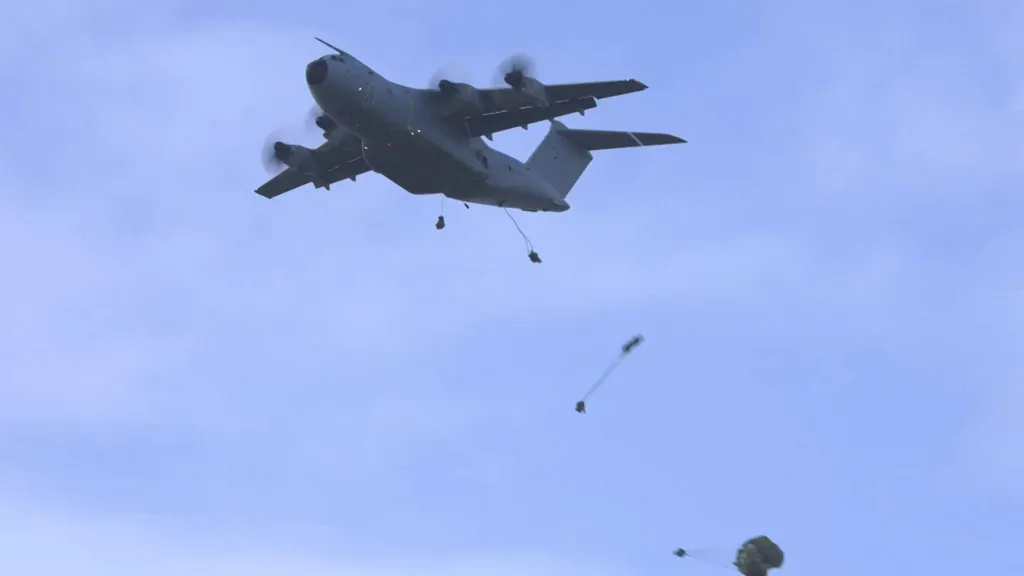
The skies over Salisbury Plain were filled with hundreds of silken canopies on Monday morning, as the British Army and the Royal Air Force (RAF) successfully executed the UK’s largest military parachute drop in over ten years. More than 270 soldiers from the 3rd Battalion of the Parachute Regiment (3 PARA) took part in the high-stakes training exercise, jumping from a fleet of three Airbus A400M Atlas transport aircraft at an altitude of just 800 feet (244m). The maneuver, which involved a rapid-deployment scenario following a short flight from RAF Brize Norton, was designed to demonstrate the UK’s ability to project power and equipment anywhere in the world at a moment’s notice.

The atmosphere among the troops was described as one of “pure excitement” mixed with the clinical focus required for such a massive airborne operation. “You can feel the energy in the hangar before we board,” noted one paratrooper from the Colchester-based regiment. “Doing this at scale—with multiple aircraft and hundreds of mates in the air at once—is exactly what we train for. It’s about more than just the jump; it’s about proving we can land as a cohesive fighting force ready to go to work.” The exercise also included a fourth aircraft tasked with the precision dropping of 24 tonnes of “heavy drop” cargo, including weapons, ammunition, and food supplies, ensuring the unit could remain self-sufficient immediately upon landing.
[Image: Three A400M Atlas aircraft in formation, with dozens of paratroopers descending against a clear blue sky]
The timing of the drop is no coincidence. As the oil price hovers at $116 and the 2026 Iran War enters a volatile second month, the UK is keen to showcase its “Global Response Force” capabilities. While British forces are currently providing support to the “Islamabad Initiative” peace talks and protecting maritime interests in the Gulf, this domestic display serves as a reminder to allies and adversaries alike that the UK maintains a “tier-one” rapid-reaction capability. General Sir Roland Walker, Chief of the General Staff, remarked that the exercise was a “clear signal” of the military’s agility in an increasingly fragmented global security environment.

The success of the 3 PARA drop also highlights the maturing partnership between the Army and the RAF’s A400M fleet, which has now fully replaced the venerable C-130 Hercules. The ability to drop 20 to 30 paratroopers in a single “pass” from each aircraft allows for a much denser and faster concentration of troops on the ground—a critical factor in modern “contested” environments where air superiority may be temporary. As the soldiers packed their chutes and regrouped on the chalky soil of Wiltshire, the “excitement” of the decade’s largest drop was replaced by a quiet sense of readiness. In the spring of 2026, the paratroopers of 3 PARA are not just training for a scenario; they are preparing for a world where the “short notice” call could come at any hour.
Related News:
 British AI Startup Outshines Human Forecasters in Global Prediction Contest
 History Will Remember Who Showed Up: Pressure Mounts on Keir Starmer to Attend Cop30 Summit
 UK Fighter Jet Purchase Could Breach Nuclear Treaty, Warns CND
 Russia repeatedly targets UK military satellites, warns Space Command chief
 Cooper Unveils £4m Cyber Plan Against Russian Hackers
 UK New Car Discounts Near £6,000 as Prices Are Slashed
 Musk Wants City on the Moon Within 10 Years
 UK Must Act with Courage and Clarity on Israel-Palestine Conflict, Says Foreign Affairs Committee Report
 How to Exit Your Broadband Contract Without Paying Exit Fees
 Unseen Killers of the Deep Inside the UK Lab Uncovering the Silent Deaths of Sea Creatures
 Radioactive Leak at UK’s Nuclear Warhead Base Sparks Outcry Over Safety and Secrecy
 Mutual Inconvenience: Why Alaska Was Chosen for the Trump-Putin Summit on Ukraine
 Terence Stamp, ’60s British Film Legend and Star of Superman, Dies at 87
 Where Is Prince William and Kate Middleton’s New House? Inside the Historic Lodge Set to Become Their ‘Forever Home’
 FIFA Eyes Biennial Club World Cup from 2029, Plans Possible Expansion
 Is the UK Ready to Put Boots on the Ground in Ukraine? Assessing Military Capacity and Challenges
 Shein UK Faces Allegations of Shifting Majority of Profits to Singapore to Reduce UK Tax
 British Couple Among 16 Killed in Lisbon Funicular Tragedy
 Jaguar Land Rover Extends Production Halt Following Cyber-Attack
 Thousands Gather in London to Protest Donald Trump’s Second UK State Visit
 Persistent Offenders Owe Over £700m in Ulez Fines as TfL Cracks Down on Evasion
 Liverpool Vs outhampton Set for Carabao Cup Clash at Anfield
 Google at 27: The Untold Story of Ruth Kedar, the Woman Behind the Iconic Logo
 A Third of EU Citizens in UK Report Discrimination by Public Bodies Post-Brexit
 Millions in the UK at Risk of Cyber-Attacks as Microsoft Ends Windows 10 Updates, Warns Which?
 Public Trust in SNP Hits Historic Low Amid NHS Concerns
 Yvette Cooper Backs Digital ID Plan for UK Teens
 Johnson Suggests Mandelson Linked to China Spy Controversy
 Rachel Reeves signals welfare reform ahead of key budget
 Reform UK candidate fined £19,000 after using AI-generated cases to challenge election
 Harry and Meghan join global AI leaders urging superintelligence ban
 UK Campaigners Launch Bill to Grant Legal Rights to Nature
 Experts Warn Russia’s Burevestnik Missile Could Destabilise Arms Control
 UK Bans Fake Numbers: Scammers Lose Their Trick
 Just Stop Oil Protesters Convicted Amid Climate Defence Row
 Patients to Test Health at Home to Ease NHS Winter Pressure
 I’m a Celebrity 2025 line-up revealed: Osbourne joins
 Britain deploys RAF specialists to assist Belgium with drone threats
 Palace May Restore Hyphen to Andrew Mountbatten-Windsor’s Name
 Northern Lights may illuminate UK skies this week
 Valve Opens the Door for Android Games on Steam
 Pokémon to open world’s first theme park in Japan next year
 Royal Navy Shadows Russian Warships Entering the Channel
 US Clears Nvidia AI Chip Sales to China in Policy Shift
 MPs warn AI financial risks threaten UK stability
 Pornhub blocks new UK users over age checks dispute
 Starmer Weighs Fast-Tracking Defence Boost
 Snow and Rain Warnings as Cold Snap Continues in the UK
 Dual Nationals Face Scramble for UK Passports as New Rules Come Into Force
 Indian University Kicked Out of AI Summit for Claiming Chinese Robot Dog as Its Own Invention
 China Shows Off Nunchuck‑Wielding Humanoid Robots for Lunar New Year
 Trump and Chagos Deal Rift Over Iran Strikes
 How Do You Modernise Mango Farming? India’s Growers Urged to Innovate as Climate Change Hits
 Australian PM Says Former Prince Andrew Has Suffered ‘Extraordinary Fall’ but That Won’t Prompt Republic Referendum
 Musk Cuts Starlink Access for Russian Forces – Giving Ukraine an Edge at the Front
 Farage Chagos Islands Row Sparks Fury
 US Will Not Back Out of Tariff Deals with UK and Others, Says Trump Trade Representative
Storm Hernando: Edinburgh Airport Flights Cancelled in US Travel Chaos
US Will Not Back Out of Tariff Deals with UK and Others, Says Trump Trade Representative
Storm Hernando: Edinburgh Airport Flights Cancelled in US Travel Chaos
 ‘We’ve been paying for happy endings for Andrew for years’: inside the royal disgrace, biographer says
 Facial Recognition Error Leads to Wrongful Arrest in Milton Keynes
 UK’s First Geothermal Plant Powers 10,000 Homes
 Social Media Trial: Woman Says Addiction Began at Six
Instagram Investigating AI Profiles ‘Fetishising’ Disabled People
Social Media Trial: Woman Says Addiction Began at Six
Instagram Investigating AI Profiles ‘Fetishising’ Disabled People
 Islanders Advised on Travel to Middle East Amid Escalation
 Brit ‘in Good Spirits’ Amid Dubai Missile Attacks, Stranded but Safe
 The US Now Has the Medicine for Cheap Swarming Drone Attacks
 Trump rebukes Starmer over Iran strikes
 We Have More Privacy Controls Yet Less Privacy Than Ever — The Paradox of Digital Life
 Study Says Only Two Nations May Survive Nuclear War
 Minister Meets Crews Who Will ‘Take Out’ Iranian Drones
 ‘We Must Finish This’: Israelis Rally Behind War Effort as Iran Strikes Tel Aviv
 UK–US Tensions Ease as Starmer and Trump Hold First Call Since Iran Row
 Yvette Cooper: UK Must Follow Principles, Not US Pressure
 Iran War Warning: Starmer Backs Ukraine Visit
 Australia Imposes Sudden Travel Ban on Iranian Visitors
 UK Forces Ready to Seize Russian Shadow Fleet Vessels
 Councils Pressed to Use Universal Parking App to Cut ‘Unfair’ Fines
 One Ant for $220: The New Frontier of Wildlife Trafficking
 Trump Considers Military Operation to Seize Iran’s Uranium
 ‘Zoom Dysmorphia’ Explosion: BDD Patients Quadruple in Post-Pandemic UK