Published: 14 November 2025. The English Chronicle Desk. The English Chronicle Online.
Princess Anne began the second day of her official visit to Singapore in a way few members of the Royal Family ever do: by settling herself into the cockpit of a state-of-the-art Airbus A350 flight simulator and preparing for virtual take-off. Her appearance at the Airbus Asia Training Centre and the nearby Rolls-Royce Seletar campus was part of a broader programme marking sixty years of diplomatic relations between the United Kingdom and Singapore. Yet the morning’s activity offered a rare glimpse of the Princess Royal’s curiosity, her good humour, and the understated ease with which she engages with complex environments that most visitors find intimidating.
The Princess arrived at the sprawling Airbus facility, which houses the largest concentration of Airbus flight crew simulators in the world, shortly after a period of heavy tropical rainfall. As she stepped inside the building, she was greeted by Martin Kent, the UK Trade Commissioner for the Asia-Pacific region, who welcomed her on behalf of both British and Singaporean partners who have long worked together on aviation training and engineering. The building itself is designed to impress, with high ceilings, long corridors, and bays of gleaming equipment that speak to the region’s rapidly growing role in global aerospace.

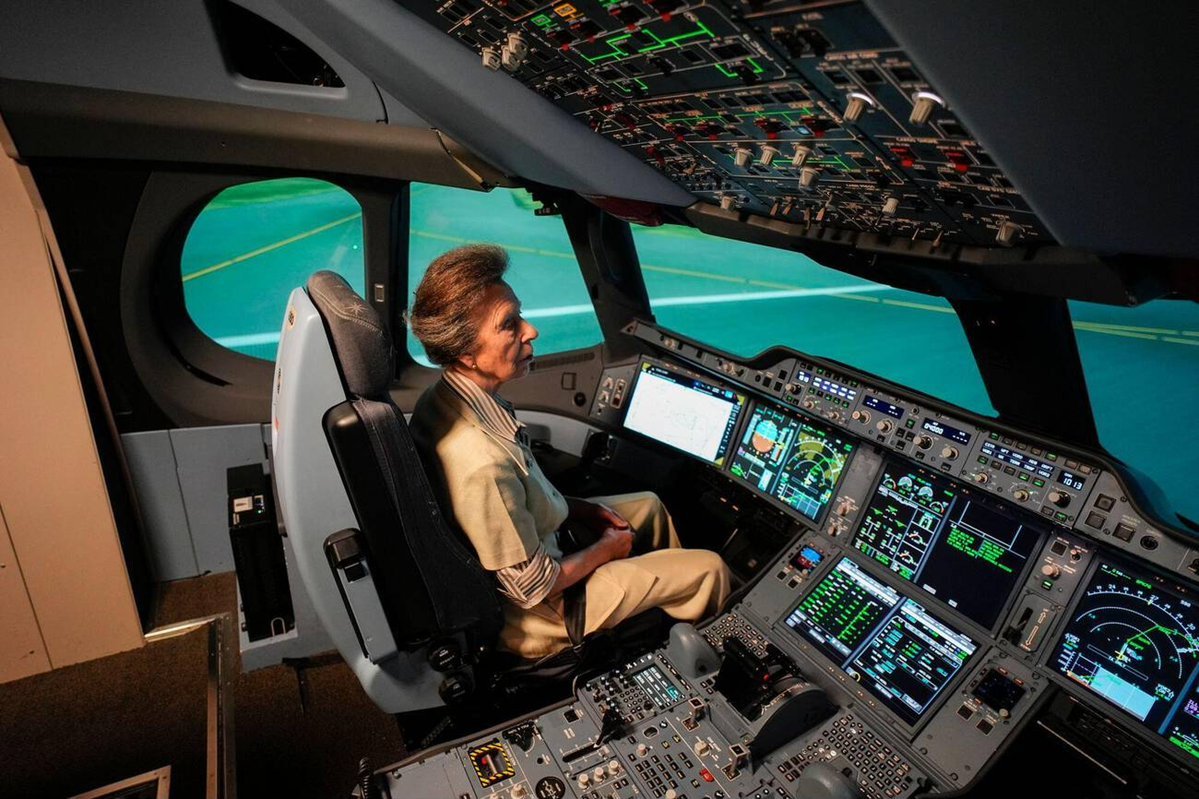
Wearing a beige buttoned jacket paired with matching trousers and a striped shirt, Princess Anne appeared both relaxed and engaged as she walked through the state-of-the-art training centre. Staff explained that the building houses nine full-motion simulators, each built to replicate the exact environment of a commercial airliner. The Airbus A350 simulator she would soon enter is among the most advanced of its kind anywhere in the world, used not only by airline pilots preparing for certification but also by senior crew undergoing specialised training for long-haul operations. The Princess listened attentively as instructors described the simulator’s capabilities, occasionally asking technical questions in her typically direct, unembellished manner.
Once inside the simulator bay, she climbed into the pilot’s seat with an ease that drew warm smiles from the Airbus team. She strapped herself in, adjusted her headset, and chuckled as the captain carried out a light-hearted safety briefing tailored to her royal audience. It was a brief exchange, but it underscored her reputation for approaching official duties with a blend of pragmatism and humour. With the controls before her and the artificial horizon displayed on the simulator’s large projection screens, she recalled the last time she had been inside a flight simulator. Although she did not specify when or where that had been, she remembered it as a far more turbulent experience. The crew reassured her that the A350 simulation would be noticeably smoother, designed to mimic the aircraft’s refined handling and stable flight profile.
As the simulator began to hum and rise subtly on its hydraulics, the Princess gripped the controls and focused on the runway that appeared on the screen before her. The platform pitched gently, giving her the sense of motion as the virtual aircraft accelerated. Observers noted how quickly she adapted to the rhythm of the simulated flight, responding calmly to the subtle cues from the instrument panel. Within moments, she appeared immersed in the experience, concentrating on the display as if she were guiding a real jet into the sky.
Her husband, Vice Admiral Sir Tim Laurence, meanwhile, was undergoing his own simulation experience in a neighbouring bay. His simulator pod was suspended in the middle of a wide open-plan hall, designed for a different type of aircraft and offering a contrasting training environment. Though the two simulations were separate, both machines soon began to sway and shift in their programmed motions, creating the quietly dramatic sight of two members of the Royal Family simultaneously navigating virtual skies hundreds of miles from home.
Once her session concluded, the Princess stepped out of the simulator with a smile that suggested genuine enjoyment. She exchanged a few final observations with the Airbus team before being escorted back through the building. Outside, the weather had turned again, with another burst of heavy rain drenching the grounds and adding a cinematic sheen to the drive between the Airbus campus and the adjacent Rolls-Royce facility. Despite the downpour, she remained composed and seemingly unfazed, waving to staff who had gathered to greet her upon arrival.
Inside the Rolls-Royce Seletar campus, the Princess was shown into the engineering halls where some of the world’s most advanced jet engines are designed, assembled, and maintained. Staff members guided her through the facility’s various sections, stopping at key installations where she could observe the components up close. At one point, she leaned forward to peer between the curved, gleaming blades of a large Trent XWB engine—the same model that powers the Airbus A350 she had just “flown” in simulation only an hour earlier. The juxtaposition between the simulated cockpit and the mechanical reality of the engines that inspire such training was not lost on those present.

During the visit, the Princess was invited to sign the facility’s visitor’s book, laid open on a table set in front of the towering engine. Staff mentioned that the book had been signed by the Prince and Princess of Wales during their 2012 tour of Singapore, which had been arranged to mark Queen Elizabeth II’s Diamond Jubilee. At that time, the Prince and Princess had also engaged with Rolls-Royce engineers and even tested a multimillion-pound jet engine themselves. The connection between the two royal visits—more than a decade apart—added a subtle historical resonance to the Princess Royal’s appearance, reminding attendees of the long-standing ties between the Royal Family and the UK’s aerospace innovation.
As the visit drew to a close, Princess Anne and Sir Tim received a warm round of applause from dozens of Rolls-Royce staff members who had gathered along the walkway to bid farewell to their distinguished guests. The Princess responded with the understated gratitude for which she is known, offering a brief smile and a nod before stepping out into the humid Singapore afternoon.
The day’s engagements reflected not only the Princess Royal’s enduring work ethic, which has made her one of the most active members of the Royal Family, but also the significance of the UK-Singapore relationship in fields ranging from aerospace technology to diplomatic cooperation. Her keen interest in the simulators, the engineering facilities, and the people who design and operate them underscored the role she continues to play in representing British expertise abroad. And perhaps most memorable for those who witnessed it, the sight of Princess Anne confidently taking her place in the cockpit showed a personal, human side to an official visit—one that combined professionalism, warmth, and a touch of adventure in the skies above Singapore, even if only simulated.
Related News:
 Prince Andrew Under Pressure as MPs Question Royal Lodge Rent Arrangements
 Prince Andrew Stripped of Title: Giuffre Family Hails Historic Moment
 Kate Winslet to Narrate Film Highlighting King’s Environmental Mission
Trump Speaks on Prince Andrew’s Royal Scandal Fallout
Kate Winslet to Narrate Film Highlighting King’s Environmental Mission
Trump Speaks on Prince Andrew’s Royal Scandal Fallout
 Prince of Wales showcases volleyball skills on Brazil visit
 Prince William Plants Trees with Brazil’s Nature Heroes
 Meghan ‘to return to acting’ after eight-year hiatus
 Oprah enjoys Meghan’s jam on English muffins
 King Charles to Lead Nation in Remembrance Sunday Service
 Second world war veterans honoured as King leads Remembrance Sunday
 The Debate Over Princess Beatrice and Eugenie’s Royal Status Intensifies
 Farage appointee to lead Reform youth accused of anti-British views
Palace to reinstate hyphen in Andrew’s surname
Farage appointee to lead Reform youth accused of anti-British views
Palace to reinstate hyphen in Andrew’s surname
 Princess of Wales Hosts Festive Christmas Service at Abbey
 Catherine urges end to stigma around addiction
 Prince Harry Cleared of Bullying Allegations Amid Charity Dispute Fallout
 Where Is Prince William and Kate Middleton’s New House? Inside the Historic Lodge Set to Become Their ‘Forever Home’
 Sussexes Warn on Children’s Phone Use Echoing Princess of Wales
 Prince Andrew told Epstein “we are in this together”
Prince Andrew steps aside as royal succession shifts
Giuffre’s bombshell memoir names Prince Andrew 88 times in shocking revelations
Prince Andrew told Epstein “we are in this together”
Prince Andrew steps aside as royal succession shifts
Giuffre’s bombshell memoir names Prince Andrew 88 times in shocking revelations
 Harry and Meghan join global AI leaders urging superintelligence ban
 William Steps Up Over Prince Andrew Palace Response
 Peterborough Mosques Tighten Security After Attack
 Reeves Faces Setback as Labour May Miss Homes Target
 Hospice Cuts Raise Alarm Across England Amid Funding Crisis
 UK Woman Loses Child Benefit After Booking Flight She Never Took
 Green Party Surges Past Labour in Latest UK Poll
 Celebrities and Charities Demand UK Government Act on Child Poverty
 Trump’s UK Ambassador Urges North Sea Drilling to Strengthen US Ties
 Children to Learn Local History in Major Curriculum Overhaul
 Granit Xhaka Rescue Earns Everton Draw at Sunderland
 French Taxi Driver Cleared in David Lammy Theft Case After Fare Dispute
 The Lowry Hotel: Manchester’s Iconic Five-Star Retreat
 UK Bans Fake Numbers: Scammers Lose Their Trick
 M&S Profits More Than Halve After Cyber-Attack
 Just Stop Oil Protesters Convicted Amid Climate Defence Row
 Kent village told to remove flags before Christmas lights go up
 Tony Blair think tank warns Rachel Reeves must cut taxes if manifesto broken
 Patients to Test Health at Home to Ease NHS Winter Pressure
 Earl of Yarmouth Faces £1.3m Legal Bill Over Family Estate
 Bellingham has ‘the edge’ among England No 10s
 How to get help when a child goes missing – call 999 urgently
 Palace May Restore Hyphen to Andrew Mountbatten-Windsor’s Name
 Millionaires group urge Reeves to introduce wealth tax to ‘lift kids out of poverty’
 Starmer Faces Growing Dissent as Labour MPs Weigh Leadership Challenge
 Shouting Works Best to Deter Gulls, UK Study Finds
 Mary Earps’s Manchester United Return Faces Mixed Reception
 Reeves rejects £1bn plea for NHS redundancy payouts
 Northern Lights may illuminate UK skies this week
 PM Condemns Leaks, Vows Loyalty to Ministers and Stability
 Son Reveals UK Couple in Iran Resort to Hunger Strike for Help
 Major Rent Reform Ends No-Fault Evictions in England
 Peers Flood Assisted Dying Bill with 942 Amendments
 Former Lion Heskey Warns of Shortage of England Strikers
 Global markets drop amid tech sell-off and China slowdown
 Mum Calls for New Licence Rules After Teen Road Death
 Mother Watches in Horror as Teen Daughter Dies on Tracks
 ‘Traumatic Wait’: Northern Ireland Women Face Breast Cancer Delays
 Commuters warned as yellow snow and ice alert hits Northern Ireland
 Labour Faces Historic Decline in Wales
 Serial Rapist and Former Cop Found Guilty Again
 PM Highlights UK Business at G20 in South Africa
 Mossmorran Plant Closure Hits Cowdenbeath Hard
 Coffins Now Too Large to Cremate Amid Rising Obesity Crisis
 Clifftop Lodges Spark Fears Over Jurassic Coast Stability
 Most Tories Expect to Support a Farage-Led Government
 HS2 woes leave Warwickshire village struggling with pollution
 Bill Murray Terrified Wes Anderson but Became His Closest Collaborator
 Moyes Defends Gueye After Dramatic Everton Bust-Up
 Labour MP claims devolution bill is ‘blatant discrimination’ against Cornwall
 The 20 best Christmas markets in the UK, from Bath to Edinburgh
 Karen Carney Stuns on Blackpool Week, Deserves Strictly Final
 Prisoner 951 Review: arrowing Retelling of Nazanin Zagharz-Ratcliffe
 Millions Face Higher Taxes Under Reeves New Budget
 Peers Get Extra Time to Debate Assisted Dying Bill
 Fibromyalgia Patients Struggle as NHS Fails to Provide Care
 Search underway for British man overboard off Tenerife
 Virgin Media Fined £23.8m Over Telecare Safety Failures
 Rising Water Bills Lift Troubled Thames Back to Profit