Published: 24 December 2025. The English Chronicle Desk. The English Chronicle Online.
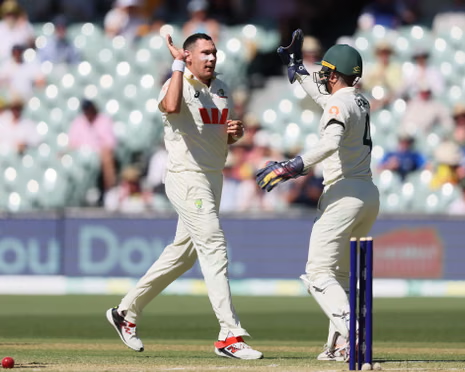
Australia’s Ashes triumph this summer has been shaped by a combination of tactical ingenuity, raw talent, and a willingness to take calculated risks, with fast bowler Scott Boland offering insight into one key strategy that has unsettled England throughout the series. Known for his pace and accuracy, Boland revealed that having wicketkeeper Alex Carey stand up at the stumps, even against faster deliveries, initially challenged both his comfort and confidence on the field. The tactic, unorthodox by conventional standards, has nonetheless proven instrumental in limiting England’s ability to manoeuvre at the crease, a strategy that was repeatedly highlighted in pre-series analysis as essential for gaining control over the opposition.
Boland explained that while facing England’s batters, the proximity of Carey to the stumps effectively restricts their movement, forcing them to play within the lines dictated by the Australian bowlers. Michael Neser, who also bowled with Carey close to the stumps during the second Test, contributed to this tactical edge, helping to stifle the English batting approach. Despite its success, Boland admitted the adjustment required both mental and technical recalibration, especially considering his usual preference for bowling at high speeds around 140km/h. The fast bowler acknowledged that his initial discomfort was a blow to his ego, describing the unusual method as “never really feeling comfortable” before witnessing its effectiveness in practice and match situations.

The adjustment, introduced in conversation with coach Andrew McDonald prior to the previous Ashes series, has only fully matured over the last two years. McDonald’s guidance emphasised the importance of restricting England’s batters to predictable areas of the crease, allowing Boland to execute his usual length while trusting Carey’s exceptional glovework to manage balls rising above the stumps. Boland recounted that the method has transformed his approach, helping maintain pressure on the English side, particularly after he faced aggressive targeting during the 2023 Ashes.
In that earlier series, Boland struggled to assert dominance, going wicketless in ten overs in Perth’s opening innings while conceding runs at over six per over. The experience reinforced the need for innovation and adaptability, prompting the Australian camp to refine a plan that could consistently challenge England’s batters. Boland’s growing trust in Carey’s ability to manage deliveries close to the stumps has been key to this strategy, allowing him to maintain his standard length without hesitation. The duo’s coordination reflects careful communication, with the captain and senior players supporting their judgment on when to employ this aggressive tactic.
Captain Pat Cummins and vice-captain Steve Smith have given Boland and Carey freedom to decide situational deployment, highlighting the trust placed in their combined expertise. Boland described how decisions were often discussed over every few overs, reinforcing the collaborative approach: if Carey felt the situation demanded him staying back, Boland complied; if he judged an opportunity to pressure the batter by coming up to the stumps, Boland backed him fully. This partnership has underscored the value of player intuition, demonstrating how individual skill and strategic thinking converge to yield results on the field.
Physical resilience has also been a factor, with Boland overcoming a hip complaint to remain in contention for the MCG Boxing Day Test. Carey’s contributions have extended beyond his glovework, with 267 runs scored this series placing him just behind Travis Head’s 379, reflecting his dual impact as both wicketkeeper and middle-order batter. This balance of tactical innovation, physical readiness, and multi-faceted skill has helped secure Australia’s dominance, culminating in a series victory achieved in just 11 days of play.
Boland’s reflections underscore a broader lesson in cricket strategy: embracing discomfort and trusting team members can create decisive advantages. What initially seemed like an ego challenge transformed into a tactical weapon, proving that unorthodox methods, when executed with precision, can disrupt even the most meticulously prepared opponents. The Australians’ willingness to innovate, combined with the individual brilliance of players like Carey and Boland, ensured that England’s plans to unsettle their bowling attack were rendered largely ineffective.

This approach, highlighted in every Test this summer, also offers insight into the evolving nature of modern cricket, where traditional roles are increasingly complemented by situational flexibility and adaptive strategies. Carey’s bravery standing close to the stumps and Boland’s willingness to adjust his style illustrate the importance of trust and communication in high-pressure matches. In a sport often dominated by statistics, these tactical choices reflect the nuanced human element behind a team’s success.
Looking forward, Australia’s experimentation with bowlers operating with keepers close to the stumps could influence coaching approaches globally. As teams analyse the effectiveness of such techniques, players and coaches may prioritise adaptability and real-time decision-making over rigid adherence to conventional methods. The lessons from this Ashes series highlight that while speed, precision, and endurance remain vital, the mental agility to trust teammates and embrace unconventional methods can be equally decisive in achieving victory.
The combination of bold tactical thinking, physical preparedness, and on-field communication has ultimately defined the Australian approach, shaping a series outcome that will be studied for years. Boland’s candid admission about the initial discomfort of bowling with the keeper up reveals the human side of elite sport, where confidence, ego, and trust intersect with performance. As Australia prepares for future challenges, the strategies employed this summer will undoubtedly influence both team culture and tactical experimentation, offering a blueprint for achieving success through adaptability, patience, and collaboration.
Related News:
 Tottenham shine at Everton but Frank wary of title push
 Matty Cash seals Villa win as City falter again at Villa Park
 Sarr Double Sinks Young Liverpool in Carabao Cup
 Nwaneri and Saka Secure Arsenal Win Over Brighton
 Woltemade Hot Streak Fires Newcastle Past Spurs
 Kieffer Moore Hat-Trick Ends Coventry’s Unbeaten Run
 Salah & Gravenberch Lead Liverpool to Win Against Villa
 Dyche Criticises Corner Decision as Forest Draw with United
 Caicedo Shines as Chelsea Edge Spurs in Chaotic Derby
 Granit Xhaka Rescue Earns Everton Draw at Sunderland
 Liverpool Edge Real Madrid 1-0 in Champions League Thriller
 Van de Ven Stunner Lifts 10-Man Spurs to UCL Glory
 Merino Shines as Arsenal Beat Slavia 3-0 Without Gyokeres
 Burn and Joelinton Head Newcastle to Victory Over Bilbao
 Foden shines as Man City dismantle Dortmund in dominant display
 Garnacho Spares Chelsea From Shock Champions League Loss in Baku
 Tension and Turmoil at Aston Villa v Maccabi Match
 Bellingham has ‘the edge’ among England No 10s
 Arteta Left Frustrated as Sunderland Deny Arsenal Late Win
Chelsea Cruise Past Wolves to Go Second in the Premier League
Man City Masterclass on Guardiola’s Milestone Day Exposes Liverpool Woes
Arteta Left Frustrated as Sunderland Deny Arsenal Late Win
Chelsea Cruise Past Wolves to Go Second in the Premier League
Man City Masterclass on Guardiola’s Milestone Day Exposes Liverpool Woes
 Lando Norris Dominates Brazil GP to Strengthen F1 Title Bid
 England cannot afford to be in awe of the All Blacks, warns Jamie George
 VAR Must Rein Its Neck In to Save Football’s Spirit
 Trescothick Hints Pope Will Keep Number Three Spot
 Ronaldo Confirms Final World Cup and Plans Retirement
 Mary Earps’s Manchester United Return Faces Mixed Reception
 Sam Kerr Stars in Chelsea Return with Champions League Double
 This kid is something else: Alex Scott’s rise to England call-up
 UK and Ireland Announce Venues for Euro 2028 Tournament
 Anthony Joshua Faces Backlash Over Proposed Jake Paul Fight
 England Maintain Perfect World Cup Qualifying Record with Win Over Serbia
 Ronaldo’s Red in Dublin Sparks Managerial Debate and Drama
 Saka Solidifies Role as Tuchel’s Key England Lieutenant
 Former Lion Heskey Warns of Shortage of England Strikers
 Osimhen doubles as Nigeria reach CAF World Cup final
 Tears of Joy as Ireland Stun Hungary to Stay in World Cup Race
 Australia Mourns Paralympic Champion Paige Greco
 Troy Parrott Hat-Trick Sends Ireland to World Cup Play-Offs
 Haaland Heroics and Portuguese Rampage Seal World Cup Qualification
 Irish Hero Parrott Says Goal Brought First Tears in Years
 Scotland Fans Reflect on France ’98 as World Cup Looms
 Nigeria Misses World Cup Again After Play-Off Loss
 Mark Wood Bowls Rapid Nets Spell, Ashes Test Hopes Rise
 Cardiff Nights Could Propel Wales to World Cup Glory
 Germany and Netherlands Confirm Places in 2026 World Cup
 Spain Qualify for 2026 World Cup After Dramatic Draw
 Scotland End 28-Year Wait With Stunning World Cup Qualification
 Cristiano Ronaldo Joins Trump, Bin Salman at State Dinner
 From heartbreak to glory: Scotland’s dramatic return to the World Cup
 Tiny Curacao Makes History as Smallest Nation to Reach World Cup
 Haiti Qualifies for World Cup Despite Coach Never Visiting Country
 Scotland Fans Celebrate Historic World Cup Qualification
 Major League Baseball Scores New Broadcast Deals Through 2028
 Barcelona Returns to Camp Nou vs Athletic Bilbao
 Rogers Double Aston Villa as Leeds Slip Deeper into Trouble
 Moyes Defends Gueye After Dramatic Everton Bust-Up
 Rookie Driver Hollie McRae Flips Car but Walks Away Safe
 Chelsea Dominates Barcelona with 3-0 Champions League Win
 India, Pakistan to Clash in T20 World Cup 2026 Group Match
 Kids Football Coach Removed Over Suspected ‘Drugs Menu’
 Mbappe Scores 4 as Real Madrid Edge Olympiakos
 Man City Lose, Champions League Risk
 Gerrard warns Liverpool’s terrible run could worsen
 Jac Morgan to Miss Six Nations Start After Surgery
 Alexander Isak ends drought as Liverpool stop rot with win at West Ham
 Mbappe rescues Real Madrid with a penalty at Girona
 Barcelona, Atletico set for decisive La Liga showdown
 Maxwell withdraws from IPL 2026 after 13 seasons
 Barcelona Come From Behind to Beat Atletico 3-1
 Mbappe stars as Real Madrid thrash Athletic, close on Barca
 Trump to attend 2026 FIFA World Cup draw in Washington
 Wales hits 20,000-strong milestone in women’s football
 Norris Edges Verstappen in Abu Dhabi GP Practice
 2026 World Cup Draw Explained Ahead of Ceremony
 Rob Key Probes England’s Noosa Break Drinking Reports
 Australia Face Big Changes as Cummins and Lyon Ruled Out of Ashes
 Van de Ven Tackle Leaves Isak with Fractured Leg
 City Set to Land Semenyo After Chelsea Exit from Transfer Race
 Arrizabalaga Sends Arsenal Through in Dramatic Shootout