Published: 19 January 2026. The English Chronicle Desk. The English Chronicle Online.
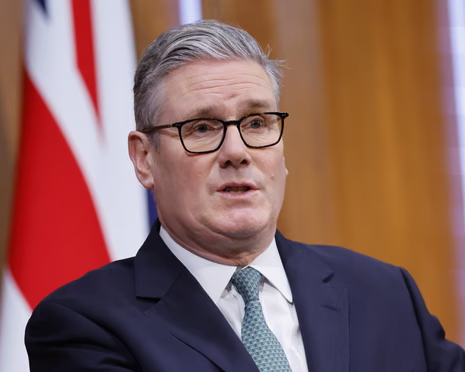
Prime Minister Keir Starmer has firmly rejected retaliatory trade measures, placing the Starmer tariffs stance at the centre of Britain’s response to mounting pressure from Washington. Speaking from Downing Street, Starmer argued that matching United States tariffs would harm the British economy and deepen unnecessary confrontation. His comments followed threats from President Donald Trump to impose tariffs on Nato allies amid a dispute linked to Greenland’s future. Within the first moments of his address, Starmer emphasised restraint, dialogue, and alliance stability as guiding principles.
The Starmer tariffs stance reflects a broader strategic calculation shaped by economic caution and diplomatic realism. The prime minister stressed that trade wars rarely produce winners, especially among long-standing allies with deeply integrated markets. Britain’s economy, still adjusting to post-Brexit trade realities and global uncertainty, would face immediate costs from escalating duties. Industries dependent on American imports and exports would feel the impact quickly, with consumers ultimately paying higher prices.

At an emergency press conference, Starmer rejected suggestions that firmness required retaliation. He described tariff threats between allies as counterproductive, arguing they undermine trust at a moment when international cooperation remains essential. While acknowledging public frustration, he maintained that leadership required calm judgment rather than emotional reaction. The Starmer tariffs stance, he said, prioritised stability over symbolism.
Trump’s warning of possible sanctions against European nations, including the United Kingdom, heightened tensions across the Atlantic. These nations have deployed troops to Greenland in response to American rhetoric regarding the Arctic territory’s strategic importance. Despite the sharp language from Washington, Starmer said he did not believe the United States president was seriously considering military action. He framed the situation as a diplomatic dispute inflated by political posturing rather than imminent conflict.
Greenland’s status emerged as a sensitive focal point in the discussion. Starmer stated clearly that decisions about the territory’s future belonged exclusively to the people of Greenland and the Kingdom of Denmark. Respect for sovereignty, he argued, remains a cornerstone of international law and alliance credibility. The Starmer tariffs stance, therefore, aligned with a broader defence of rules-based order rather than short-term leverage.
Defence and security cooperation featured prominently in Starmer’s remarks. He highlighted intelligence sharing, nuclear deterrence, and joint military planning as pillars of the UK-US relationship. These ties, he insisted, outweighed temporary disputes over trade policy. Maintaining constructive engagement with Washington served Britain’s national interest, even when disagreements surfaced. The Starmer tariffs stance was presented as compatible with strength, not weakness.
Domestically, Starmer faces pressure from opposition figures and some Labour backbenchers to confront Trump more aggressively. Critics argue that refusing retaliation risks signalling acquiescence. Starmer countered that mature alliances require honest disagreement expressed through dialogue. He confirmed that he had already spoken directly with Trump, making Britain’s position clear while keeping channels open.
European reactions have added complexity to Britain’s approach. The European Union is actively considering retaliatory tariffs and broader economic countermeasures against the United States. Several European leaders have publicly condemned Trump’s threats, calling them destabilising. Starmer confirmed ongoing discussions with EU leaders and European Commission President Ursula von der Leyen, emphasising coordination without automatic alignment.
Britain’s decision not to mirror EU retaliation underscores its distinct post-Brexit foreign policy path. While cooperating closely with European partners, London retains autonomy over trade responses. The Starmer tariffs stance reflects an effort to balance solidarity with independence, avoiding escalation while supporting diplomatic unity. Officials believe this approach preserves Britain’s role as a bridge between Washington and Brussels.
Economic analysts largely welcomed the prime minister’s caution. Many warned that retaliatory tariffs often trigger spiralling measures that damage supply chains and investor confidence. Britain’s services-heavy economy, particularly financial and professional services, relies on predictable transatlantic relations. The Starmer tariffs stance reassured markets seeking stability amid geopolitical noise.
However, some trade experts cautioned that restraint carries risks. If the United States proceeds with tariffs regardless, Britain may face limited leverage without countermeasures. Starmer acknowledged this possibility but argued that prevention remained preferable to reaction. He left open the option of future responses if circumstances changed, while stressing his current priority was de-escalation.
Public opinion remains divided. Surveys suggest many Britons value the US alliance but feel uneasy about Trump’s confrontational style. Starmer addressed these sentiments directly, recognising understandable public concern while urging perspective. He argued that emotional responses should not dictate policy when economic livelihoods and security cooperation are at stake. The Starmer tariffs stance thus sought to reconcile public mood with long-term interests.
Historically, Britain has often acted as a moderating influence within transatlantic disputes. From Cold War crises to modern trade disagreements, UK leaders have frequently emphasised diplomacy. Starmer’s approach fits this tradition, portraying Britain as a steady partner capable of absorbing pressure without fracturing alliances. Supporters argue this enhances Britain’s international credibility.
The Greenland dispute itself highlights shifting global dynamics in the Arctic. Melting ice has increased strategic and economic interest in the region, drawing attention from major powers. Starmer avoided speculation about future territorial ambitions, focusing instead on respect for existing agreements. His comments suggested Britain prefers multilateral frameworks to unilateral assertions of influence.

Within government, officials emphasise preparedness alongside restraint. Departments are assessing potential economic impacts should US tariffs materialise. Contingency planning continues quietly, even as public messaging stresses calm. The Starmer tariffs stance does not imply passivity, advisers insist, but measured readiness.
Opposition leaders responded cautiously. Some Conservative figures praised Starmer’s emphasis on national interest, while others accused him of naivety. Smaller parties called for stronger alignment with European retaliation. Starmer’s challenge will be sustaining consensus if tensions escalate or if economic consequences emerge.
International observers view Britain’s position as a test of its post-Brexit identity. Choosing dialogue over retaliation signals a desire for pragmatic global engagement. Whether this approach influences Washington’s calculations remains uncertain. Starmer expressed hope that cooler heads would prevail through continued conversation.
As diplomatic exchanges continue, the immediate focus remains preventing a trade war. Starmer concluded his remarks by reiterating that tariffs between allies serve no one. The Starmer tariffs stance, he said, aims to protect jobs, maintain security partnerships, and uphold international norms. In an increasingly volatile world, Britain’s leadership believes restraint can still be a form of strength.
Related News:
 Tasers Introduced in UK Prisons to Combat Rising Violence and Protect Staff
 Peter Kyle Condemns Nigel Farage Over Reform UK’s Promise to Scrap Online Safety Act
 David Lammy Faces Possible Legal Challenge Over Foreign Office Secondment Scheme
 Ministers Accused of Defamation Over Palestine Action Ban and Mass Arrests
 Police Advised to Disclose Ethnicity of Suspects in High-Profile Cases
 Sally Rooney Pledges BBC Royalties to Support Palestine Action Despite UK Terror Ban
 UK’s First Transgender Judge Seeks Rehearing of Supreme Court Ruling on Biological Sex
 Government Signs Deal with Iraq to Return Illegal Migrants in Latest Bid to Deter Small Boats
 Migrant Hotel Chaos as Councils Consider Legal Action to Ban Asylum Seekers
 DWP Launches Independent Review of Post Office Staff Prosecutions
 Angela Rayner Admits Underpaying Stamp Duty on £800,000 Seaside Flat
 Angela Rayner Faces Scrutiny as Stamp Duty Row Deepens
 Shabana Mahmood Faces Daunting Challenges as New UK Home Secretary
 Tanni Grey-Thompson Faces Abuse Over Opposition to Assisted Dying Bill
New Home Secretary Hosts International Talks as Small-Boat Migrant Crossings Surge
Tanni Grey-Thompson Faces Abuse Over Opposition to Assisted Dying Bill
New Home Secretary Hosts International Talks as Small-Boat Migrant Crossings Surge
 Police Watchdog Calls for End to Recording Non-Crime Hate Incidents
 Charlie Kirk Killing Used to Mobilise UK’s Largest Far-Right Rally in Decades
 First “One In, One Out” Deportation Flight Departs Without Migrants Amid Legal Challenges
 Hillsborough Law to Hold Public Officials Accountable, Promising Jail for Serious Misconduct
 Labour Urged to Rethink Growth Strategy as Top Economist Warns of Far-Right Surge
 Corbyn and Sultana Clash Over Membership Portal as Divisions Surface in New Leftwing Party
 Commons Speaker Warns UK Parliament Vulnerable to Foreign Espionage After China-Linked Case Dropped
Mahmood Pledges Reform of Modern Slavery Laws After Court Blocks Deportation Appeal
Commons Speaker Warns UK Parliament Vulnerable to Foreign Espionage After China-Linked Case Dropped
Mahmood Pledges Reform of Modern Slavery Laws After Court Blocks Deportation Appeal
 Migrants in UK May Need to Contribute or Face Removal, Home Secretary Signals
 Jailed Georgian Opposition Leaders Warn UK of Iranian Links to Ruling Party
 UK Police to Gain New Powers to Manage Repeated Protests, Home Office Announces
 MPs’ pay watchdog seeks to give public greater voice in how politicians are funded
 Digital ID Plans Ignite Debate Over £600m Treasury Tax Boost and Privacy Concerns
 Boris Johnson Breached Rules on Post-Office Business Contacts
 Shabana Mahmood Warns Border Failings Are Eroding Trust in States
 Lucy Powell urged ministers to reconsider costly legal case for Labour donor’s firm
 Starmer Accused of Creating ‘Toxic Downing Street’
 Tories Push to Dilute Labour’s Workers’ Rights Bill
 China Spy Case Hearing Reveals Key Gaps in Prosecution
 It’s time to come clean on the China spy case
Johnson Approved China’s London ‘Super-Embassy’ in 2018
It’s time to come clean on the China spy case
Johnson Approved China’s London ‘Super-Embassy’ in 2018
 Rachel Reeves Admits Renting Home Without Required Licence
 Experts Question HMRC Over Possible Child Benefit Privacy Breach
 Phillipson urges careful review of gender recognition guidance
 French Taxi Driver Cleared in David Lammy Theft Case After Fare Dispute
 Met Police Culture Makes Racial Harm ‘Inevitable’
 Remaining rebel Labour MPs have whip restored
 Tim Davie resigns as BBC director general amid bias claims
 Palace to reinstate hyphen in Andrew’s surname
 Victims’ commissioner Baroness Newlove dies aged 63
 BBC Apologises to Trump but Rejects $1bn Compensation Claim
 Major Rent Reform Ends No-Fault Evictions in England
 Peers Flood Assisted Dying Bill with 942 Amendments
 Nandy says BBC review to probe political board influence
 Your Party Turmoil Deepens Over Withheld Donations
 UK Unveils Fast-Track Deportation and Asylum Overhaul
 UK Asylum Overhaul Sparks Debate Over Human Rights and Deportations
 UK Asylum Reforms: Temporary Refugee Status and Faster Deportations
 Mahmood Defends Tough Overhaul of UK Asylum System
 Scottish Ministers Express Alarm Over UK Asylum Reforms
 Westminster Advances Legacy Bill Amid Criticism
 Minister Defends Tough New Asylum Reform Plan
 UK Net Migration Falls Sharply After ONS Revisions
 Peers Get Extra Time to Debate Assisted Dying Bill
 Plans to Limit Jury Trials Face Retreat After Mounting Opposition
 UK Must Act with Courage and Clarity on Israel-Palestine Conflict, Says Foreign Affairs Committee Report
 Targeted Attack in Bury Sparks Murder Investigation as Community Awaits Justice
 Radioactive Leak at UK’s Nuclear Warhead Base Sparks Outcry Over Safety and Secrecy
 Merseyside Police Helicopter Crew Cleared After Low-Altitude Pursuit of Suspect
 Nigel Farage Unveils Controversial Immigration and Welfare Plans at Reform UK Press Conference
 No Evidence Found to Substantiate Alleged Rape in Oxfordshire Churchyard, Police Confirm
 Kemi Badenoch Unveils ‘Golden Rule’ to Halve Spending Cuts for Deficit Reduction at Tory Conference
 UK border officers deployed to Balkans to tackle migrant smuggling
 UK MPs warn of repeat riots over online misinformation
 Army Barracks to House Migrants as Hotels Phase Out
 Trump’s UK Ambassador Urges North Sea Drilling to Strengthen US Ties
 Millionaires group urge Reeves to introduce wealth tax to ‘lift kids out of poverty’
 Reeves rejects £1bn plea for NHS redundancy payouts
 PM Condemns Leaks, Vows Loyalty to Ministers and Stability
 Trump Urges Herzog to Grant Netanyahu Full Pardon
 ICC to Rule on Duterte’s Provisional Release
Starmer Says Labour’s Economic Plan Needs Years to Deliver
ICC to Rule on Duterte’s Provisional Release
Starmer Says Labour’s Economic Plan Needs Years to Deliver
 England delays four mayoral elections amid criticism
 US Senate rejects resolution limiting Trump military powers
 Woman Jailed for Life After Killing E-Bike Rider in Tragic Mistaken Identity Case