Published: March 27, 2026. The English Chronicle Desk. The English Chronicle Online
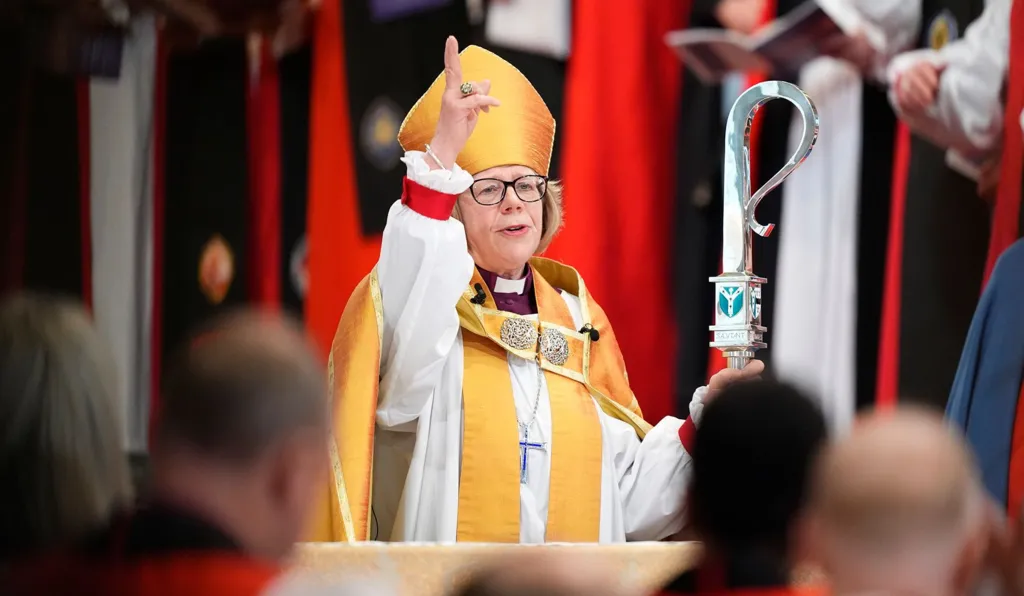
In a moment of profound historical weight, the Most Reverend Sarah Mullally has been formally installed as the 106th Archbishop of Canterbury, becoming the first woman to lead the Church of England in its 1,400-year history. During her inaugural sermon at Canterbury Cathedral on Wednesday, Archbishop Mullally moved the 2,000-strong congregation by reflecting on her own journey from a secular career in nursing to the highest office in the Anglican Communion. “This resonates with me as I look back over my life,” she told those gathered, “at the teenage Sarah who put her faith in God and made a commitment to follow Jesus. I could never have imagined the future that lay ahead, and certainly not the ministry to which I am now called.“

The ceremony, rich with ancient tradition yet punctuated by modern milestones, saw the Archbishop knock three times on the Great West Door of the cathedral before being greeted by local schoolchildren. The presence of the Prince and Princess of Wales, alongside Prime Minister Sir Keir Starmer, underscored the national significance of the event. Mullally, 63, succeeds Justin Welby, who resigned in late 2024. Her path to the “Chair of St Augustine” is unique; she formerly served as the Chief Nursing Officer for England before pursuing full-time ministry, a background many hope will bring a “healing touch” to a church currently grappling with internal divisions and the legacy of safeguarding failures.
The theme of the service was “Nothing will be impossible with God,” a message Mullally wove into a sermon that drew parallels between her own unexpected path and the biblical figure of Mary. She spoke candidly about the “stained glass ceiling” that has finally been shattered, acknowledging that while her appointment is a joyous occasion for many, it remains a point of contention for conservative wings of the global Anglican church. In a gesture of reconciliation, several female bishops from across Africa—known as the “Africa Six”—participated in the procession, signaling a shift in the global landscape of faith leadership.
Archbishop Mullally’s first acts in her new role have been focused on transparency and reform. She has pledged to “shine a light” on the Church’s past handling of abuse, describing safeguarding as a “non-negotiable responsibility.” Her installation also comes at a time of geopolitical tension; in her first official prayers, she called for peace in the Middle East, Ukraine, and Sudan. For many in the pews, her elevation represents more than just a change in personnel; it is a signal that the Church of England is attempting to align itself more closely with the realities of 21st-century society.
As she begins her six-year tenure—limited by the Church’s compulsory retirement age of 70—the new Archbishop faces an immediate “in-tray” of daunting challenges. These include the ongoing debate over same-sex blessings, declining attendance in rural parishes, and the role of bishops in a reforming House of Lords. However, Mullally has signaled that she intends to lead with the same “pragmatic kindness” she once brought to the wards of the NHS. Her message to young women and girls watching the ceremony was clear: “It is entirely possible for you to follow your dreams, whatever they may be.“

The day concluded with a symbolic pilgrimage through the city, where the Archbishop met with local residents and pilgrims who had traveled to witness the historic moment. While the legal confirmation of her role took place in January at St Paul’s Cathedral, it was the sounding of the bells at Canterbury that truly marked the start of the “Mullally Era.” For a woman who spent her teenage years in Surrey never dreaming of the clergy, the weight of the pastoral staff now in her hand serves as a testament to a future she truly could not have imagined.
Related News:
 The Victorian aristocrat who became Britain’s first Muslim lord
 Police Assessing Stansted Airport Private Flights Over Epstein Ties
 ‘Just Push Us Into the Sea’: The Frustration of an Area Failed by Politics
 Last‑ditch Call to Save Police Front Counters in London
 Britain’s Special Needs Spending Crisis Will Be Labour’s Ruin
 Fury as Jobless-Migrant Households Receive Benefits Worth £10bn – ‘We Need to End This’
 Schools in England to Get Budget for Children with Special Needs as Part of SEND Overhaul
 Why Independence Is Still a Political Dividing Line in Scotland
 Muslim Group Wants Mosques to Be Used as Polling Stations Ahead of UK Elections
 Manchester Students Mourn Ayatollah Amid Protest
 Labour Faces Backlash Over Conscription Warning
 SNP Health Secretary Criticised Over NHS Failures Locally
 Scotland Combines Alcohol and Drug Strategy to Cut Addiction Deaths
 Middle East tensions hit London’s streets as march banned
 Jobless Man on £15k Benefits Accused of Hurling Abuse at Anti-Migrant Demo
 Andrew Mountbatten-Windsor’s New Home Dispute as Vans Seen at Sandringham
 Church Attendance Report Pulled After Fraudulent Responses
 UK Poverty Hits 13.4 Million Amid Major Data Revisions
 Met Police Resume Arrests for Palestine Action Supporters
 UK Must Act with Courage and Clarity on Israel-Palestine Conflict, Says Foreign Affairs Committee Report
 Chancellor Faces Mounting Pressure Amid “Impossible Trilemma” Over Tax Rises
 Radioactive Leak at UK’s Nuclear Warhead Base Sparks Outcry Over Safety and Secrecy
 Mutual Inconvenience: Why Alaska Was Chosen for the Trump-Putin Summit on Ukraine
 Chancellor Rachel Reeves Pushes for Sweeping Changes to Environmental Protections to Accelerate Development
 Is the UK Ready to Put Boots on the Ground in Ukraine? Assessing Military Capacity and Challenges
 Police Scotland Spends £500,000 Compensating Officers Over Trump Visit
 Britain’s Migration Challenge: Rising Asylum Numbers and Hotel Pressures
 Elon Musk Sparks New Controversy by Backing Tommy Robinson Amid Farage Feud
 Urgent Action Needed on Windrush Compensation as Survivors Speak of “Waiting to Die”
 Tanni Grey-Thompson Faces Abuse Over Opposition to Assisted Dying Bill
 TfL Invites RMT to Resume Talks as London Tube Strikes End
 Nigel Farage Unveils Controversial Immigration and Welfare Plans at Reform UK Press Conference
 Ed Miliband Warns UK Government on X, Citing Elon Musk as a “Dangerous Influence”
 Kemi Badenoch Unveils ‘Golden Rule’ to Halve Spending Cuts for Deficit Reduction at Tory Conference
 UK border officers deployed to Balkans to tackle migrant smuggling
 UK MPs warn of repeat riots over online misinformation
 Army Barracks to House Migrants as Hotels Phase Out
 Trump’s UK Ambassador Urges North Sea Drilling to Strengthen US Ties
 Millionaires group urge Reeves to introduce wealth tax to ‘lift kids out of poverty’
 Reeves rejects £1bn plea for NHS redundancy payouts
 PM Condemns Leaks, Vows Loyalty to Ministers and Stability
 Major Rent Reform Ends No-Fault Evictions in England
 Starmer Says Labour’s Economic Plan Needs Years to Deliver
 England delays four mayoral elections amid criticism
 UK Ministers Drop Foreign Student Targets for Global Education Push
 No Gas Boiler Ban as UK Warm Homes Plan Backs Heat Pumps
 Shinzo Abe’s killer receives life sentence in Japan
 Police response times face strict new national limits
 Labour policing overhaul sparks fears over growing central control
 Starmer warns of toxic division politics in Reform challenge
 Labour Utterly Humiliated by Straight-Talking Mum Who Cut Through Keir Starmer’s Insanity
 Palantir contracts face UK halt calls over transparency
 Diane Abbott Slams Applause for Keir Starmer as PM Vows to Stay On After Mandelson-Epstein Row
 Renters Furious as Decent Homes Standard Delayed Until 2035
 Could Manchester Lead the UK’s Economic Revival?
 Starmer Weighs Fast-Tracking Defence Boost
 Motorists Could Face ‘Mandatory’ Driving Ban for Road Offences Under Tougher Laws
 US Civil Rights Leader Jesse Jackson Dies Aged 84
 Farage to Name Jenrick as Reform Chancellor Pick
 Snow and Rain Warnings as Cold Snap Continues in the UK
 Civil Service Pay: Union Urges Ministers to End ‘Barking Mad’ Limits
 Antonia Romeo appointment sparks criticism
 ‘Don’t Make Us Security Guards,’ Says Teacher Stabbed by Pupil
 Australian PM Says Former Prince Andrew Has Suffered ‘Extraordinary Fall’ but That Won’t Prompt Republic Referendum
 Farage Chagos Islands Row Sparks Fury
 Reform UK targets workers’ rights repeal
 Russian Trade Routed Through British Islands Exposed
 Mandelson Arrest: Met Apologises to Hoyle
 Calls Grow to Remove Billboard Following Lyra McKee Graffiti
 Police Scotland Pays £8m Compensation to Staff
 Minister Meets Crews Who Will ‘Take Out’ Iranian Drones
 Thousands Protest Iran Strikes Outside US Embassy London
 UK Oil and Gas Supplies Reassured Amid Middle East Concerns
 Father Dies by Suicide Weeks After Wedding in Clitheroe
 Teen Wins Payout After TRNSMT Crush Horror
 Tommy and Gail Sheridan to Stand for New Political Party After Alba Demise
 ‘Heating Oil Suppliers Are Holding Us to Ransom’ as Prices and Cancellations Surge
 Nepal to swear in ex-rapper as new prime minister
 UK Forces Ready to Seize Russian Shadow Fleet Vessels
 Watchdog Probes Police Handling of Andrew Tate Abuse Claims