Published: 07 April 2026. The English Chronicle Desk. The English Chronicle Online.
The escalating tension between Washington and Tehran has reached a critical juncture that transcends traditional diplomacy and enters the realm of profound ethical crisis. For the officers within the United States military, the current landscape presents a harrowing choice that few ever expected to face in their professional lives. They are caught between the ironclad duty of the chain of command and the fundamental principles of international law. President Donald Trump has issued a series of increasingly violent threats directed toward the civilian infrastructure of Iran, creating a volatile atmosphere of dread. The specific demand for the Iranian government to open the Strait of Hormuz by a strict Tuesday deadline has placed the world on edge. Failure to comply, according to the President, will result in a devastating military campaign he has dubbed Power Plant Day. This rhetorical escalation is not merely a political tactic but a direct challenge to the moral integrity of every service member.
The language used by the President on his Truth Social platform has been exceptionally blunt and devoid of typical diplomatic nuance. He warned of a hellish reality for the Iranian people if his specific demands regarding the vital shipping lane were ignored. Such statements have moved beyond simple posturing and into the territory of specific, premeditated military targeting of non-combatant assets. Just days prior to this ultimatum, the President explicitly stated his intention to strike every single electric generating plant across the nation. This plan was not shared in a vacuum but was amplified through official government channels and social media accounts. The sheer scale of the proposed destruction targets the essential life-support systems for nearly ninety-three million people living within Iran. For the military personnel tasked with executing these potential orders, the legal ramifications are as terrifying as the tactical ones.

Legal experts and former high-ranking military officials have begun to voice their deep-seated concerns regarding the legality of such operations. There is a broad consensus that targeting civilian infrastructure on this scale would constitute a major violation of international treaties. Former judge advocate general officers have noted that these rhetorical outbursts place service members in a profoundly challenging legal position. These individuals are trained throughout their entire careers to uphold the laws of armed conflict and the Geneva Conventions. To follow through with a strike on bridges and power grids would be to abandon decades of rigorous legal education. The sudden shift in policy represents a jarring rupture from the ethical foundation that the American military claims to represent. It forces a confrontation between the traditional requirement for total obedience and the individual conscience of the soldier.
The historical precedent for refusing illegal orders is well-documented but rarely tested under such extreme presidential pressure. Scholars of political science point to moments in history where soldiers chose to intervene against atrocities rather than participate. The infamous My Lai massacre during the Vietnam War remains the most striking example of this difficult moral standing. In that instance, certain personnel chose to risk their own lives and careers to stop the slaughter of innocents. The subsequent court cases established that simply following orders is not a valid defense for committing a crime. If an order is palpably illegal, the responsibility to refuse it falls squarely on the shoulders of the individual officer. However, the definition of what is clearly illegal can become dangerously blurred during the chaos of an active conflict. The current administration has further complicated this by suggesting that dissent or refusal could be viewed as seditious.
The pressure on the rank and file is compounded by recent changes within the leadership of the Department of Defense. Efforts to streamline the command structure have resulted in the removal of key legal advisors and oversight units. By dissolving groups dedicated to mitigating civilian harm, the administration has removed the very safety nets designed to prevent war crimes. This leaves individual officers without the institutional support they need to navigate complex legal and moral dilemmas in real time. Many soldiers are now turning to external hotlines to seek advice on their rights and their obligations. While surveys indicate that most service members can distinguish between a legal order and an illegal one, acting on that knowledge is difficult. The fear of court-martial for insubordination remains a powerful deterrent against standing up to the highest office in the land.
The President has shown little interest in de-escalating the situation, recently suggesting that the entire country of Iran could be destroyed. When questioned about the limits of his military strategy, he indicated that very few targets would be considered off-limits. This total-war mentality has revived fears regarding the potential use of nuclear weapons in a moment of desperation. In the American system, the President holds the sole authority to launch a nuclear strike, assisted by a portable briefcase of codes. While a security conference call is required, the ultimate decision rests with the commander-in-chief and his immediate circle. The only barrier to a catastrophic nuclear event would be the refusal of those within the immediate chain of command. Past military leaders have attempted to implement informal checks on such volatility, but those safeguards are now being systematically dismantled.

Nuclear experts have expressed a chilling lack of confidence that anyone would step in to stop a disastrous presidential order today. The systematic purging of dissenting voices within the Pentagon has created a culture where loyalty is valued above the law. Officers who might have once served as a voice of reason have been replaced by those more likely to comply. This environment makes the prospect of a miscalculation or a fit of pique leading to war much more likely. The psychological weight on those holding the keys to the arsenal is becoming an unbearable burden as the deadline approaches. They are being asked to choose between their careers, their freedom, and the lives of millions of people. It is a moment of unprecedented tension that tests the very soul of the American military institution.
As the clock ticks toward the evening deadline, the international community watches with a mixture of disbelief and profound anxiety. The infrastructure of a modern nation hangs in the balance, tied to a dispute over a narrow stretch of water. For the pilots and the commanders at the buttons, the transition from peace to a potential war crime is a matter of seconds. The smooth flow of command is currently a path toward a legal and moral precipice from which there may be no return. The dilemma is no longer theoretical but a tangible reality that requires a choice of immense historical consequence. Whether the officers will choose the law or the leader remains the most pressing question of this decade. The world can only hope that the training in ethics and humanity prevails over the rhetoric of total destruction.
This situation highlights a fundamental flaw in any system that centralizes such vast power in a single individual. When the guardrails of the state are weakened, the burden of history falls upon the individuals tasked with pulling the trigger. The English Chronicle will continue to monitor these developments as the Tuesday deadline draws nearer for all parties involved. The outcome will define the standing of the United States on the world stage for generations to come. It serves as a stark reminder that the most powerful weapons are only as stable as the minds of those who command them. In the coming hours, the strength of the American military code will be tested in a way that few ever imagined. The lives of millions depend on whether a few individuals have the courage to say no to the unthinkable. This is the heavy reality of the modern era, where the line between duty and disaster has become dangerously thin.
Related News:
 Thousands Protest ICE Operations in Nationwide US Day of Action
 US Charges Sinaloa Governor in Major Cartel Case
 US judge dismisses Kilmar Abrego Garcia indictment
 Tulsi Gabbard exits after turbulent intelligence tenure
 Former ICC prosecutor condemns US sanctions
 Trump Weighs Retreat from Controversial $1.8bn Slush Fund
 US National Guard Member Killed in DC Shooting
 Trump to pause migration from ‘third-world countries’
 Franklin Turtle, Sabrina Carpenter Slam US Social Media Use
 Trump Receives Machado’s Nobel Medal in White House Meeting
 Starmer tariffs stance rejects US trade retaliation
 American democracy faces crisis after Trump’s return
 Trump officials continue false claims after Alex Pretti shooting
 Files Link Andrew to Epstein Dinner After Prison Release
 Emails Show Epstein Funded Mandelson’s Husband After Jail
 Partial US Government Shutdown Hits Homeland Security Funding
 Epstein Files Reveal Trump Officials’ Emails with Financier
 Thousands Protest ICE in New York Against Trump Deportation Campaign
 Michigan Battleground: Middle East Crisis Stirs US Senate Race
 Swalwell Faces Pressure to Quit Governor Race
 Trump Signals Hope for New Iran Talks as Ceasefire Fades
 Harmeet Dhillon Faces Scrutiny in DOJ Role Debate
 GOP Senator Criticizes Trump’s Feud With Pope Leo XIV
 Trump at Press Dinner Sparks Tension
 Investigation Into Anti-Trump Motives After Gala Shooting
 Judge Blocks Trump Bid for Arizona Voter Data
 US Court Weighs Fate of TPS for Migrants
 Florida Redistricting Map Sparks Major US Political Battle
 USS Gerald R Ford Ends Record Naval Deployment
 US Voting Rights Ruling Sparks Celebration and Outcry
 US Court Ruling Reshapes Voting Rights Landscape
 US states redraw maps after voting rights ruling
 Trump orders US troop pullout from Germany
 Judge halts deportation of Yemeni refugees in US
 White House Security Case Sparks Political Firestorm
 Trump warns Iran as Middle East tensions surge again
 US Supreme Court fast-tracks Voting Rights ruling
 Indiana Republicans Defy Trump in Key Vote Test
 US Court Restores Abortion Pill Access Temporarily
 Tensions Emerge in Netanyahu-Trump Alliance
 Immigration Judges Fear Pressure in Trump Era
 FDA Chaos Deepens as Trump Eyes Makary Exit
 US green card applicants must apply from abroad, DHS says
 Trump’s Revenge Drive Deepens GOP Divide
 Gunman Killed After White House Security Shootout
 Prosecutor Proposes Law to Combat Election Deceit
 Trump’s Mount Rushmore Speech: A Divisive Anniversary
 Mystery Grows Over Mitch McConnell’s Health
 Trump Refuses to Sign Housing Bill, But Law Takes Effect
 House Democrats Divided Over Israel Military Funding Bid
 Houthis Strike Saudi Arabia as Middle East Tensions Rise
 Trump Orders Signs Criticising Smithsonian Museum
 Tanni Grey-Thompson Faces Abuse Over Opposition to Assisted Dying Bill
 Trump Urges Herzog to Grant Netanyahu Full Pardon
 Major Rent Reform Ends No-Fault Evictions in England
 ICC to Rule on Duterte’s Provisional Release
 Mandelson apologises over Epstein ties after public scrutiny
 Australia grants Asio powers to designate hate groups under new laws
 Trump press secretary attacks reporter over ICE question
 Greenland Crisis Forces Europe to Draw a Line With Trump
 South Korea Jails Ex-President in Martial Law Ruling
 Starmer Challenges US Over Controversial Greenland Deal
 Spoof “Make America Go Away” Caps Rally Denmark Over Greenland
 Trump Fed bid heads to Supreme Court
 Sinema payment row deepens after $9,000 transfer claim
 Nurses’ families fear breakup under UK immigration crackdown
 New Zealand Covid Response Praised Despite Lingering Scars
 Suspected Plot Targets Pipeline Before Hungary Vote
 Trump’s Presidency: A House of Cards Collapsing?
 Trump Starts $166bn Tariff Refund Process
 Trump Defiant After Washington Hotel Shooting
 Trump approval plunges amid Iran war fears
 US ‘Narco Boat’ Strikes Draw Global Outcry
 One Nation Candidate’s Surprising Ties to Independents
 Tony Abbott Returns as New Liberal Party President
 Discontent grows around Putin amid war strain
 Trump Urged to Condemn UFC Fighter Over Obama Slurs
 US Military Pacific Boat Strike Kills Three People
 US Courts Back Trump on Park Signage Removals
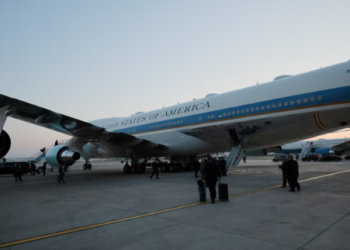 Trump Swaps Planes Amid Iran Tensions