Published: 05 January 2026. The English Chronicle Desk. The English Chronicle Online.
Africa’s superpowers are asserting themselves in the Cup of Nations knockout stages, showing dominance and flair. Morocco, Senegal, Nigeria, and Mali have all demonstrated strong performances, signalling a highly competitive quarter-final lineup for this year’s tournament. From the first whistle, the focus on African football excellence has been unmistakable, with Morocco, the host nation, particularly emphasising strategy and individual talent. Early tournament matches confirmed the power and depth of these teams, setting the stage for a knockout phase that promises to combine skill, tension, and historic ambitions.
For over a decade, African football has grown broader, with more nations capable of challenging the continent’s elite, but few have reached such high-powered consistency. Morocco’s hosting of the Cup of Nations highlights this shift, as the traditional powers reassert themselves with clinical precision. Morocco, the 2022 World Cup semi-finalists, have leveraged home advantage, with players like Achraf Hakimi rising to key moments. Their 1-0 win over Tanzania was built on a decisive forward surge and Brahim Díaz’s finishing, reflecting both technical ability and composure under pressure.

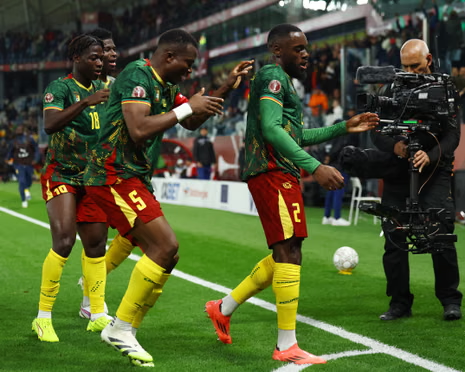
South Africa produced a resilient performance against Cameroon, emerging 2-1 victors despite the latter’s storied history and recent coaching controversies. Cameroon’s squad, shaped by federation president Samuel Eto’o and coach David Pagou, has impressed with direct attacking football, while South Africa’s tactical adjustments nearly forced a second-half comeback. Junior Tchamadeu and Christian Kofane scored for Cameroon, yet South Africa’s persistence proved decisive, illustrating the thin margins that define knockout football. The outcome ensures Morocco faces a confident and battle-tested South African team in the quarter-finals.
Senegal’s encounter with Sudan was equally revealing. Although they fell behind early, their superior finishing and tactical adjustments led to a comfortable victory. Pape Gueye scored twice before the highly-rated 17-year-old Ibrahim Mbaye added a late third goal, cementing Senegal’s status as one of the tournament favourites. Still, Senegal’s midfield balance remains a question mark, which could challenge them against tactically flexible sides such as Mali. The young PSG forward’s impact reflects Africa’s growing pool of talent capable of influencing critical matches.
Mali’s 10-man triumph over Tunisia, orchestrated by experienced coach Tom Saintfiet, offered a mix of unpredictability and tactical discipline. Despite numerical disadvantage, Mali’s disciplined defence and opportunistic finishing allowed them to progress to the quarter-finals. Saintfiet’s expertise in managing underdog sides has consistently produced resilient performances, highlighting Mali’s ability to exploit opposition weaknesses and maintain competitive balance. Four draws were enough to advance, underscoring their consistency and adaptability under pressure.
Nigeria and Egypt are also on course to reach the quarter-finals if their upcoming matches succeed, joining Morocco, Senegal, and Mali among the continent’s historically successful sides. Should Algeria or DR Congo advance, the quarter-finals will feature a rare concentration of teams with multiple Cup of Nations titles. Such a lineup emphasises both the tournament’s prestige and the high level of tactical and technical quality present at this stage.
One observation from the knockout phase so far is that the tournament has been relatively predictable, with established powers progressing as expected. However, this predictability has a silver lining, ensuring the quarter-finals showcase elite African football talent at its peak. While individual breakout stars have been less visible than in previous editions, collective performance quality remains extraordinary. Morocco, Senegal, and Mali, in particular, illustrate how tactical organisation and individual brilliance converge in high-stakes competition, reflecting both historical prowess and contemporary football evolution.

The Cup of Nations knockout stage also underscores the growing importance of youth development and international experience. Players such as Mbaye, Hakimi, and Gueye represent the new generation bridging domestic leagues and international recognition, while veteran coaches guide teams through complex tactical challenges. The combination of experience and youthful energy is shaping a tournament where every knockout game carries historical significance, national pride, and the potential for legendary performances.
As the tournament progresses, the concentration of talent in the quarter-finals promises intense competition, with African superpowers setting the standard. Morocco’s home advantage, Senegal’s attacking depth, Mali’s tactical discipline, and Nigeria’s and Egypt’s potential form a compelling narrative of dominance, resilience, and continental pride. Fans can expect a thrilling sequence of matches where strategy, skill, and passion intersect. With each game, the Cup of Nations continues to define Africa’s football identity, balancing tradition and innovation in a way few tournaments elsewhere can replicate.
In summary, Africa’s superpowers are firmly in control as the Cup of Nations knockout stages unfold. Morocco, Senegal, Mali, Nigeria, and Egypt demonstrate that the tournament’s depth and quality have reached unprecedented levels. This year’s quarter-finals are likely to be remembered as a showcase of elite African football, combining historical pedigree, emerging talent, and tactical brilliance. The knockout phase offers high-stakes drama and a reminder that African football’s evolution continues to impress globally, blending resilience, flair, and unrelenting ambition at every stage of the competition.
Related News:
 Tottenham shine at Everton but Frank wary of title push
 Matty Cash seals Villa win as City falter again at Villa Park
 Sarr Double Sinks Young Liverpool in Carabao Cup
 Nwaneri and Saka Secure Arsenal Win Over Brighton
 Woltemade Hot Streak Fires Newcastle Past Spurs
 Kieffer Moore Hat-Trick Ends Coventry’s Unbeaten Run
 Salah & Gravenberch Lead Liverpool to Win Against Villa
 Dyche Criticises Corner Decision as Forest Draw with United
 Caicedo Shines as Chelsea Edge Spurs in Chaotic Derby
 Granit Xhaka Rescue Earns Everton Draw at Sunderland
 Liverpool Edge Real Madrid 1-0 in Champions League Thriller
 Van de Ven Stunner Lifts 10-Man Spurs to UCL Glory
 Merino Shines as Arsenal Beat Slavia 3-0 Without Gyokeres
 Burn and Joelinton Head Newcastle to Victory Over Bilbao
 Foden shines as Man City dismantle Dortmund in dominant display
 Garnacho Spares Chelsea From Shock Champions League Loss in Baku
 Tension and Turmoil at Aston Villa v Maccabi Match
 Bellingham has ‘the edge’ among England No 10s
 Arteta Left Frustrated as Sunderland Deny Arsenal Late Win
Chelsea Cruise Past Wolves to Go Second in the Premier League
Man City Masterclass on Guardiola’s Milestone Day Exposes Liverpool Woes
Arteta Left Frustrated as Sunderland Deny Arsenal Late Win
Chelsea Cruise Past Wolves to Go Second in the Premier League
Man City Masterclass on Guardiola’s Milestone Day Exposes Liverpool Woes
 Lando Norris Dominates Brazil GP to Strengthen F1 Title Bid
 England cannot afford to be in awe of the All Blacks, warns Jamie George
 VAR Must Rein Its Neck In to Save Football’s Spirit
 Trescothick Hints Pope Will Keep Number Three Spot
 Ronaldo Confirms Final World Cup and Plans Retirement
 Mary Earps’s Manchester United Return Faces Mixed Reception
 Sam Kerr Stars in Chelsea Return with Champions League Double
 This kid is something else: Alex Scott’s rise to England call-up
 UK and Ireland Announce Venues for Euro 2028 Tournament
 Anthony Joshua Faces Backlash Over Proposed Jake Paul Fight
 England Maintain Perfect World Cup Qualifying Record with Win Over Serbia
 Saka Solidifies Role as Tuchel’s Key England Lieutenant
 Former Lion Heskey Warns of Shortage of England Strikers
 Osimhen doubles as Nigeria reach CAF World Cup final
 Australia Mourns Paralympic Champion Paige Greco
 Troy Parrott Hat-Trick Sends Ireland to World Cup Play-Offs
 Irish Hero Parrott Says Goal Brought First Tears in Years
 Scotland Fans Reflect on France ’98 as World Cup Looms
 Nigeria Misses World Cup Again After Play-Off Loss
 Mark Wood Bowls Rapid Nets Spell, Ashes Test Hopes Rise
 Germany and Netherlands Confirm Places in 2026 World Cup
 Spain Qualify for 2026 World Cup After Dramatic Draw
 Scotland End 28-Year Wait With Stunning World Cup Qualification
 Cristiano Ronaldo Joins Trump, Bin Salman at State Dinner
 From heartbreak to glory: Scotland’s dramatic return to the World Cup
 Tiny Curacao Makes History as Smallest Nation to Reach World Cup
 Haiti Qualifies for World Cup Despite Coach Never Visiting Country
 Scotland Fans Celebrate Historic World Cup Qualification
 Major League Baseball Scores New Broadcast Deals Through 2028
 Barcelona Returns to Camp Nou vs Athletic Bilbao
 Moyes Defends Gueye After Dramatic Everton Bust-Up
 Chelsea Dominates Barcelona with 3-0 Champions League Win
 Kids Football Coach Removed Over Suspected ‘Drugs Menu’
 Mbappe Scores 4 as Real Madrid Edge Olympiakos
 Man City Lose, Champions League Risk
 Gerrard warns Liverpool’s terrible run could worsen
 Jac Morgan to Miss Six Nations Start After Surgery
 Alexander Isak ends drought as Liverpool stop rot with win at West Ham
 Mbappe rescues Real Madrid with a penalty at Girona
 Barcelona, Atletico set for decisive La Liga showdown
 Maxwell withdraws from IPL 2026 after 13 seasons
 Barcelona Come From Behind to Beat Atletico 3-1
 Mbappe stars as Real Madrid thrash Athletic, close on Barca
 Trump to attend 2026 FIFA World Cup draw in Washington
 Norris Edges Verstappen in Abu Dhabi GP Practice
 Australia Face Big Changes as Cummins and Lyon Ruled Out of Ashes
 Van de Ven Tackle Leaves Isak with Fractured Leg
 City Set to Land Semenyo After Chelsea Exit from Transfer Race
 Arrizabalaga Sends Arsenal Through in Dramatic Shootout
 Ashes Shock: Boland Admits Struggle Bowling With Keeper Up
 Alex Sarama: How a 30-Year-Old Englishman Became WNBA Coach
 ECB powerless to halt England’s recurring Ashes failures
 Stokes urges empathy for England players amid Ashes struggles
 England Win Staggering Two-Day Test in Melbourne
 Aston Villa Remain Arsenal’s Key Obstacle in Title Pursuit
 Damien Martyn in Induced Coma After Meningitis Diagnosis
 Spin Bowling Struggles as Pace Dominates 2025 Ashes Series
 Anthony Joshua Released After Nigeria Car Crash
 Chelsea Sack Looms: Enzo Maresca Relationship Collapses