Published: 16 January 2026. The English Chronicle Desk. The English Chronicle Online
Sir Jacob Rees-Mogg has called on the Conservatives and Reform UK to unite following the dramatic defection of Robert Jenrick, warning that failure to do so could hand long-term power to the progressive Left and fundamentally reshape British politics. The former cabinet minister said the centre-Right had a “duty” to come together, arguing that continued division under the first-past-the-post system would all but guarantee defeat at the next general election.
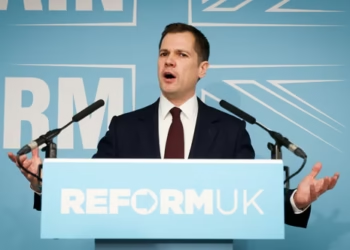
His intervention came just hours after Mr Jenrick, the former Conservative cabinet minister and leadership contender, publicly announced his move to Nigel Farage’s Reform UK. In a combative press conference on Thursday night, Mr Jenrick launched a blistering attack on his former party, declaring that the Conservatives had “broken Britain” and that their decline was necessary to allow Reform to form a future government. The announcement sent shockwaves through Westminster and deepened an already intense debate about the future of the Right in British politics.

Earlier in the day, Conservative leader Kemi Badenoch had sacked Mr Jenrick as shadow justice secretary and suspended his party membership, saying she had evidence he was preparing to defect. By the evening, those suspicions were confirmed, with Mr Jenrick accusing his former colleagues of betraying core principles on the economy, migration and law and order. He argued that both Labour and the Conservatives were now dominated by figures lacking the “competence or backbone” required to fix the country’s problems.
Sir Jacob, speaking on his GB News programme, said the moment demanded realism rather than recrimination. He warned that two competing parties on the Right would inevitably split the vote, repeating the pattern seen at the 2024 general election, when Reform’s rise cost the Conservatives dozens of seats. That outcome, he said, had helped entrench a political landscape in which progressive forces were increasingly dominant.
“We need to go into a general election with one party of the Right, not with two parties,” Sir Jacob said. “If we go with two parties in a first-past-the-post system, we both lose.” He went on to paint a stark picture of the consequences, warning of policies he described as economically damaging and socially divisive if the Right failed to regroup. His comments reflected a growing anxiety among Conservative traditionalists that the fragmentation of their voter base could lead to long-term exclusion from power.
Sir Jacob’s remarks place him alongside other senior figures on the Tory Right, including Esther McVey and former home secretary Suella Braverman, who have also argued for some form of pact or understanding between the Conservatives and Reform ahead of the next election. While the exact nature of such a deal remains unclear, proponents argue that electoral cooperation, whether through non-aggression agreements or informal seat arrangements, could prevent vote splitting and maximise the chances of a centre-Right victory.
The idea remains deeply controversial. Both Mr Farage and Mrs Badenoch have repeatedly ruled out a formal coalition, insisting that their parties represent distinct political projects. Mr Farage, welcoming Mr Jenrick to Reform, described the defection as “a big day in the realignment of the genuine centre-Right”, framing it as evidence that momentum was firmly on his side. Reform has enjoyed a significant poll lead over the Conservatives for much of the past year, fuelling speculation that it could supplant them as the main opposition force on the Right.
Despite those public positions, Sir Jacob suggested that a deal was still possible and, in his view, unavoidable. He said it was “in the national interest” for the Right to come together, adding that if some more centrist or liberal Conservatives felt uncomfortable with such an arrangement and chose to drift towards the Liberal Democrats, that would be an acceptable price to pay. His remarks underlined the ideological fault lines within the Conservative Party as it struggles to redefine itself after electoral defeat.
Addressing Mr Jenrick’s claim that he did not want to trigger talks of a pact, Sir Jacob was sceptical. He suggested that politicians often downplay the prospect of deals at the moment of defection, only for negotiations to follow later. In his view, the logic of the electoral system would eventually force both sides to reconsider their red lines.
Mr Jenrick, for his part, appeared unapologetic about the turmoil his move caused. Taking questions from journalists, he argued that the Conservative Party’s “death” was a necessary precondition for political renewal on the Right. He singled out senior figures such as Sir Mel Stride, the shadow chancellor, and Dame Priti Patel, the shadow foreign secretary, accusing them of presiding over failure during their time in government.
Conservative sources were quick to push back, pointing to Mr Jenrick’s previous praise for both figures and accusing him of opportunism. Mrs Badenoch acknowledged that the party had made mistakes while in office but insisted it had learned from them and was now charting a new course. She framed Mr Jenrick’s departure as a betrayal rather than a principled stand, arguing that unity, not fragmentation, was the path back to power.
Amid the political drama, Sir Jacob was keen to distance himself from suggestions that he might follow Mr Jenrick into Reform. Asked directly on BBC Newsnight whether he planned to defect, he replied with characteristic dryness that he was “off home actually”. He stressed that he remained a Conservative and intended to support the party, even as he expressed admiration for Mr Jenrick and described his departure as a significant loss.
In a later interview with Channel 4 News, Sir Jacob struck a more reflective tone. He said Mr Jenrick had articulated “some difficult truths” about the Conservatives’ record in government, but cautioned against portraying their time in office as an unbroken catalogue of failure. This balancing act highlighted Sir Jacob’s attempt to bridge loyalty to his party with a recognition of the grievances driving voters and politicians towards Reform.

For many observers, the episode encapsulates a broader crisis facing the British Right. Reform’s rise has tapped into disillusionment with traditional politics, while the Conservatives remain divided over how far they should move to reclaim voters who feel alienated. The question of whether unity is achievable, or even desirable, remains unresolved.
Mr Jenrick concluded his defection speech by framing his decision as an act of patriotism rather than ambition. He said the country was in a “precarious, dangerous position” and that political leaders had a duty to speak uncomfortable truths and act on them. In his assessment, the Conservatives had failed to uphold their principles on key issues and could no longer be trusted to deliver meaningful change.
Whether his move will accelerate the decline of the Conservatives or force a reckoning that leads to renewed unity on the Right is an open question. What is clear is that the defection has intensified pressure on both parties to clarify their strategy before the next election. As Sir Jacob Rees-Mogg’s intervention shows, the debate over unity is no longer theoretical. It is now central to the future shape of British politics.
Related News:
 British Woman in Iran ‘Losing Hope’ Amid Ongoing Detention
 BBC Journalist Held and Interrogated in Vietnam
 Boris Johnson: Tories Risk Election Loss if They ‘Bash the Green Agenda’
 Green Party Surges Past Labour in Latest UK Poll
 Celebrities and Charities Demand UK Government Act on Child Poverty
 Sultana says new party is aiming to ‘run government’
 Reform Councillor Defects to Tories Over ‘Uncomfortable’ Policies
 Trump’s UK Ambassador Urges North Sea Drilling to Strengthen US Ties
 FBI Director Kash Patel Defends Girlfriend Amid Government Jet Claims
 Phillipson urges careful review of gender recognition guidance
 French Taxi Driver Cleared in David Lammy Theft Case After Fare Dispute
 Rachel Reeves Set to Break Labour Pledge and Raise Income Tax
 Who is Rama Duwaji? What Zohran Mamdani’s wife has said about Gaza and ICE as he’s elected NYC mayor
 Lancashire council plans to close care homes and day centres
 MPs Press Rachel Reeves to Hike Gambling Taxes
 Met Police Culture Makes Racial Harm ‘Inevitable’
 Nicola Sturgeon Urges SNP to Oppose New Oil Fields
 Eleven Arrested After Pro-Palestine Protest at Villa Match
 Labour Falls to Fourth in Poll, Faces Historic Election Loss
Boris Johnson accused of undermining BBC leadership
Labour Falls to Fourth in Poll, Faces Historic Election Loss
Boris Johnson accused of undermining BBC leadership
 Remaining rebel Labour MPs have whip restored
 Cuts to home insulation funding threaten UK climate goals
 Tim Davie resigns as BBC director general amid bias claims
 ‘Reckless’ cuts to victims’ services will cost more than they save
 BBC director-general and news chief resign amid bias row
 Millionaires group urge Reeves to introduce wealth tax to ‘lift kids out of poverty’
 Starmer Faces Growing Dissent as Labour MPs Weigh Leadership Challenge
 BBC Faces Backlash as Reform UK Withdraws from Film
 Tim Davie Defends BBC Amid Bias Scandal Storm
 Reeves rejects £1bn plea for NHS redundancy payouts
 Farage appointee to lead Reform youth accused of anti-British views
 Palace to reinstate hyphen in Andrew’s surname
Donald Trump threatens BBC over edited speech
Palace to reinstate hyphen in Andrew’s surname
Donald Trump threatens BBC over edited speech
 Politics latest: Starmer ‘will fight any leadership coup’ as Streeting denies attempt to oust Labour PM
 PM Condemns Leaks, Vows Loyalty to Ministers and Stability
 Major Rent Reform Ends No-Fault Evictions in England
 Peers Flood Assisted Dying Bill with 942 Amendments
 England’s Special Needs Support Faces Breaking Point
 MoD warned over Excel risks before Afghan data breach
 UK Unveils Fast-Track Deportation and Asylum Overhaul
 UK Asylum Overhaul Sparks Debate Over Human Rights and Deportations
 UK Asylum Reforms: Temporary Refugee Status and Faster Deportations
 UK Candidate Moved to Safe House After Election Threats
 Mahmood Defends Tough Overhaul of UK Asylum System
 Scottish Ministers Express Alarm Over UK Asylum Reforms
 UK Warns China After MI5 Issues Espionage Alert
 Westminster Advances Legacy Bill Amid Criticism
 Minister Defends Tough New Asylum Reform Plan
 UK Net Migration Falls Sharply After ONS Revisions
 UK Vulnerable to Attack, Defence Committee Finds
 Labour Faces Historic Decline in Wales
 Rama Rebukes Mahmood for Targeting Albanian Families
 Russian Vessel Used Lasers on RAF Pilots, UK Claims
 PM Shares Emotional Letter to Son on Men’s Struggles
 MP Offers Seat to Help Burnham Challenge Starmer
 PM Highlights UK Business at G20 in South Africa
 Boris Johnson Oversaw Toxic No 10 Culture, Covid Inquiry Finds
 Kate Forbes: Motherhood Harder Than Politics
 Welsh Government Christmas 2020 Lockdown Criticised
Reeves to Crack Down on Benefit Fraud While Lifting Two-Child Limit
Welsh Government Christmas 2020 Lockdown Criticised
Reeves to Crack Down on Benefit Fraud While Lifting Two-Child Limit
 BBC to Expand Standards Panel and Create Deputy Director Role
 Most Tories Expect to Support a Farage-Led Government
 Labour MP claims devolution bill is ‘blatant discrimination’ against Cornwall
 English Mayors Set to Introduce Tourist Taxes
 Ex-Classmate Accuses Farage of Dishonesty on Racism Claims
 Millions Face Higher Taxes Under Reeves New Budget
 Peers Get Extra Time to Debate Assisted Dying Bill
 Planned Palestinian Flag Raising at Belfast City Hall Faces Delay Amid Legal Concerns
 Ex-Brexit MEP Rejects Claim of Pro-Russia Payments
 Government righting decades-old injustice for miners
 Starmer Says Labour’s Economic Plan Needs Years to Deliver
 UK delays ruling on China embassy plan until January
 Culture secretary to review Telegraph takeover by Daily Mail owner
 Andy Burnham Apologises for Past LGBTQ+ Police Discrimination
 UK to Launch Military ‘Gap Year’ Scheme to Boost Recruitment
 Reeves Slams Farage Over Two-Child Benefit Cap Opposition
 Mandelson Refuses Apology Over Epstein Ties
 Plans to Limit Jury Trials Face Retreat After Mounting Opposition
 Jenrick Reform defection deepens Tory civil war
 China Dependence Threatens UK Energy Supply Chains and Jobs