Published: 09 February 2026. The English Chronicle Desk. The English Chronicle Online.
More than three hundred thousand children now face a decade of insecurity under the UK government’s proposed settlement overhaul, as analysis shows the earned settlement policy could leave migrant families waiting far longer for permanent status. The earned settlement reform, aimed at increasing the qualifying period for settled status from five to ten years, was first outlined by the Home Office in its consultation last year and has sparked fierce debate among politicians, advocacy groups, and families directly affected by the looming changes. At the heart of this debate sits the earned settlement dilemma, a term that has rapidly entered public discourse as millions of migrants and their children grapple with uncertainty about their futures living in the United Kingdom.
The Institute for Public Policy Research (IPPR) has highlighted the potential impact of these proposals, noting that nearly a quarter of the estimated 1.35 million people currently on a path to settlement are children, most of whom depend on their families’ work visas. If implemented without transitional protections, the new earned settlement rules could mean that these children, many of whom have spent much of their lives in the UK, may have to wait up to ten years before they or their families secure permanent residency. The IPPR warns that extending this wait risks locking families into prolonged insecurity and undermining opportunities for integration, education, and stable employment.

Currently, migrant workers and their families on eligible visas can apply for settled status after five years, a threshold meant to offer stability and long-term planning for those contributing to British society. However, the earned settlement model doubles this period as a baseline, with further adjustments possible depending on an individual’s earnings, English language skills, and other contribution metrics set by the Home Office. The government also proposes penalties for those claiming public funds, overstaying visas, or entering the UK irregularly, which could extend waiting times beyond ten years for some applicants.
For many families, the implications of the earned settlement wait are deeply personal and immediate. Parents and children who have built lives around the expectation of securing permanent residence after five years now face a starkly different reality. For children approaching adulthood, the delay could mean missing out on crucial opportunities such as university access or financial support available only to those with settled status. Educational plans may be disrupted, and families may struggle to access benefits or secure long-term employment in an increasingly uncertain landscape.
Critics of the policy, including around forty Labour MPs, argue that applying these changes retrospectively is fundamentally unfair. They have described the approach as “moving the goalposts” mid-journey for families who entered the UK under different rules and made life-altering decisions based on those expectations. These concerns were forcefully aired during a Westminster Hall debate, where MPs urged the government to reconsider retrospective application and protect those already living here.
Tony Vaughan, MP for Folkestone and Hythe, encapsulated the frustration felt by many, saying the idea of earned settlement loses legitimacy when the criteria shift after people have already invested years in compliance and contribution. The retrospective element, he argued, undermines trust and weakens the social contract between immigrants and the state. Another MP, Rachael Maskell of York Central, warned that the reforms could exacerbate existing skills shortages by deterring international talent and straining sectors that rely heavily on migrant labour.
Representatives from migrant advocacy organisations have echoed these concerns, stressing that families deserve clarity and fairness. Many families, particularly those in lower-paid roles such as care workers, have already contributed significantly to communities across the UK, yet face a longer wait for the settled status that would provide them with security and the means to fully participate in society. The IPPR and others have called on the government to include a clear protection clause for those already on settlement pathways so that current expectations are honoured.
The impact on children caught in this policy shift has been poignantly illustrated by personal testimonies. One 18-year-old, who stands on the brink of qualifying for settlement after five years, now finds the goalposts shifted to ten. His father, an NHS doctor, moved his family to the UK in good faith, believing in the promise of stability. Now, with the possibility of extended waiting and limited access to student finances, his dream of studying medicine in the UK may be out of reach. The emotional toll on the family has been profound, leaving his mother in tears as they confront a future clouded by policy decisions made far from their everyday lives.
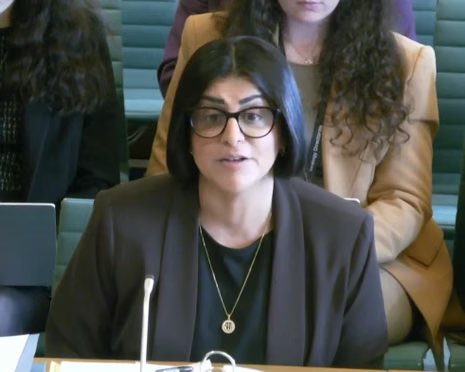
Home Secretary Shabana Mahmood has defended the changes, framing settlement as a privilege that must be earned through contribution and compliance with UK requirements. In testimony to MPs, she stressed that a five-year qualifying period was relatively short compared to international norms and that extending it would ensure migrants contribute significantly to the economy and society before receiving the full benefits of settled status. Mahmood also suggested that there could be mechanisms to reduce the qualifying period for those who meet higher thresholds in areas such as earnings and language proficiency.

The government’s broader immigration strategy, which includes the earned settlement model, aims to balance the need to reduce net migration pressures while maintaining the UK’s appeal as a destination for skilled workers. Yet, the controversy surrounding retrospective application and the potential effects on children has underscored sharp divisions within political and public opinion. Advocates caution that without compromise or clear transitional arrangements, the reforms could inflict long-term harm on families and communities that have already invested in life in the UK.
As the consultation period unfolds and debate continues in Parliament, many hope that policymakers will take heed of the voices of those most affected. Families who arrived under one set of rules now find themselves navigating a system in flux, with their futures uncertain as they await decisions that will shape their lives for years. Whether the earned settlement model will ultimately provide a fair and effective framework for long-term residency remains contested, but the story of the 300,000 children facing potential waits of ten years or more has brought urgency and human depth to what might otherwise be considered an abstract policy discussion.
Related News:
 British Woman in Iran ‘Losing Hope’ Amid Ongoing Detention
 BBC Journalist Held and Interrogated in Vietnam
 Green Party Surges Past Labour in Latest UK Poll
 Celebrities and Charities Demand UK Government Act on Child Poverty
 Trump’s UK Ambassador Urges North Sea Drilling to Strengthen US Ties
 FBI Director Kash Patel Defends Girlfriend Amid Government Jet Claims
 French Taxi Driver Cleared in David Lammy Theft Case After Fare Dispute
 Rachel Reeves Set to Break Labour Pledge and Raise Income Tax
 MPs Press Rachel Reeves to Hike Gambling Taxes
 Boris Johnson accused of undermining BBC leadership
 ‘Reckless’ cuts to victims’ services will cost more than they save
 Millionaires group urge Reeves to introduce wealth tax to ‘lift kids out of poverty’
 Starmer Faces Growing Dissent as Labour MPs Weigh Leadership Challenge
 Reeves rejects £1bn plea for NHS redundancy payouts
 Farage appointee to lead Reform youth accused of anti-British views
 Politics latest: Starmer ‘will fight any leadership coup’ as Streeting denies attempt to oust Labour PM
 PM Condemns Leaks, Vows Loyalty to Ministers and Stability
 Major Rent Reform Ends No-Fault Evictions in England
 Peers Flood Assisted Dying Bill with 942 Amendments
 England’s Special Needs Support Faces Breaking Point
 MoD warned over Excel risks before Afghan data breach
 UK Unveils Fast-Track Deportation and Asylum Overhaul
 UK Asylum Overhaul Sparks Debate Over Human Rights and Deportations
 UK Asylum Reforms: Temporary Refugee Status and Faster Deportations
 UK Candidate Moved to Safe House After Election Threats
 Mahmood Defends Tough Overhaul of UK Asylum System
 UK Warns China After MI5 Issues Espionage Alert
 Westminster Advances Legacy Bill Amid Criticism
 UK Vulnerable to Attack, Defence Committee Finds
 Labour Faces Historic Decline in Wales
 Rama Rebukes Mahmood for Targeting Albanian Families
 Russian Vessel Used Lasers on RAF Pilots, UK Claims
 PM Highlights UK Business at G20 in South Africa
 Kate Forbes: Motherhood Harder Than Politics
 Welsh Government Christmas 2020 Lockdown Criticised
Reeves to Crack Down on Benefit Fraud While Lifting Two-Child Limit
Welsh Government Christmas 2020 Lockdown Criticised
Reeves to Crack Down on Benefit Fraud While Lifting Two-Child Limit
 Most Tories Expect to Support a Farage-Led Government
 Labour MP claims devolution bill is ‘blatant discrimination’ against Cornwall
 Millions Face Higher Taxes Under Reeves New Budget
 Peers Get Extra Time to Debate Assisted Dying Bill
 Planned Palestinian Flag Raising at Belfast City Hall Faces Delay Amid Legal Concerns
 Government righting decades-old injustice for miners
 Starmer Says Labour’s Economic Plan Needs Years to Deliver
 UK delays ruling on China embassy plan until January
 Culture secretary to review Telegraph takeover by Daily Mail owner
 Andy Burnham Apologises for Past LGBTQ+ Police Discrimination
 Reeves Slams Farage Over Two-Child Benefit Cap Opposition
 Mandelson Refuses Apology Over Epstein Ties
 Plans to Limit Jury Trials Face Retreat After Mounting Opposition
 Jenrick Reform defection deepens Tory civil war
 China Dependence Threatens UK Energy Supply Chains and Jobs
 Right Must Unite After Jenrick Defection, Urges Rees-Mogg
 Romford MP Andrew Rosindell defects to Reform UK
 UK Ministers Drop Foreign Student Targets for Global Education Push
 MPs warn AI financial risks threaten UK stability
 MPs warn AI financial risks threaten UK stability
 No Gas Boiler Ban as UK Warm Homes Plan Backs Heat Pumps
 Hugh Grant Joins Call for Under-16 Social Media Ban in UK
 Shinzo Abe’s killer receives life sentence in Japan
 US Africa aid remarks spark anger after leaked State email
 Lords Vote Piles Pressure on Starmer Over Social Media Ban
 Judge-only trials plan fails to ease court backlog
 Planned Troubles Board Game Sparks Outrage in Northern Ireland
 Reform UK Health Plan ‘Would Cost £1.7bn’, Streeting Says
 Police response times face strict new national limits
 Labour policing overhaul sparks fears over growing central control
 Tories criticised after Braverman defection sparks mental health row
 Burnham Westminster return hopes fade amid Labour rift
 Starmer warns of toxic division politics in Reform challenge
 Starmer China visit raises human rights pressure on Beijing
 Labour Must Revive High Streets to Avoid Election Collapse
 Conservative Party Rejects Centrism Under Badenoch’s Leadership
 Calls Grow for King Charles to Apologise for Crown’s Role in Slavery
 Starmer Signals UK Return to EU Defence Pact Talks
 Cory Bernardi joins One Nation for SA election
 Starmer crisis deepens as Labour MPs turn on PM
 Palantir contracts face UK halt calls over transparency
 Barclays drops Global Counsel after Mandelson link scrutiny
 Labour Thinktank Row Deepens Over Journalist Probe Claims
 Morgan McSweeney downfall shocks Labour leadership