Published: 25 February 2026. The English Chronicle Desk. The English Chronicle Online.
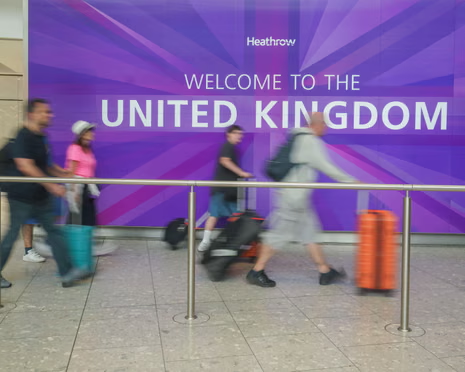
British dual nationals are facing imminent travel restrictions, with many at risk of refusal to enter the UK from Wednesday. The Home Office has confirmed the government will enforce new border rules, which require all British citizens to present a valid British passport or a certificate proving their right to enter. Families, the3million campaign group, the Liberal Democrats, and former Conservative cabinet minister David Davis urged the government to allow a grace period, but these calls have been dismissed. Under the updated rules, those without the correct documentation may be denied boarding on flights, ferries, or trains, raising urgent concern among dual nationals.
A Home Office spokesperson explained that the UK is moving to a modernised digital immigration system, intended to strengthen border security. International carriers will begin checking all passengers for valid permission or travel status to the UK, similar to the current checks for visa nationals. “The correct permission for British citizens is a British passport or a foreign passport endorsed with a certificate of entitlement,” the spokesperson said. Carriers may, at their discretion, accept some expired British passports as alternative documentation, but this remains at the operator’s judgment.
The changes form part of a wider government initiative to digitise and streamline border controls. From Wednesday, non-visa nationals attempting to enter the UK without a £16 electronic travel authorisation (ETA) can be refused boarding, yet dual nationals are explicitly excluded from ETA eligibility. Migration Minister Mike Tapp emphasised the importance of travel readiness, urging all intending visitors to ensure they carry appropriate documentation to smooth their journey. ETAs are also required for passengers making connecting flights within the UK, further complicating travel for dual nationals without a British passport.

Calls from Davis and the Liberal Democrats for a temporary grace period were rejected by the government. Many dual nationals have reported last-minute disruption and stress, with hundreds reaching out to media outlets to share their experiences. One man described cancelling a flight to attend his father’s memorial service, while a family missed a grandparent’s 80th birthday celebration, and another traveller abandoned plans to attend a wedding in Spain. These individuals only learned about the new rule in the past ten days, highlighting gaps in communication regarding the policy.
Davis acted after receiving a constituent complaint from the Netherlands, whose mother was gravely ill in a Yorkshire care home. She was unable to visit due to her British passport being held for renewal. Similarly, a British couple on honeymoon in New Zealand were forced to cut their trip short, incurring significant cancellation costs, as the husband, a dual national, lacked his British passport. EU citizens who recently naturalised as British face delays because they cannot apply for a British passport until after their citizenship ceremony, effectively rendering them vulnerable under the new rules.
Although the Home Office published the rules on the official gov.uk website in November, affected individuals say the guidance was not communicated effectively to dual nationals. Many first became aware of the changes through media reports on 13 February, leaving little time to adjust travel plans. The alternative documentation, a certificate of entitlement, costs £589 and can take up to eight weeks to obtain. Dual nationals have criticised the cost as punitive, especially compared with the £16 ETA fee available to other tourists.
In response, the Home Office acknowledged that the changes represent a significant shift in entry requirements. It provided temporary guidance to carriers, indicating that expired passports issued after 1989 may be accepted alongside a valid non-visa national passport, provided biographic details match. However, the acceptance of such alternatives remains an operational decision for carriers, leaving passengers uncertain and at risk of refusal despite holding legitimate proof of British nationality.
The policy forms part of a broader government strategy to modernise the UK border, embracing digital verification processes intended to improve security and efficiency. Proponents argue that the system will ensure smoother operations in the long term, but the immediate impact on dual nationals is profound, disrupting family visits, ceremonies, and essential travel. Social media has amplified frustrations, with many sharing personal stories of missed milestones, showing widespread distress caused by limited awareness of the rule.
The £589 certificate of entitlement, while an alternative, imposes both financial and administrative burdens on dual nationals. Reports indicate processing times of up to eight weeks, creating urgent dilemmas for those who must travel before Wednesday. The contrast between this cost and the comparatively affordable ETA for other visitors has prompted criticism from campaign groups and opposition politicians, who argue the policy unfairly penalises dual nationals.
Dual nationals describe an acute sense of uncertainty, compounded by the lack of clarity regarding acceptable alternative documentation. Families report difficulty confirming whether airlines will accept expired British passports or third-country documents, creating anxiety and last-minute disruptions. For some, travel has been postponed or entirely abandoned, revealing the human cost of the policy shift. Stories emerging from across the UK and Europe highlight the emotional strain, particularly when urgent family matters, such as funerals or health emergencies, are involved.
Legal experts note that dual nationals remain British citizens under UK law, yet the practical ability to prove nationality has become suddenly restrictive. Without a valid British passport or certificate of entitlement, they may face denial at boarding, despite their citizenship status. This creates a disparity between legal recognition and practical access, which campaigners say must be addressed to avoid widespread hardship.
Despite repeated calls for clarity and support, the Home Office has maintained that carriers have discretion to accept certain documentation as evidence of nationality, yet this does not guarantee protection for travellers. The reliance on individual airline judgment introduces further unpredictability, adding to the stress experienced by British dual nationals. Advocacy groups continue to lobby for improved communication and more accessible pathways to secure travel documentation.
Critics argue that the policy could disproportionately affect families and communities with transnational ties. Many dual nationals have strong personal or professional reasons to travel, and the lack of a grace period has left some facing missed events and disrupted relationships. Public reaction has highlighted the need for policymakers to consider both security objectives and the practical realities facing dual nationals in an increasingly interconnected world.
The Home Office asserts that digitalisation of the border is essential for modern security, aiming to streamline checks and reduce risks. Yet, the human consequences, particularly for dual nationals unaware of the rapid implementation, reveal the challenges of balancing efficiency with fairness. Families have expressed frustration that minimal guidance, short notice, and high costs have created avoidable stress during emotionally significant periods.

Moving forward, advocacy groups are urging the government to introduce temporary measures to mitigate the immediate impact. Suggestions include extending validity periods for expired passports or simplifying access to certificates of entitlement. Until such measures are considered, dual nationals must navigate a precarious environment, with travel plans subject to strict documentation rules and uncertain acceptance by carriers. The situation underscores the broader tension between modernised border security and individual rights, especially for citizens with multiple national affiliations.
As the enforcement date approaches, the human stories continue to surface. Families missing reunions, couples abandoning vacations, and citizens unable to attend crucial ceremonies illustrate the emotional toll of these changes. Social media has amplified these experiences, highlighting widespread concern and urging policymakers to consider the consequences for British dual nationals. The Home Office’s position remains firm, emphasising that rules are designed to strengthen border security, while passengers and campaigners argue for practical accommodation to ensure that British citizens can exercise their travel rights.
The new rules mark a significant transformation in UK border policy, with immediate implications for dual nationals and broader consequences for families and communities. While the government emphasises operational efficiency and security, the lived experience of affected citizens paints a picture of confusion, financial strain, and personal distress. Balancing these competing priorities will be essential to ensure that the modernised system protects national borders without unfairly penalising those with dual nationality.
Related News:
 Kate Winslet to Narrate Film Highlighting King’s Environmental Mission
 Trump’s UK Ambassador Urges North Sea Drilling to Strengthen US Ties
 UK Bans Fake Numbers: Scammers Lose Their Trick
 Vibe coding’ named Collins dictionary’s word of the year
BBC to Apologise Over Edited Trump Speech Amid Backlash
Vibe coding’ named Collins dictionary’s word of the year
BBC to Apologise Over Edited Trump Speech Amid Backlash
 Millionaires group urge Reeves to introduce wealth tax to ‘lift kids out of poverty’
 Reeves rejects £1bn plea for NHS redundancy payouts
 PM Condemns Leaks, Vows Loyalty to Ministers and Stability
 Phillipson Accused of Appeasing Unions by Diluting EBacc
 Saka Solidifies Role as Tuchel’s Key England Lieutenant
 Greene Pushes Epstein Files Amid Trump Fallout
 Zelenskyy Signs Fighter Jet Deal Amid Russian Drone Attacks
 Sundar Pichai Cautions on AI Hype and Market Risks
 Shadow Fleet at Sea: Europe’s Battle Against Illicit Oil Shipping
 Snow and Ice Cause Travel Chaos in North Yorkshire
 Director Michael Caton-Jones Reflects on Career and Beginnings
 Inside the Helpline Protecting Missing Children in the UK
 PlayStation PS5 Deals Hit Lowest Prices Ahead of Black Friday
 US Suspends Afghan Immigration After White House Shooting
 Five-Year-Old Dies After Rare Tonsil Surgery Complication
 Starmer Says Labour’s Economic Plan Needs Years to Deliver
 ‘Extinct’ Antelope Returns to Sahara, Bringing Hope
 IndiGo Cancels Hundreds of Flights Amid Pilot Shortages
 Young Britons Face Heaviest Burden from Ageing Population, Lords Warn
 U‑Turn on Farmers’ Inheritance Tax Sparks Political Firestorm
 Aston Villa Remain Arsenal’s Key Obstacle in Title Pursuit
 Irish Beach Tragedy: Irish Drown at Whitehaven Beach in Australia
 Starmer Faces Parliamentary Battles Over UK-EU ‘Reset’ Plan
 Met Police Vetting Failures Let Serial Rapists Remain
 Federal Immigration Shift: Officers Leave Louisiana for Minneapolis
 Fatal Bolton Taxi Crash Claims Three Teens and Driver
 Australia grants Asio powers to designate hate groups under new laws
 Friedman Uninvited From 2024 Adelaide Writers’ Week
 ScottishPower Tops List of Worst UK Energy Suppliers
 Judi Dench Champions Fight to Save London’s Green Spaces
 Crowborough Camp Welcomes First Asylum Seekers
 BBC Funding Crisis: Tim Davie Warns of Jeopardy Ahead
 ABC Facebook Page Briefly Hacked, Adult Photos Posted
 Trump Defiant After Washington Hotel Shooting
 Cross-Border Crisis Shatters Fragile Afghan Peace
 Urban Flood Crisis: A Growing Threat to English Homes
 Ashley Cole: Finding His Voice and Vision in Italy
 New AI Tool To Target Obesity Risk And Transform NHS Care
 Greens Face Internal Row Over Antisemitism Claims
 Tough Fiscal Realities Await Next Scottish Government
 The Burning Lens: An Iranian Artist’s Visual Resistance
 Met Officers Probed Over Al Fayed Abuse Allegations
 One Nation Candidate’s Surprising Ties to Independents
 Aramco Surges as East-West Pipeline Counters Gulf Tensions
 Reform UK Faces Crisis as Newly Elected Councillors Resign
 Starmer Strikes Back as 100 MPs Sign Support Pledge
 Scepticism and tight security as Beijing braces for Trump
 Tensions Flare as Israeli Nationalists March in Jerusalem
 UK Firms Freeze Spending as Iran Conflict Bites
 UK Job Market Squeezed as Iran War Drives Jobless Rate to 5%
 Reeves to Fast-Track Clean Energy Amid Iran Crisis
 The Battle for Wembley Sparking Unprecedented Legal Warfare
 Tony Abbott Returns as New Liberal Party President
 Pope Meets Families in Italy Toxic Waste Zone
 Royal Ascot Allegation Sparks Wider Police Inquiry
 Secret Role of UK Security Services in Troubles Amnesty Law
 Tube Strike Brings Capital to a Standstill Over Shift Disputes
 Teaching Machines Right From Wrong in the Digital Age
 Is Ollie Robinson the Chaos English Cricket Needs Today?
 The Hidden Crisis Eroding Trust in British Communities
 Saving the Scalloped Hammerhead: The Pacific Battle
 Stolen Mobiles Could Soon Become Useless Bricks
 Clean Air Initiatives Spark Major Fall in London Hospital Admissions
 Fearless Pioneer of Investigative Journalism Dies Aged 83
 Trump Urged to Condemn UFC Fighter Over Obama Slurs
 The Fear Gap: Why Europe Feels Less Safe Than It Is
 US Military Pacific Boat Strike Kills Three People
 Dettol Apologises for ‘Toxic Men’ Advert Backlash in China
 UK Care Crisis: Row Explodes Over New Visa Settlement Rules
 Sainsbury’s Boss Optimistic As Grocery Inflation Eases
 US Advance Past Bosnia in World Cup Thriller
 Trump’s Mount Rushmore Speech: A Divisive Anniversary
 Trump’s Red-Card Intervention Hurts the US World Cup
 US Airman Avoids British Court in Indecent Exposure Case
 Britain’s Mini Fan Craze Sparks Major Waste Crisis