Published: 27 February 2026. The English Chronicle Desk. The English Chronicle Online.
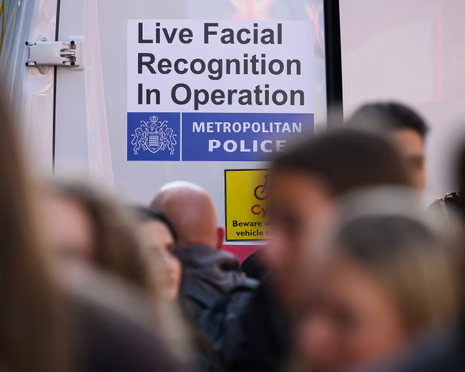
The Metropolitan Police are set to pilot handheld facial recognition devices to verify citizens’ identities during routine stops. Mayor Sadiq Khan confirmed that one hundred officers will test the technology over a six-month period, describing it as a tool to reduce unnecessary arrests while critics warn of potential civil liberties infringements. The announcement follows rising public concern over AI-powered policing, as handheld scanners resemble the software commonly used in smartphones and commercial applications. Facial recognition has previously been deployed by UK forces using cameras on vans and in fixed urban locations, demonstrating a growing reliance on biometric identification.
Past deployments in Croydon, Manchester, and South Wales revealed the technology’s capability to identify individuals retrospectively, though errors have occasionally led to wrongful arrests. In one recent instance reported by the Guardian, a man was mistakenly apprehended for burglary hundreds of miles from his residence due to algorithmic confusion with another person of similar ethnicity. Additionally, the Met signed a three-month £490,000 contract with American AI firm Palantir to detect rogue officers, highlighting a broader strategy of integrating artificial intelligence into law enforcement practices.

Zoë Garbett, the Green Party London Assembly member who prompted Khan’s disclosure, described the pilot as “an alarming change” that could redefine the relationship between police and the public. She raised concerns that officers would gain the ability to scan people on demand, potentially bypassing consent and eroding trust in policing institutions. Khan countered that the technology would only be employed during lawful stops when officers have doubts about a person’s identification, framing it as a practical alternative to detaining individuals unnecessarily at police stations.
“The only alternative the police have is to arrest that person and take them to the police station,” Khan explained, emphasising that the handheld devices aim to minimise inconvenience while ensuring accurate identity verification. He stressed that biometric data would only be retained temporarily and deleted immediately if no match is found, seeking to reassure the public about data protection concerns.
The pilot coincides with calls from the Equality and Human Rights Commission for independent oversight of facial recognition technologies in the UK. Policing minister Sarah Jones described the innovation as “the biggest breakthrough for catching criminals since DNA matching,” reflecting official optimism about its crime-fighting potential. Conversely, Mary-Ann Stephenson, chair of the equalities watchdog, highlighted risks of racial bias and false positives, warning that inaccuracies could cause human rights infringements and undue distress.
South Wales Police have already employed operator-initiated facial recognition using NEC’s NeoFace algorithm on smartphones, allowing officers to confirm identities of missing, wanted, or at-risk individuals when traditional verification methods are unavailable. The system may also assist in identifying deceased or unconscious persons, though covert use is prohibited. Civil liberties groups, including Big Brother Watch, have criticised the regulations as vague, raising fears of expansive use in situations unrelated to criminal activity.
“It’s shocking that I had to force the mayor to disclose that they are trialling operator-initiated facial recognition technology,” Garbett said. She argued that handheld devices introduce new privacy risks, as UK law generally does not require individuals to provide identification to police without strong justification. Unregulated scanning, she warned, threatens this fundamental legal safeguard.
The pilot follows prior statements from Khan, who indicated that the Metropolitan Police would consult stakeholders and consider ethical, legal, and policy implications before introducing operator-initiated facial recognition. In December, Sarah Jones launched a 10-week consultation emphasising the technology’s ability to remove dangerous criminals from the streets and strengthen community safety. Early trials, such as the Croydon live facial recognition project, reportedly led to the arrest of over one hundred wanted offenders within three months.
Lindsey Chiswick, the Met’s lead for facial recognition, described the operator-initiated devices as innovative tools designed to confirm identities quickly and accurately. She noted that the rollout would initially involve a small number of officers and highlighted the importance of immediate deletion of biometric data when no match is detected. Chiswick emphasised that the approach aims to reduce prolonged detentions while maintaining public safety.
Critics argue that even with safeguards, the expansion of handheld scanning represents a significant shift in police powers and public surveillance. There are concerns that false matches may disproportionately affect ethnic minorities, compounding existing tensions between communities and law enforcement. Legal experts note that current legislation does not explicitly address operator-initiated facial recognition, underscoring the need for robust statutory guidance to prevent misuse or overreach.

Supporters counter that the technology can streamline policing, allowing officers to verify identities without resorting to time-consuming detentions. By reducing administrative burdens and enhancing the speed of identification, proponents claim the devices can free officers to focus on broader crime prevention strategies. The government and police leadership frame the technology as complementary to existing investigative methods, integrating AI tools with traditional policing practices.
Public debate continues regarding the balance between effective law enforcement and civil liberties, with watchdog groups advocating for independent oversight to monitor accuracy, data retention, and proportionality of use. International experience shows that facial recognition technology often exhibits biases, reinforcing the argument for strict regulation to prevent unwarranted infringements on personal privacy. Observers warn that pilot programs, if expanded prematurely, could normalise invasive surveillance practices without adequate safeguards.
As London’s Metropolitan Police prepare to trial handheld facial recognition, stakeholders from government, civil society, and technology sectors are closely monitoring outcomes. The pilot represents a critical test case for the broader implementation of AI in policing, highlighting both potential efficiencies and ethical challenges. Future evaluations will likely determine whether handheld scanning can coexist with fundamental rights while enhancing public safety, making transparent oversight essential. The introduction of this technology sparks urgent questions about accountability, fairness, and public trust in the capital’s law enforcement.
Related News:
 Government urges schools to ban phones to curb classroom disruption
 Starmer’s communications chief to outline media strategy overhaul
 TikTok to Strengthen Age Verification Across the EU
 Five More Prisoners Freed by Mistake in Essex Week
 How Bringing Forests Into Preschools Boosts Children’s Health
 Nearly 48,000 Zombie Knives Removed from UK Streets in a Year
 Afghan man charged with murder after west London knife attack
 Man Charged Over Cambridgeshire Train Stabbing
 Phillipson urges careful review of gender recognition guidance
 French Taxi Driver Cleared in David Lammy Theft Case After Fare Dispute
 UK Bans Fake Numbers: Scammers Lose Their Trick
 England Curriculum Review Recommends Major Changes
 Just Stop Oil Protesters Convicted Amid Climate Defence Row
 Experts Urge Legal Right to Timely Cancer Care
 Met Police Culture Makes Racial Harm ‘Inevitable’
 Patients to Test Health at Home to Ease NHS Winter Pressure
 Newcastle United Lifts Ban on Fan Over Gender-Critical Views
 One of world’s last dinosaurs on sale for £3m
 British Grandmother to Return Home After Death Sentence in Bali
 North Sea oil workers must lose weight or face job loss
 Remaining rebel Labour MPs have whip restored
 King Charles to Lead Nation in Remembrance Sunday Service
 No link found between paracetamol in pregnancy and autism
 Tim Davie resigns as BBC director general amid bias claims
 Northern Lights May Illuminate UK Skies Amid Strong Solar Storm
 Palace to reinstate hyphen in Andrew’s surname
 Northern Lights may illuminate UK skies this week
 Pop Stars Call on UK Government to Cap Resale Prices for Fans
 UK Greenlights First Small Nuclear Plant in North Wales
 Reeves Rejects £1bn NHS Payout Plea from Streeting
 Major Rent Reform Ends No-Fault Evictions in England
 Peers Flood Assisted Dying Bill with 942 Amendments
 ‘Fake Admiral’ Sparks Outrage at Remembrance Event
 Higgs Donates Nobel Medal to His Beloved University
 UK Unveils Fast-Track Deportation and Asylum Overhaul
 Couple Win Damages Over Arrest Linked to WhatsApp Chat
 UK Asylum Overhaul Sparks Debate Over Human Rights and Deportations
 UK Asylum Reforms: Temporary Refugee Status and Faster Deportations
 Mahmood Defends Tough Overhaul of UK Asylum System
 Paralegal Fired After Exposé on Illegal Worker Scam
 Dan Wootton Rejects Catfishing Allegation in Court
 Scottish Ministers Express Alarm Over UK Asylum Reforms
 Westminster Advances Legacy Bill Amid Criticism
 Minister Defends Tough New Asylum Reform Plan
 UK Net Migration Falls Sharply After ONS Revisions
 Court to Hear Challenge to Wimbledon Expansion Plan
 Serial Rapist and Former Cop Found Guilty Again
 Coffins Now Too Large to Cremate Amid Rising Obesity Crisis
 UK Taskforce Unveils Plan to Streamline Nuclear Reactor Rules
 Thinktank Urges Smaller Hospitals to End NHS ‘Permacrisis’
 NHS paediatric leave parents waiting months for answers
 Gardener Guilty of Brutal Attack on Teacher Partner
 Ofcom urges platforms to limit abuse and curb online ‘pile-ons’
 Peers Get Extra Time to Debate Assisted Dying Bill
 Second homes curbs quashed in Gwynedd legal ruling
 Virgin Media Fined £23.8m Over Telecare Safety Failures
 UK Car Sales Pass 2 Million as Chinese Brands Surge
 AI Grok Sparks Child Safety Alarm in the UK
 Google Employee Claims Redundancy After Harassment Report
 Plans to Limit Jury Trials Face Retreat After Mounting Opposition
 Amazon Milton Keynes closure sparks concern for UK warehouse workforce
 AI will transform human jobs, enhancing skills, says minister
 Woman Jailed for Life After Killing E-Bike Rider in Tragic Mistaken Identity Case
 Why China’s ‘Mega Embassy’ Poses Less Risk Than Critics Claim
 MPs warn AI financial risks threaten UK stability
 MPs warn AI financial risks threaten UK stability
 Tim Walz urges Trump to withdraw federal agents immediately
 AI job losses UK: Britain faces sharper employment shock
 Pornhub blocks new UK users over age checks dispute
 UK New Car Discounts Near £6,000 as Prices Are Slashed
 Study Finds One in Seven England Takeaways Are Dark Kitchens
 Labour Attacks Reform Candidate Over Tommy Robinson Backing
 Childnet Censorship Row Over Teen Safety Speeches
 Starmer Reverses Local Election Delay Plan
 Starmer Ally Investigated Over Smear Claims
 Revenge Porn Crackdown: 48-Hour Rule Warning
 Civil Service Pay: Union Urges Ministers to End ‘Barking Mad’ Limits
 UK Anti-Slavery Watchdog Urges Adult Sites Overhaul
 Facial Recognition Error Leads to Wrongful Arrest in Milton Keynes
 UK Social Media Ban for Under-16s Gains Momentum