Published: 06 March 2026
The English Chronicle Desk
The English Chronicle Online
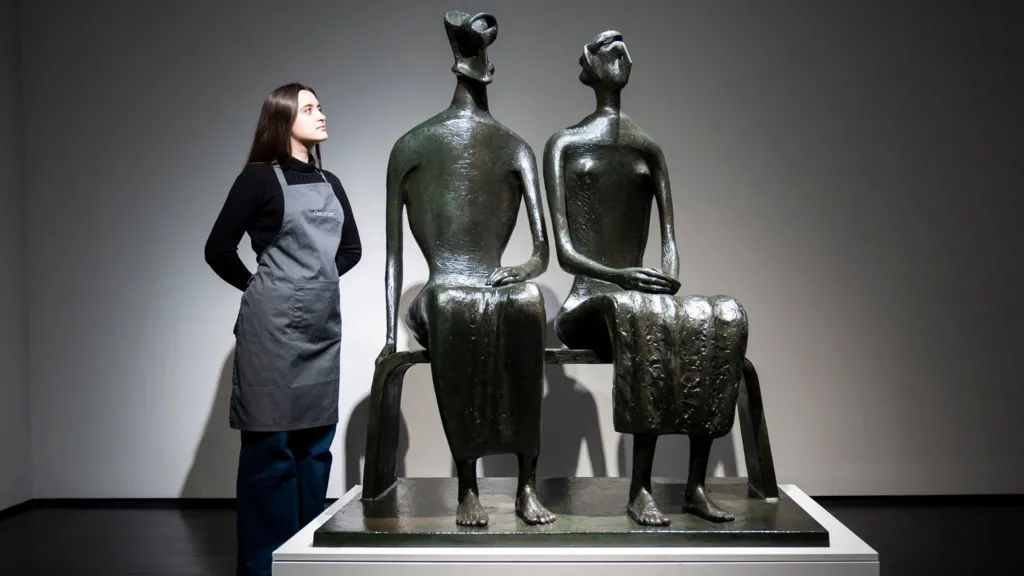
A landmark sculpture by Henry Moore has sold for £26.3 million at Christie’s London, setting a new world auction record for the British artist .
King and Queen, conceived between 1952 and 1953, was the top-selling lot of the auction house’s 20/21 Evening Sales, which generated a total of £197.5 million on 5 March . The piece attracted nearly eight minutes of bidding from six prospective buyers before finally selling for 76 per cent above its pre-sale high estimate of £15 million .

The 164-centimetre tall bronze had remained in the same private British collection for more than seven decades, having been purchased directly from Moore’s studio in 1953 . It is the only cast of this particular sculpture still in private hands, with other examples held in major public institutions including the Hirshhorn Museum in Washington D.C., the Norton Simon Museum in Pasadena, the Middelheim Museum in Antwerp and the MOA Museum of Art in Japan . Two further casts were produced subsequently for the Tate Collection in 1957 and the Henry Moore Foundation in 1985 .
Art critic Robert Melville described the work in 1954 as “Moore’s finest achievement since the war, and probably the most graceful of all his works” . The sculpture depicts two seated regal figures, their forms blending abstraction with figuration in a manner that became characteristic of Moore’s post-war output .
Speaking before the auction, Katharine Arnold, Vice-Chairman of 20th/21st Century Art at Christie’s, said the work was “the most exciting sculpture I’ve ever seen brought to market” . Philip Harley, Senior Director in Modern British and Irish Art at Christie’s, described it as “undisputedly a masterpiece” with “incredible presence” that ranks as “arguably his finest achievement in bronze” .
Moore drew inspiration for the piece from a variety of sources, including an ancient Egyptian double portrait of a pharaoh and his wife in the British Museum . The sculptor was fascinated by how the ancient work conveyed the differences between male and female forms while retaining a sense of intimacy . The angular, almost beak-like head of the king emerged spontaneously as Moore moulded a piece of wax, while the queen’s more refined features evolved through sustained experimentation .
In contrast to the stylised heads, the hands and feet were rendered with striking realism. Moore explained that he made these details more naturalistic “to bring out the contrast between human grace and the concept of power in primitive kingship” . The queen’s gently clasped hands were modelled on those of the artist’s wife, Irina Moore, while the king’s hands and feet were reportedly based on Philip Hendy, then director of the National Gallery in London .
The work represents a pivotal moment in Moore’s career, marking his move towards placing bronze sculptures in landscape settings . “It was like a moment of realisation that his work could then go on to become larger scale and be placed outdoors,” Harley explained .
Moore, who was born in Castleford, West Yorkshire, in 1898, studied at Leeds School of Art alongside fellow sculptor Barbara Hepworth before attending the Royal College of Art in London . He went on to become one of Britain’s most celebrated sculptors, winning the International Sculpture Prize at the Venice Biennale in 1948 . His works can now be found in public parks and plazas worldwide, as well as in the collections of major museums including the Tate, the Guggenheim and the Art Gallery of Ontario .
The previous auction record for a Moore sculpture was set in 2016, when Reclining Figure: Festival (1951) sold for £24.7 million at Christie’s New York .
Christie’s 20/21 Evening Sales, which also included works by Wassily Kandinsky, Pablo Picasso and Gerhard Richter, achieved a 52 per cent increase on the total from the previous year, with 96 per cent of lots sold . The sales marked the unveiling of a newly redesigned rostrum by Sir Jony Ive and his team at LoveFrom, created for the auction house’s 260th anniversary .
Related News:
 Karen Gillan Reveals What She Misses Most About Scotland’s Food and People
 Why Alan Carr Bought a Castle in Kent
 BBC Apologises After Racial Slur Aired at BAFTAs by Guest With Tourette’s
 Fringe Dreams Strained as Oasis Reunion Sparks Soaring Costs for Edinburgh Performers
 Unseen Killers of the Deep Inside the UK Lab Uncovering the Silent Deaths of Sea Creatures
 Drag Queens Forced to Stop Reading ‘Dear Zoo’ to Children Amid Protests at Belfast Library
 Jack Osbourne Breaks Silence with Heartfelt Tribute Following Ozzy Osbourne’s Funeral
 Wembley Investigates Allegations of Ticketless Entry at Oasis Reunion Concerts
 Prince Charles Cinema Eyes Expansion to East London Amid Leicester Square Uncertainty
 Russell T Davies Warns of Declining UK Gay Rights Amid Rise of Reform UK and Trump Influence
 Terence Stamp, ’60s British Film Legend and Star of Superman, Dies at 87
 Millie Bobby Brown and Jake Bongiovi Begin Parenthood Through Adoption
 Chappell Roan Delivers Fairytale Spectacle at Reading Festival, Cementing Pop Stardom
 Watchdog, Cornflakes and Courage: Remembering John Stapleton, a Broadcaster Who Did It All
 Dawson’s Creek” Cast Reunites for Special Broadway Benefit to Support James Van Der Beek
 Actor Noel Clarke Arrested at London Home Amid Ongoing Investigation
 Patricia Crowther, Known as UK’s Oldest Witch, Dies Aged 97
 Labi Siffre Demands Tommy Robinson Stop Using Iconic Anti-Apartheid Anthem
 Man Buys Model Thunderbird 3 Only to Discover It’s a Gigantic 18-Foot Replica
 George and Amal Clooney Celebrate Global Human Rights Champions at Star-Studded Albies
 Jilly Cooper: The Bonkbuster Queen Who Redefined Romantic Fiction
 Celebrity Traitors First Look: A Star-Studded Highland Adventure That Hooks from the Start
 Who is Ruth Codd? All about the Irish actress on Celebrity Traitors
 Former BBC DJ Tim Westwood Charged with Rape and Sexual Assault
 Academy Award-Winning Actress Diane Keaton Dies at 79
 Paedophile Singer Ian Watkins Dies After Prison Attack
 Strictly Celebs Starstruck as Cynthia Erivo Shines
 Alan Davies Criticises England Flag Displays and Patriotism
 Grange Hill Creator Criticises TV’s ‘Oxbridge Gang’ Rule
 D’Angelo: Neo-Soul’s Radical Genius and Lasting Legacy
 Marianne Faithfull Family Clash Over £400k Inheritance
 Dave Ball: The Unsung Genius Behind Soft Cell’s Bold Sound
 Fabio Wardley stuns Joseph Parker to earn Usyk title shot
 British Airways suspends podcast sponsorship after controversial interview
 Prunella Scales: From Fawlty Towers Icon to Beloved Canal Explorer
 Charlie Kaufman: They told me Being John Malkovich would never get made
 The Line of Beauty, Almeida review: A wild, witty ride through Thatcher-era high society
 Kate Winslet to Narrate Film Highlighting King’s Environmental Mission
 Hollywood Is an Industry of Looney Tunes Pretending to Be Normal
 Prince of Wales showcases volleyball skills on Brazil visit
 Top Christmas Books Reads: Classics to Cozy Romcoms
 Meghan ‘to return to acting’ after eight-year hiatus
 Oprah enjoys Meghan’s jam on English muffins
 Pauline Collins, Beloved ‘Shirley Valentine’ Star, Dies at 85
 I’m a Celebrity 2025 line-up revealed: Osbourne joins
 Lola Petticrew: ‘Calling it the Troubles minimises what it really was’
 Amber Davies Shines on Strictly – Time to Drop the West End Debate
 VAR Must Rein Its Neck In to Save Football’s Spirit
 David Szalay’s ‘Flesh’ Wins 2025 Booker Prize
 Pop Stars Call on UK Government to Cap Resale Prices for Fans
 Princess of Wales Hosts Festive Christmas Service at Abbey
 Anthony Joshua Faces Backlash Over Proposed Jake Paul Fight
 EastEnders icon Pat Butcher returns to Walford this Christmas
 UK Government to Ban Reselling Tickets Above Face Value
 TikTok Star Jessie Yendle Mocked by KFC
 Chef Skye Gyngell, Slow Food Pioneer, Dies Aged 62
 11 Best Supermarket Wines Chosen by Experts and Sommeliers
 Reggae Legend Jimmy Cliff Dies at 81
 Prince Andrew Named Punchline in Top Christmas Cracker Joke
 John Lithgow criticises Rowling stance in trans debate
 David Furnish Says Alleged Daily Mail Hacks of Him and Elton John Were ‘An Abomination’
 Flat Fury: Made In Chelsea Star Still Owes Thousands for Trashing £1.8m Apartment
 ‘She Loved Painting Life Out Loud’: The Story of Beryl Cook’s Saucy Art
 One Battle After Another Triumphs at BAFTAs as Robert Aramayo Wins Best Actor
 How a Welsh Village Saved Its Forest … and Its Future
 Meet Robert Aramayo: From Humble Beginnings in Hull to Juilliard and BAFTA Glory After Beating Timothée Chalamet
 ‘We Pray for Peace’: Indian Filmmaker From Troubled State Who Won a BAFTA
 The Hidden Dark Side of Early Reality TV Fame
 Mediterranean Storms: A New Era of Climate Tragedies
 Tracey Emin Says My Bed Would Be ‘Tidy, Clean and Boring’ If Made Today
 Actor Awards: The Winners and Nominations in Full
 Actor Awards: The Red Carpet in Pictures
 After Decades of Decline, Why Welsh Male Voice Choirs Are Back
 Tributes to The Quarrymen’s Len Garry Who Has Died
 ‘The Bride!’ Review: Maggie Gyllenhaal’s Bride of Frankenstein Riff Is Exhilarating and Unforgettable
 Birmingham Bin Strike Enters Sixth Month as Negotiations Stall
 Over 40% of Private Renters Forced to Ration Energy to Afford Bills, Study Reveals
 Systemic Racism in Maternity Care Continues to Endanger Black Women in England, MPs Warn
 Northern Ireland Faces Fears of Prolonged Race Riot “Permacrisis”
 UK Job Vacancies Hit Five-Year Pandemic Low