Published: 09 March 2026. The English Chronicle Desk. The English Chronicle Online.
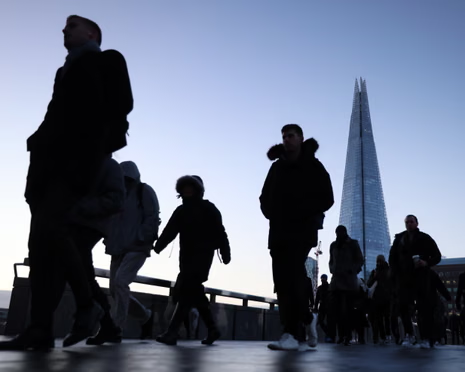
Office attendance across the UK has surged, reaching its highest point since the Covid-19 pandemic, according to recent research. Workers are returning in large numbers, with data showing office occupancy levels are no longer in decline but stabilising. Experts describe the trend as a sign that employees are adjusting to hybrid and flexible working norms while companies adapt to post-pandemic expectations.
Investment banks such as Goldman Sachs and JPMorgan Chase have spearheaded the return-to-office movement, enforcing strict five-day mandates. While these policies have provoked frustration among staff, many organisations in sectors like law, finance, and accounting still allow hybrid schedules. Employees can typically work remotely for two days each week, balancing workplace presence with flexibility.

According to Remit Consulting’s ReTurn report, average UK office attendance has consistently exceeded 40% since January. The week ending 13 February recorded a peak of 44.2%, the highest figure since March 2020, when the first nationwide lockdown was enforced. Attendance slightly dipped to 42.2% during the half-term holiday, then rose again to 44.1% in the following week.
Office occupancy varied widely among the nine cities monitored by the consultancy. Bristol reached 69.2% in the week ending 27 February, Leeds 64.6%, Cardiff 63.8%, Edinburgh 53.7%, Manchester 50.7%, Birmingham 42.3%, London 41.5%, Newcastle upon Tyne 39.3%, and Glasgow 31.6%. These differences reflect the mix of private and public-sector employment, office culture, and local commuting patterns.
Lorna Landells, a partner at Remit and co-author of the report, explained: “Office attendance is no longer in freefall nor in recovery mode; it is settling. Employees are more open to being in the office, but only where it feels purposeful and workable.” She added that flexibility is now considered a baseline expectation, rather than a perk.
The study also highlights the evolving focus for occupiers, investors, and developers. “The question is no longer whether people will return to the office but what kind of office experience genuinely supports modern work,” Landells said. She noted that high-quality workplace design, clarity, and functionality are becoming increasingly critical in driving employee attendance.
Despite these trends, resistance to full-time office work remains strong. More than 2,000 of JPMorgan Chase’s 300,000-plus employees worldwide signed a petition opposing the bank’s five-day in-office mandate. The petition described the policy as “a great leap backward,” arguing it harms staff, customers, shareholders, and corporate reputation.
The petition claimed that rigid office requirements worsen traffic and pollution while disproportionately affecting women, caregivers, senior staff, and employees with disabilities. Many of these employees are top performers, whose participation in the workforce depends on hybrid arrangements. It also raised concerns about conflicting with JPMorgan’s diversity, equity, and inclusion commitments.
One employee emphasised the challenges of global collaboration: “My team is spread across two continents and three time zones. JPMC is a global company – why can’t that include my home office?” Another said: “Hybrid is working and employees love the happy medium.” These perspectives underline the ongoing tension between employer mandates and employee expectations.

Data from Remit Consulting shows that cities like Birmingham and Newcastle have maintained office attendance above 40% recently, while Leeds and Cardiff report over 60%. Bristol saw occupancy as high as 75.4% in the final week of January, reflecting strong corporate office demand. Glasgow, with a large public-sector workforce, has seen slower growth but recently exceeded 30% after years of lower attendance. The city faced stricter Covid restrictions, delaying the post-pandemic return to offices.
Pre-pandemic, national office occupancy ranged from 60% to 80%, accounting for absenteeism due to sickness, holidays, external meetings, and other operational factors. The current data indicates that while full pre-Covid levels are not fully restored, companies are increasingly committing to long-term office space.
Commercial property group CoStar reported 14 new office lettings over 100,000 sq ft in 2025, matching the highest figures since 2017 and double the number in 2024. Major tenants included JP Morgan and HSBC, each taking roughly 200,000 sq ft after downsizing during the pandemic’s peak. This trend suggests firms are recognising the value of physical office presence alongside hybrid arrangements.
Property consultancy Knight Frank highlighted that while hybrid-office patterns dominate, businesses are planning for peak occupancy days. Some accept off-peak inefficiencies to maximise team collaboration when most needed. A few firms have adopted targeted strategies to reduce waste, such as closing certain floors on Fridays, balancing operational efficiency with employee preferences.
Overall, the latest figures indicate that UK office attendance is stabilising at levels unseen since before the pandemic. Companies are adapting, employees are negotiating new expectations, and workplace design is becoming a strategic factor. While hybrid arrangements remain popular, the importance of purposeful office presence is clear, shaping a new era of post-pandemic work culture in the UK.
Related News:
 Reeves Faces Setback as Labour May Miss Homes Target
 Virgin Trains Moves Closer to Challenging Eurostar Monopoly
 Trump’s UK Ambassador Urges North Sea Drilling to Strengthen US Ties
 Ryanair Chief UK Economy ‘Doomed’ Under Labour
 ABF May Split Primark from Food Division Amid Tough Market
 UPS Cargo Plane Crash in Kentucky Kills Seven
 M&S Profits More Than Halve After Cyber-Attack
 Tony Blair think tank warns Rachel Reeves must cut taxes if manifesto broken
 Oprah enjoys Meghan’s jam on English muffins
 MPs Press Rachel Reeves to Hike Gambling Taxes
 Earl of Yarmouth Faces £1.3m Legal Bill Over Family Estate
 Millionaires group urge Reeves to introduce wealth tax to ‘lift kids out of poverty’
 From Lego to Pokémon: How Adults Are Driving UK Toy Market Growth
 UK toy market enjoys bumper year as ‘kidults’ fuel demand
 New laws to bolster UK’s defences against cyber attacks on NHS, transport and energy
 Skims Eyes Global Expansion After Reaching $5 Billion Value
 Trump Moves to Cut Coffee and Banana Tariffs in Latin America Deals
 Global markets drop amid tech sell-off and China slowdown
 Canada Passes Carney’s First Budget in Tight Parliamentary Vote
 PM Highlights UK Business at G20 in South Africa
 Mossmorran Plant Closure Hits Cowdenbeath Hard
 UK Taskforce Unveils Plan to Streamline Nuclear Reactor Rules
 Steel billionaire Lakshmi Mittal reportedly leaves UK
 India’s Labour Law Overhaul Sparks Fierce Debate
 Starmer Says Labour’s Economic Plan Needs Years to Deliver
 Virgin Media Fined £23.8m Over Telecare Safety Failures
 Rising Water Bills Lift Troubled Thames Back to Profit
 Tesla Warns UK That Weak EV Rules Could Threaten Sales
 BP agrees £7.4bn Castrol sale to US investment firm
 Sainsbury’s CEO leads business honours in New Year list
 FTSE 100 Hits 10,000: UK Market Celebrates Record Year
 UK House Prices Fall Sharply at Year-End, Nationwide Reports
 Wessex Water chiefs receive £50,000 extra despite government bonus ban
 3,000 Jobs at Risk Without UK Helicopter Order
 German Supermarket Aldi to Open 180 US Stores This Year
 China Dependence Threatens UK Energy Supply Chains and Jobs
 Canada-China trade gains momentum in new strategic partnership
MPs warn AI financial risks threaten UK stability
Canada-China trade gains momentum in new strategic partnership
MPs warn AI financial risks threaten UK stability
 MPs warn AI financial risks threaten UK stability
 B&M and The Works Struggle During Christmas Trading
 UK Disposable Income Growth Transforms Eleven Towns and Cities
 US Dollar Hits Four-Year Low Amid Market Turmoil
 Amazon mistakenly signals new global layoffs to employees
 Labour Must Revive High Streets to Avoid Election Collapse
 Households in England Face Rising Water Bills in April
 UK needs new factory to reach 1.3m car target, says industry chief
 UK food industry urges transition if post-Brexit rules reset
 UK New Car Discounts Near £6,000 as Prices Are Slashed
 Study Finds One in Seven England Takeaways Are Dark Kitchens
 Riverford sales surge as UK organic market booms
 Telstra AI jobs cuts as automation drive expands
 BT Names New Openreach Chief Amid Major Fibre Expansion
 AI fears hit UK wealth and comparison sites
 UK Housing Market Shows Early Recovery Signs
 UK economy struggles as growth stalls at 0.1% in late 2025
 Schroders sold to US investor in £9.9bn deal ending family control
 Bank of England Urged to Cut Rates to Spur Growth
 Lloyds Faces Scrutiny Over Staff Data Use in Pay Talks
 Santos Wins Landmark Greenwashing Case in Court
 Royal Mail Blames Poor Weather and Sickness for Delayed Deliveries
 British Steel wins Turkey rail boost
 Glencore Approves $2bn Payout Despite Profit Slump
 Sanders Condemns Billionaire ‘Greed’ in California Tax Debate
 UK Job Vacancies Hit Five-Year Pandemic Low
 UK Youth Unemployment Surges Amid Tax Changes
 Ministers Urged to Ban Crypto Political Donations
 Strong Rebound for UK Housing Market Sees 6% More Homes
 HSBC Signals Overhaul Nearing Completion Despite Profit Drop
 Reserve Bank May Hike Rates Twice Amid Persistent Inflation
 Inflation Pressure RBA Policies
 Engie UK Power Networks Deal Seals £10.5bn Buy
 Reeves Must Back Defence Plan or Face Dismissal, Says Unite Chief
 Qantas Revamps Loyalty Program Amid $1.46bn Profit Surge
 Doom Bar Closure Stuns Cornish Brewing Fans
 Switching Energy Deal Can Save £200 as Price Cap Falls
 UK house prices rise as market steadies
 Oil Prices Surge as Iran War Jolts Markets
 Caffè Nero Warns Coffee Prices May Rise Again
 Oil Prices Surge Above $100 Amid Iran War
 G7 Weighs Emergency Oil Reserves as Prices Surge