Published: 10 March 2026. The English Chronicle Desk. The English Chronicle Online.
European leaders delivered a strong message of unity after the recent Cyprus drone strike heightened tensions across the eastern Mediterranean region. The dramatic incident, involving Iranian-made drones targeting strategic facilities on the island, has drawn an immediate and coordinated response from several European governments. Leaders from France, Greece, and Cyprus gathered at a military airbase in Paphos to underline their shared determination to protect European territory and stability.
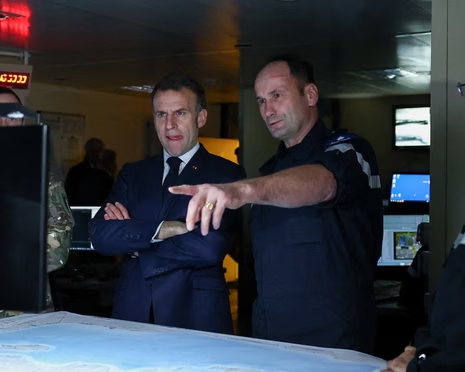
French President Emmanuel Macron spoke firmly during the visit, declaring that Europe would stand beside Cyprus during this critical moment. His remarks came after a week of escalating concern following the Cyprus drone strike, which damaged infrastructure near a major British military installation. The French leader stressed that any attack on Cyprus should be understood as an attack on Europe itself.
Standing beside Cypriot President Nikos Christodoulides and Greek Prime Minister Kyriakos Mitsotakis, Macron emphasised collective responsibility. He said European partners must demonstrate solidarity when any member state faces direct threats from regional conflict. The gathering symbolised a united front as the broader Middle East conflict continues influencing security across nearby European territories.
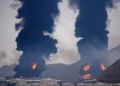
The incident occurred when a Shahed drone reportedly crashed into a hangar at RAF Akrotiri. The hangar sustained serious structural damage, leaving a visible hole through its metal roof and surrounding walls. Military analysts believe reconnaissance aircraft were stationed inside the facility during the time of the Cyprus drone strike.

Hours after the initial crash, two additional combat drones approached the island’s airspace. British fighter jets intercepted and destroyed both aircraft before they reached their targets. Officials later confirmed that the drones had been launched from Lebanon, approximately 150 miles east of Cyprus.
Cypriot Foreign Minister Constantinos Kombos explained that investigations traced the flight paths across the eastern Mediterranean before interception. Authorities believe the drones were part of wider regional military activity connected to the escalating Iran war. The Cyprus drone strike therefore represents the first direct spillover of the conflict onto European soil.
Macron described the development as a serious turning point for Europe’s security outlook. He warned that the conflict now carries wider implications for the continent’s political stability and defence strategy. His comments highlighted growing concern that regional warfare could increasingly affect European infrastructure and trade routes.
France has already taken concrete steps to strengthen defensive support for Cyprus. French naval and air forces quickly deployed to the region following the attack. Among the assets sent was the nuclear-powered aircraft carrier Charles de Gaulle, accompanied by support vessels and surveillance aircraft.
Air defence systems have also been installed to help shield the island from potential future attacks. These systems are designed to detect and intercept incoming drones or missiles. Officials described the deployment as precautionary measures designed purely for defensive purposes.
Greek Prime Minister Kyriakos Mitsotakis echoed Macron’s remarks during the joint appearance in Paphos. He stated clearly that European territory must never be left vulnerable to hostile actions. According to Mitsotakis, the Cyprus drone strike demonstrates how regional instability can quickly affect neighbouring continents.
Greece has therefore strengthened its own military contribution to Cyprus’ protection. Four F-16 fighter jets were dispatched and are now stationed at the Paphos airbase. Two naval frigates have also been deployed, including the advanced vessel Kimon, widely regarded as a flagship of the Greek fleet.
Other European countries have joined the coordinated effort to reinforce security around Cyprus. Italy, Spain, the Netherlands, and the United Kingdom have all pledged additional military resources. Their contributions include warships, surveillance equipment, and aerial defence capabilities.
The United Kingdom has increased protection around its sovereign military bases on the island. RAF Akrotiri remains a strategically important hub for intelligence and surveillance operations across the Middle East. Following the Cyprus drone strike, Britain deployed Royal Navy Wildcat helicopters equipped to intercept aerial threats.
Additional F-35 fighter jets have also arrived to reinforce defensive coverage around the British installations. Officials confirmed that these aircraft are capable of responding rapidly to any renewed drone activity. Their presence signals the seriousness with which London views the developing regional situation.
European governments also worry about the potential economic consequences of the ongoing conflict. The eastern Mediterranean plays a vital role in global energy transportation and maritime trade routes. Any disruption could affect international markets and supply chains worldwide.
One area receiving particular attention is the Strait of Hormuz, a narrow waterway connecting the Persian Gulf with the wider ocean. Approximately twenty million barrels of oil travel through the strait every day. This volume represents nearly one fifth of the world’s seaborne crude supply.
Macron used his visit to announce preparations for a European-led maritime mission designed to reopen and secure the passage. He described the initiative as a purely defensive support operation intended to restore safe shipping. The mission will likely begin once the most intense phase of the conflict subsides.
The French president stressed that maintaining open maritime corridors remains essential for international economic stability. Energy supplies from the Gulf region depend heavily on uninterrupted passage through the strait. European shipping companies, including many Greek tanker operators, play a central role in transporting these resources.
Security analysts believe the Cyprus drone strike has accelerated discussions about Europe’s strategic independence in defence matters. Relations between Europe and the United States have faced strains in recent years. The coordinated response surrounding Cyprus reflects a growing desire for stronger European security cooperation.
Experts say Macron’s presence in Paphos carried both symbolic and practical significance. The visit demonstrated visible European solidarity while also addressing immediate defence coordination. Regional observers noted that such high-level diplomacy helps reassure populations living close to volatile conflict zones.
Cleopatra Kitti, a senior policy adviser at a Greek think tank, described the moment as historically important. She explained that Europe rarely responds so quickly with visible unity after external threats emerge. According to Kitti, the Cyprus drone strike has pushed European governments toward deeper security coordination.
Cypriot President Nikos Christodoulides also welcomed the unprecedented level of support shown by European partners. Speaking to journalists, he said the presence of France and Greece demonstrated the collective nature of European security. He added that Cyprus now clearly stands within a shared protective framework.

Christodoulides emphasised that cooperation will remain essential as the wider regional conflict continues evolving. He acknowledged that uncertainty remains high across the eastern Mediterranean region. Nevertheless, the Cyprus drone strike has prompted a powerful demonstration of European unity.
For Cyprus itself, the situation represents a reminder of the island’s unique geopolitical position. Located between Europe and the Middle East, it often becomes a strategic crossroads during regional crises. This geography provides advantages for diplomacy but also exposes the island to nearby conflicts.
As tensions continue across the region, European leaders appear determined to prevent further escalation. Military deployments and diplomatic coordination aim to deter additional attacks while maintaining regional stability. The message delivered from Paphos remains clear: Europe will stand firmly behind Cyprus.
Whether the Cyprus drone strike becomes an isolated incident or the beginning of wider confrontations remains uncertain. However, the swift response from European governments demonstrates the seriousness of the moment. In an increasingly interconnected security environment, threats against one member state now carry implications for the entire continent.
Related News:
 High-speed Spain train crash leaves nation in mourning
 EU weighs response amid Greenland tariff crisis with Trump
 EU Says US Ties Have Suffered ‘Big Blow’ After Greenland Crisis
 Thousands Left Without Heating in Ukraine Amid Russia Strikes
 Russia sanctions hit economy hard, says EU envoy
 Portugal Election Delivers Socialist Win as Far Right Surges
 Hungary Faces Political Tension Over the Ukraine Crisis
 Just Stop Oil Protesters Convicted Amid Climate Defence Row
 BBC to Apologise Over Edited Trump Speech Amid Backlash
 Britain deploys RAF specialists to assist Belgium with drone threats
 Palace May Restore Hyphen to Andrew Mountbatten-Windsor’s Name
 Greene Pushes Epstein Files Amid Trump Fallout
 Trump Deploys DHS to Charlotte in Major Arrest Operation
 December Run-Off in Chile as Election Produces No Winner
 Zelenskyy Signs Fighter Jet Deal Amid Russian Drone Attacks
 Orban Says Ukraine Has ‘No Chance’ as EU Support Continues
 Canada Passes Carney’s First Budget in Tight Parliamentary Vote
 Shadow Fleet at Sea: Europe’s Battle Against Illicit Oil Shipping
 Tiny Curacao Makes History as Smallest Nation to Reach World Cup
 Haiti Qualifies for World Cup Despite Coach Never Visiting Country
 Deadly Russian Strikes Hit Western Ukraine, 20 Killed in Ternopil
 Pentagon Officials in Ukraine to Discuss War End
 Ukraine Peace Plan: Zelensky Ready for Dialogue
 Venezuela Threatens Nobel Winner Machado with Fugitive Status
 Royal Navy Shadows Russian Warships Entering the Channel
 US Suspends Afghan Immigration After White House Shooting
 Two National Guard Soldiers Critically Injured Near White House
 Georgians Defy Government Crackdown After Year of Protests
 Southern Lebanon reels as Israeli strikes shatter communities
 Tokyo court rules Japan’s same-sex marriage ban constitutional
 ‘Extinct’ Antelope Returns to Sahara, Bringing Hope
 EU plans $105bn Ukraine aid using frozen Russian assets
 American Mother Extradited From UK to U.S. on Murder Charges
 Russia losses Ukraine war peace talks intensify amid rising deaths
 Facebook Slow to Remove Bondi Attack Praise, Anti-Hate Group Claims
 Australian Cruise Ship Freed After Reef Grounding in Papua New Guinea
 US Cities Erupt in Protests Against Trump’s Venezuela Military Action
 Albanese Opens Door to Bondi Royal Commission Amid Rising Pressure
 Trump Escalates Minnesota Immigration Surge Amid Rising Tensions
 Iran Protesters Defy Crackdown as Violent Clashes Intensify
 US Clears Nvidia AI Chip Sales to China in Policy Shift
 Trump Threatens Strong Action If Iran Executes Protesters
 Gulf states warn Trump Iran strikes risk wider Middle East war
 Machado Trump medal gesture reshapes Venezuela power struggle
 Sydney Shark Attack Surge Shocks Australia Beaches
 Thousands Flee Cambodia Scam Centres Amid Global Pressure
 Andrew Hastie Emerges as Leadership Rival to Ley
 Videos reveal earlier clash before Alex Pretti shooting
 UK New Car Discounts Near £6,000 as Prices Are Slashed
 Israel Moves to Bar MSF From Gaza Operations
 Tragic Ski Lift Accident Claims Australian Snowboarder
 Australian Families Leave Syrian Camp for Home
 SA Police Intensify Search in Gus Lamont Case
 Trump Attacks UK-California Energy Pact
 Andrew Arrest Sparks Republic Debate in Australia
 Global corruption crisis: Who Washington shields
 Farage Chagos Islands Row Sparks Fury
 Gold Rush in Gugulethu Leaves South Africans Desperate for Work and Hope
 Louvre Museum Director Resigns Months After High‑Profile Heist
 Orbán Accuses Ukraine of Disrupting Oil Supplies to Hungary
 Hilary Knight speaks out on Trump’s recent hockey remarks
 Champions League Thrills as Atalanta and Galatasaray Advance
 Trump Speech Sparks Intense Debate Across Divided America
 Has Europe truly learned from the failures of 2022?
 Social Media Trial: Woman Says Addiction Began at Six
 UK Personnel Near Iranian Missile Strike in Bahrain
 Trump Faces Questions Over Iran Conflict Plan
 Iran Civilian Deaths Surge Past 200 Amid Fear
 Herzog Asio meeting sparks security storm
 Trump rebukes Starmer over Iran strikes
 Middle East attacks intensify as Trump rejects Iran talks
 Iran-Iraq border airstrikes spark new tensions
 Petrol Prices Soar as Retailers Accused of Gouging Amid Global Tension
 Penny Wong silent on Australian crew in sub strike
 Macron Finds ‘Freedom Fries’ Redemption in Iran Crisis
 Australians on US Submarine in Iranian Warship Strike
 Finland Plans to Lift Decades‑Old Ban on Hosting Nuclear Weapons
 Oil Prices Surge Above $100 Amid Iran War
 Pete Hegseth Iran War Remarks Spark Alarm
 India T20 World Cup Triumph Seals Historic Title Defence